Best Air Purifier for Airbnb: Smoke, Odor and Fast Turnovers
Disclosure: Clean Air Adviser may earn a commission when you buy through links on this page. This does not change what you pay. We have not physically tested these purifiers in an Airbnb or other short-term rental. Recommendations are based on current manufacturer specifications, independent purchased-unit testing, government guidance, Airbnb policies, and clearly identified host reports.
Quick answer: The best air purifier for an Airbnb depends on the problem you are trying to prevent. For fast turnover cleaning and everyday smoke particles, the Levoit Core 600S-P moves the most air for the money. For a bedroom or smaller rental, the Winix 5510 is the more affordable choice. If tobacco odor is already strong, the Austin Air HealthMate has far more activated carbon than a typical consumer purifier, but it is slower at particle removal and costs much more. The IQAir HealthPro Plus is the premium middle ground, combining stronger particle performance with a five-pound gas filter.
An air purifier for Airbnb use is useful equipment for a short-term rental, but it is not a reset button. It can capture smoke particles while they are airborne and a substantial carbon filter can reduce some odor-causing gases. It cannot pull tobacco residue out of walls, upholstery, mattresses, curtains, or carpet. When smoke has settled into surfaces, cleaning and sometimes professional remediation come before filtration.
If the next guest arrives today
Do not try to cover smoke odor with plug-ins or fragrance sprays. Document the condition, remove the source, ventilate with clean outdoor air when conditions allow, wash removable fabrics, clean hard surfaces, and run a properly sized particle-and-carbon purifier on high. If the odor is still obvious, delaying check-in is safer than presenting a scented room that still contains smoke residue.
We do not recommend a do-it-yourself ozone generator. The US Environmental Protection Agency says ozone is a lung irritant, is difficult to control indoors, has limited ability to remove many contaminants at concentrations within health standards, and may create irritating reaction products.
Best air purifier for Airbnb hosts: quick comparison
| Pick | Particle performance | Gas and odor media | Best Airbnb use | Main tradeoff |
|---|---|---|---|---|
| Levoit Core 600S-P | 15-minute HouseFresh PM1 test; about 410 cfm estimated CADR | 0.79 lb carbon in the optional Smoke Remover filter, according to HouseFresh | Fast turnovers and large living areas | Standard filter has less carbon; replacement costs rise with heavy smoke |
| Winix 5510 | 253 cfm official smoke CADR; 249 cfm HouseFresh estimate | Separate AOC carbon layer, but much less carbon than heavy-duty units | Value pick for bedrooms and smaller rentals | Very loud at maximum; PlasmaWave is optional and can be turned off |
| IQAir HealthPro Plus | 28-minute HouseFresh PM1 test; about 250 cfm | Approximately 5 lb activated carbon and zeolite gas cartridge | Premium balance of particles and odors | High purchase price and expensive filters |
| Austin Air HealthMate | 52-minute HouseFresh PM1 test; 156 cfm estimated at top speed | 15 lb activated carbon and zeolite | Persistent odor support after thorough surface cleaning | Slow for its price, loud on high, heavy, and no smart controls |
Room-size marketing can make these machines look interchangeable. They are not. Particle airflow and odor capacity are separate jobs. The Core 600S-P clears airborne particles much faster than the Austin Air, while the Austin Air contains almost twenty times as much carbon as the Core 600S Smoke Remover filter. A host dealing with a little cooking smoke needs a different machine from a host managing a property with repeated tobacco violations.
How to choose an air purifier for Airbnb turnover risk
Most air-purifier roundups assume the same people live with the machine every day. A rental creates a different problem. The source can change with every booking, the cleaner may have only a few hours, and a guest may switch the purifier off or move it into a corner. Odor also has a direct business cost. A room that looks spotless can still trigger a complaint the moment a sensitive guest opens the door.
That changes the buying priorities. An air purifier for Airbnb hosting should have enough airflow to make a measurable difference during a turnover, filters that are easy to inspect, replacement filters that can be obtained quickly, controls a cleaner can understand, and a design that can run continuously without creating another guest complaint. Wi-Fi and air-quality graphs are helpful only after those basics are covered.
Airbnb allows hosts to set a standard house rule covering smoking, vaping, and e-cigarettes. Its current Host Damage Protection terms also describe certain reasonable, customary, unexpected smoke-odor cleaning costs when smoking violated the house rules. Coverage is subject to the current terms, documentation, deadlines, exclusions, and Airbnb’s review. A purifier purchase does not prove who smoked and does not guarantee reimbursement.
What an air purifier can remove after a smoking violation
Airborne smoke particles
Smoke contains fine particles that can remain suspended and move between rooms. A high-efficiency particle filter can capture these particles as room air passes through the machine. Clean air delivery rate, or CADR, is the most useful consumer number for this job because it combines filter efficiency with airflow.
The US Environmental Protection Agency advises choosing a smoke CADR large enough for the room. The common AHAM starting point is a smoke CADR at least two-thirds of the room area for an eight-foot ceiling. A 300-square-foot living room therefore needs roughly 200 cfm as a minimum. For a short turnover after a smoke event, more capacity is useful because you want repeated air changes, not a slow one-pass-per-hour marketing result.
Our main smoke purifier guide explains CADR and room sizing in more detail. If the source is outdoor wildfire smoke rather than a guest, use the more conservative room targets in our wildfire smoke guide.
Some airborne odor compounds
HEPA-style particle media does not remove gases. Odor control requires activated carbon or another sorbent designed for specific gases. EPA notes that carbon can be effective when a large amount of material is used, but there is no widely used consumer rating comparable to CADR for gas removal. Carbon type, quantity, humidity, contact time, pollutant chemistry, and saturation all affect the result.
A thin carbon-coated sheet may help with a mild cooking smell. It is not a serious answer to repeated tobacco smoke. Pellet or granular carbon provides more usable material, and heavy-duty machines hold pounds rather than a light coating. Our separate guide to air purifiers for smoke smell goes deeper into the difference between haze and odor.
What filtration cannot remove
Thirdhand smoke is residue that sticks to indoor surfaces after the airborne smoke has cleared. Peer-reviewed research has found nicotine and related compounds persisting in fabrics and dust. A purifier can capture part of what later returns to the air, but it cannot clean the reservoir inside carpet, drapes, upholstered furniture, mattresses, painted surfaces, or dust.
This is why a purifier may make the air monitor look better while a guest still notices the smell. The nose is responding to compounds coming from surfaces, not only to particles currently floating near the machine. Washing removable textiles, HEPA vacuuming, wet cleaning appropriate surfaces, and dealing with heavily contaminated porous material remain essential. Severe or repeated contamination may need a restoration professional.
1. Levoit Core 600S-P: best for fast turnovers
The Core 600S-P is the most practical first purchase for a host with a large open living area and a limited turnover window. HouseFresh bought and tested the unit in a 728-cubic-foot room. It reduced PM1 to zero in 15 minutes, with an estimated particle CADR of about 410 cfm. That is the fastest result among the four picks here.
Speed matters when a cleaner discovers cooking smoke, fireplace haze, incense, or a suspected smoking violation at checkout. The Core 600S also supports app control and scheduling, so an off-site host can confirm that the machine is on before the next arrival. A control lock reduces casual setting changes, although no feature prevents a guest from unplugging it.
The limitation is odor capacity. HouseFresh measured about 0.79 pound of carbon in the optional Smoke Remover replacement filter. That is meaningful compared with a thin coated sheet, but it is still modest beside the five-pound IQAir cartridge or the Austin Air’s 15-pound mixture. Buy the correct smoke-focused replacement filter if odor is the main reason for choosing this model. The standard filter should not be treated as equivalent.
Best fit: roughly 500 to 600 square feet at close to five air changes per hour, depending on the exact certified airflow, ceiling height, and layout. Closed doors divide the property into separate air zones. One machine in the lounge does not meaningfully clean a closed bedroom.
If this capacity is excessive for the property, our Levoit Core 400S review covers the smaller smart model. The Vital 200S review is also worth reading when an accessible washable prefilter matters more than maximum airflow.
2. Winix 5510: best value for a bedroom or studio
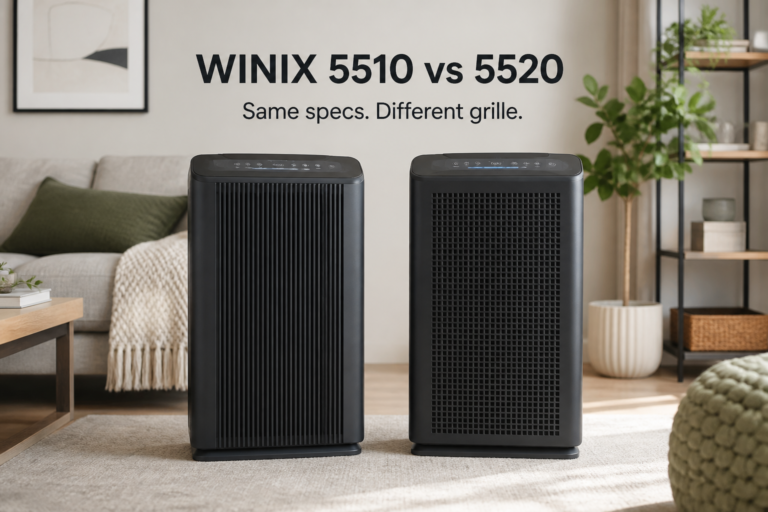
The Winix 5510 balances useful particle airflow, a separate washable prefilter, a removable pellet-carbon layer, and a price that makes multi-room coverage more realistic. Winix lists a 253 cfm smoke CADR. HouseFresh’s purchased-unit testing estimated 249 cfm with PlasmaWave on and found a similar result with it off, so disabling the electronic feature does not remove the core particle-filtration benefit.
For a studio, one-bedroom apartment, or individual sleeping room, this air purifier for Airbnb use is a sensible is a sensible maintenance machine. The washable prefilter is easy for a cleaner to inspect for dust and hair. The carbon layer is more practical than a carbon coating bonded to the main particle filter, but its quantity is still aimed at normal household odor rather than a deeply contaminated smoking room.
The main operational problem is noise. HouseFresh measured 67.2 dBA at maximum, which is too loud for most guests. Use high during an empty turnover, then lower the speed before check-in. Do not rely only on Auto mode after a known smoke event. Its sensor responds to some gases, but no low-cost sensor sees every smoke component and automatic modes may reduce airflow before the room is actually ready.
PlasmaWave can be switched off. Hosts who prefer mechanical filtration only can leave it disabled. Our full Winix 5510 review covers measured noise, energy use, replacement filters, and owner concerns. If older 5500-2 stock appears cheaper, see the Winix 5510 versus 5500-2 comparison before ordering.
3. IQAir HealthPro Plus: best premium balance
The IQAir HealthPro Plus sits between a fast conventional purifier and a heavy carbon specialist. HouseFresh reports a 28-minute PM1 result and approximately 250 cfm particle airflow, plus about five pounds of activated carbon and zeolite in the V5-Cell gas cartridge. That combination gives it more serious odor capacity than mainstream cylindrical purifiers without sacrificing as much particle speed as the Austin Air.
This is the pick for a high-value property where a single bad odor complaint may cost more than the machine. It also makes sense when smoke drifts into the unit repeatedly from a neighboring balcony or corridor and source control is partly outside the host’s control. No purifier can make continuing secondhand smoke safe, but the IQAir can reduce airborne particles and some gases while the host pursues the source.
Expect a high initial price, large replacement-filter bills, and a substantial cabinet. It is not a machine to hide behind a sofa. It needs open intake and outlet space. Put it in the main affected room, not in an entry hall chosen only because an electrical outlet is convenient.
4. Austin Air HealthMate: best carbon capacity for persistent odor support
The Austin Air HealthMate is the specialist choice. Austin Air specifies up to 15 pounds of activated carbon and zeolite. HouseFresh bought a HealthMate and measured a 52-minute PM1 clearing time, with an estimated top-speed CADR of 156 cfm. That particle performance is modest for a machine at this price, but the carbon quantity is far beyond the typical consumer filter.
Choose it only when odor capacity is more important than fast particle turnover. A heavily contaminated room still needs surface cleaning first. The Austin Air then helps capture gases that return to the air. It should not be presented as a way to avoid washing curtains, cleaning walls, replacing a saturated HVAC filter, or dealing with contaminated carpet.
The one-dial control is easy for a cleaner. The metal body and casters suit repeated use, but the machine is heavy, lacks app monitoring, and draws much more power than most smart purifiers at high speed. HouseFresh measured 61.5 dBA at maximum. Its claimed five-year filter life applies to normal residential conditions, not an unlimited series of smoking violations. Odor breakthrough is a reason to inspect or replace the filter sooner.
A practical smoke-turnover checklist
1. Document before cleaning
Ask the cleaner to report smoke odor immediately through the normal operations channel. Photograph physical evidence such as ash, cigarette butts, burn marks, or moved smoke detectors. Save cleaner invoices and describe extra work separately from the routine turnover. Keep communication with the guest on Airbnb when possible.
An odor is difficult to photograph, which is a repeated concern in host discussions on Reddit. Those reports are useful for understanding the operational problem, but they are not a promise about how Airbnb will decide a claim. Follow Airbnb’s current request process and deadlines. Do not invent evidence or state that a purifier reading proves tobacco use.
2. Stop the source and check adjacent areas
Remove ash, butts, vaping cartridges, burned food, trash, and heavily affected disposable items. Check balconies, entryways, HVAC returns, bathroom exhausts, and shared corridors. A neighbor’s smoke can enter through a window or leakage path and produce a real complaint even when the prior guest did not smoke indoors.
Do not disable required smoke or carbon-monoxide alarms. An air purifier is not a smoke alarm, a carbon-monoxide detector, or a substitute for legally required safety equipment.
3. Ventilate only when the outdoor air is cleaner
Open windows and use exhaust ventilation when weather, security, and outdoor pollution make that safe. If wildfire smoke or a smoking neighbor is outside, opening everything can make the problem worse. Run compatible HVAC systems on recirculate while filtering, and replace an HVAC filter that has captured a major smoke load.
4. Clean the reservoirs
Launder removable bedding, throws, and curtains according to their care labels. HEPA vacuum carpets and upholstery. Wet-clean washable hard surfaces with products appropriate for the finish. Pay attention to ceilings, cabinet faces, blinds, baseboards, and the tops of doors where routine cleaning may not reach.
Research on thirdhand smoke remediation found that combined cleaning could reduce surface and dust nicotine, but contamination could persist or rebound from reservoirs. That is the honest reason no article can give a guaranteed two-hour cure. When a property has a history of indoor smoking, professional assessment may be cheaper than repeated refunds and fragrance-heavy turnovers.
5. Run the purifier on a fixed high speed
Place the machine in the affected room with clear space around its intake and outlet. Close the door if you are treating one bedroom. Run the highest practical speed while the unit is empty, then reduce it before a guest arrives. A purifier’s fastest laboratory result is measured at maximum speed. Sleep and Auto modes move less air.
For multi-bedroom properties, use one appropriately sized purifier in each closed sleeping area or rotate a machine as part of a documented turnover process. A hallway purifier cannot pull enough air through closed doors. Our bedroom purifier guide compares quieter machines for continuous guest use.
6. Inspect the filters and use your nose
A saturated carbon filter may stop reducing odor even when the fan and particle filter still work. Label each filter with its installation date and keep one replacement on site. After a heavy event, smell the air leaving the purifier. A smoky outlet odor is a warning that the filter may be loaded.
Consumer particle sensors cannot certify that a room is odor-free or safe. They usually estimate particulate matter and may miss gases. Have a second person check the property when possible, especially if the cleaner has become accustomed to the odor.
Should an air purifier for Airbnb guests run during the stay?
Usually yes, at a quiet continuous speed, provided the machine is stable, undamaged, and placed where children or pets cannot tip it or block it. Continuous filtration can help with cooking particles, tracked-in dust, pollen, pet dander, and smoke that drifts from outside. It also keeps the room from starting the next turnover with a full day of accumulated particles.
Use a short laminated instruction that explains the power button and asks guests not to cover or move the unit. Avoid exaggerated health promises. “Helps reduce airborne particles” is more accurate than “removes all allergens and viruses.” If you allow pets, an accessible prefilter is especially valuable. Our pet air purifier guide covers hair, dander, and odor maintenance.
Do not use scented oils in or near the purifier unless the manufacturer explicitly designs the machine for them. Fragrance may bother sensitive guests and can mask an unresolved odor without removing it. A neutral-smelling room is the goal.
How to size an air purifier for Airbnb rooms
Start with separate air zones when sizing an air purifier for Airbnb use. A studio is usually one zone. A two-bedroom apartment with closed doors is at least three: each bedroom and the living area. Measure each room’s length and width, then calculate area. For an eight-foot ceiling, the AHAM starting point is smoke CADR at least two-thirds of that area.
For fast turnover work, targeting close to five air changes per hour is reasonable. The rough formula is room volume multiplied by five, divided by 60. A 15-by-20-foot room with an eight-foot ceiling contains 2,400 cubic feet. Five air changes per hour needs about 200 cfm of clean air. Higher ceilings, open stairways, leaky doors, and continuing smoke entry increase the requirement.
This calculation applies to particle removal. It does not tell you whether the carbon bed can handle the odor load. For tobacco odor, compare actual carbon quantity where available. If a manufacturer says only “activated carbon” without identifying the type or amount, assume the odor capacity is uncertain.
Problems hosts often misdiagnose as cigarette smoke
- Wildfire or neighbor smoke: Check outdoor conditions, balconies, shared hallways, and window leakage before accusing a guest.
- Overheated cooking oil: Fast particle filtration and range-hood exhaust usually matter more than a very heavy carbon machine.
- Fireplace residue: Inspect the damper, chimney, hearth, and ash container. A purifier cannot correct backdrafting.
- Musty odor: EPA says filtration does not solve a moisture or mold source. Find the leak or humidity problem.
- Fragrance and cleaning chemicals: Ventilate and reduce the source. Adding another scent can make the room less acceptable.
- Pet odor: Clean bedding, upholstery, floors, and any accident site. A purifier treats only the airborne fraction.
- Carbon monoxide: It is odorless and is not controlled by a residential air purifier. Use functioning CO alarms and follow emergency guidance.
What host reports add to the evidence
Recent discussions in the Airbnb host community repeat three themes. First, smoke odor is subjective and can be noticed by one guest after a cleaner missed it. Second, hosts struggle to document odor when there is no ash or visible damage. Third, many people recommend inexpensive ozone generators.
The first two points are useful operational warnings. Train the cleaning team, document physical evidence, keep invoices, and take a complaint seriously even if the property looked clean. The ozone recommendation should not be followed casually. EPA says no federal agency has approved ozone generators for occupied spaces, safe concentrations have limited cleaning power for many contaminants, and reactions can create harmful byproducts. A host is also responsible for guests, cleaners, pets, plants, neighbors, furnishings, and local rules. We therefore recommend mechanical particle filtration, substantial carbon where needed, source removal, and qualified remediation for severe cases.
Frequently asked questions
What is the best air purifier for an Airbnb?
For a large living area and fast turnovers, the Levoit Core 600S-P offers the strongest particle airflow among our four picks. Use its Smoke Remover filter when odor capacity matters. For a bedroom or studio, the Winix 5510 is the better value. Choose IQAir HealthPro Plus or Austin Air HealthMate only when the larger gas filter justifies the higher cost.
Will an air purifier remove cigarette smell before the next guest?
It may reduce airborne odor if it contains enough fresh activated carbon. It will not remove thirdhand smoke embedded in walls, fabrics, carpet, furniture, or dust. Clean those reservoirs first and treat filtration as one part of the turnover.
How long should a purifier run after smoke?
Run it continuously on high while the property is empty and cleaning is underway. The required time varies with room volume, airflow, carbon capacity, smoke quantity, and how much residue reached surfaces. A laboratory PM1 clearing time is not an odor-removal promise. Do not guarantee a fixed time to the next guest.
Can I put one purifier in the hallway for the whole Airbnb?
Not if bedroom doors are closed. Portable purifiers clean the room or connected area where they can circulate air. Use one unit per important closed zone or move a purifier through the property during the turnover.
Should I use an ozone machine in an empty rental?
We do not recommend do-it-yourself ozone treatment. EPA explains that effective concentrations may exceed levels safe for people and can produce irritating or corrosive byproducts. Severe smoke contamination is a job for a qualified restoration professional who can evaluate surfaces, HVAC, local regulations, re-entry procedures, and whether any specialized treatment is appropriate.
Can an air purifier prove that a guest smoked?
No. A consumer PM or gas sensor can react to cooking, candles, cleaning products, wildfire smoke, and other sources. Use Airbnb messages, cleaner reports, photos of physical evidence, itemized invoices, and the current claims process. Do not present a purifier graph as conclusive proof.
Is an air purifier worth it for hosts who have never had a smoking violation?
Often yes, because the machine also reduces cooking particles, pollen, dust, and some pet-related material. The strongest business case is reducing everyday airborne particles and giving the cleaner a ready tool for unexpected events. It does not replace a clear no-smoking rule, ventilation, alarms, or a remediation plan.
Final recommendation
The best air purifier for Airbnb hosts depends on the risk. Buy the Levoit Core 600S-P when fast particle removal in a large living area is the priority. Add its Smoke Remover filter if occasional odor is part of the job. Choose the Winix 5510 for a smaller rental or multi-room setup where buying more than one machine is practical. Step up to the IQAir HealthPro Plus when you need a better balance of airflow and serious gas media. Reserve the Austin Air HealthMate for persistent odor support after proper cleaning, not as an excuse to skip remediation.
The operational rule is simple: prevent indoor smoking, document quickly, remove the source, clean the surfaces, ventilate when outdoor air is suitable, then filter continuously. A purifier protects the turnover process best when it is already sized, maintained, and ready before the complaint arrives.
Related reading: Compare our cigarette-smoke purifier picks, read the smoke-odor guide, or review lower-risk options for allergy-sensitive guests.
Sources
- US Environmental Protection Agency: Guide to Air Cleaners in the Home
- US Environmental Protection Agency: Ozone Generators that are Sold as Air Cleaners
- US Centers for Disease Control and Prevention: Preventing Exposure to Secondhand Smoke in the Home
- Airbnb Help Center: Add House Rules to a Listing
- Airbnb: 2026 Host Damage Protection Terms
- Airbnb Resource Center: Ground Rules for Guests
- HouseFresh: Purchased-Unit Tests for Cigarette and Cigar Smoke Purifiers
- HouseFresh: Austin Air HealthMate Purchased-Unit Review
- Austin Air: HealthMate Official Product Page
- Tobacco Control: Remediating Thirdhand Smoke Pollution in Multiunit Housing
- Reddit r/airbnb_hosts: Guest Smoke Odor and Cleaning Discussion
- Reddit r/AirBnB: Guest Report of Persistent Thirdhand Smoke Odor