Best Air Purifier for Cats With Asthma: What Helps and What Does Not
Disclosure: Clean Air Adviser may earn a commission when you buy through links on this page. This does not change what you pay. We have not physically tested these purifiers. Recommendations are based on current manufacturer specifications, independent purchased-unit testing, government guidance, veterinary sources, and clearly identified owner reports. This article is not veterinary advice.
Quick answer: An air purifier may lower airborne dust, smoke particles, pollen, and other suspected irritants around a cat with asthma. It is not a treatment for feline asthma and cannot stop an attack. For most medium rooms, the Levoit Vital 200S-P is the most practical first choice because it combines strong measured particle removal, a washable prefilter, quiet usable speeds, a control lock, and no ionizer.
An air purifier for cats with asthma is not an emergency device. If your cat is coughing, wheezing, breathing rapidly, or breathing with an open mouth, contact a veterinarian. Cornell University explains that several heart, lung, and infectious conditions can resemble feline asthma. Medication appropriate for one problem may be wrong for another. Do not wait for a purifier to arrive before seeking care.
The most important limitation
Cornell notes that purifying indoor air and avoiding allergens are sometimes recommended because they help some human asthma patients, but these measures have not been rigorously tested or proven to work in feline asthma patients. Think of a purifier as one part of household irritant control, not as a substitute for diagnosis, corticosteroids, bronchodilators, or any treatment prescribed by your veterinarian.
Best air purifier for cats with asthma: quick comparison
| Pick | Particle airflow | Practical room target | Why it made the list |
|---|---|---|---|
| Best overall: Levoit Vital 200S-P | 242 cfm certified smoke CADR; 23-minute HouseFresh PM1 test | About 360 sq. ft. at roughly 5 air changes per hour | No ionizer, removable prefilter, control lock, app, quiet usable speed |
| Best compact smart pick: Levoit Core 400S | About 213 cfm estimated in HouseFresh’s US PM1 test | About 320 sq. ft. using that measured estimate | No ionizer on the standard US Core 400S, small footprint, app and control lock |
| Best high-airflow value: AirFanta 3Pro | 353 cfm estimated by HouseFresh at top speed | About 530 sq. ft. at roughly 5 air changes per hour | High particle airflow, adjustable speed, no electronic air cleaning |
| Best simple proven pick: Coway AP-1512HH | 233 cfm smoke CADR | About 350 sq. ft. at roughly 5 air changes per hour | Long track record, widely available filters, optional ionizer can stay off |
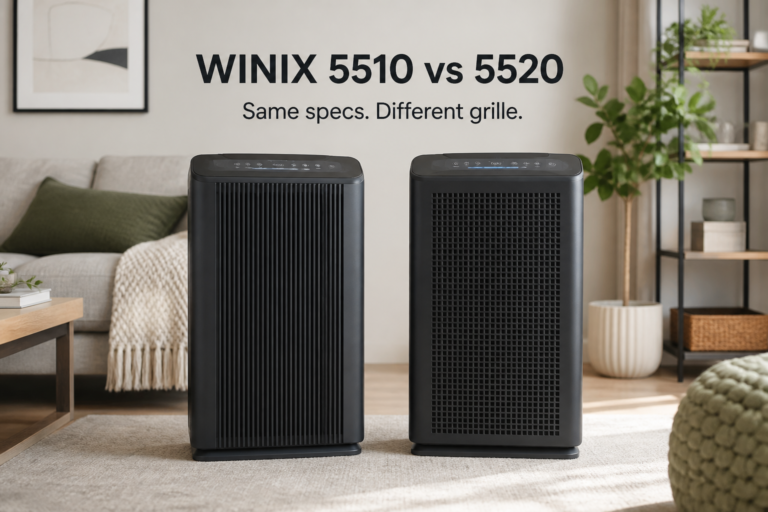
| Best separate carbon filter: Winix 5510 | 253 cfm certified smoke CADR; 248 cfm HouseFresh estimate with PlasmaWave on | About 380 sq. ft. at roughly 5 air changes per hour | Washable prefilter, separate pellet-carbon layer, app; ionizer can be disabled |
Room targets above use an eight-foot ceiling and approximately five air changes per hour at the stated airflow. They are intentionally smaller than marketing claims based on one or two cleanings per hour. Choose a larger purifier, two purifiers, or a smaller room target when the ceiling is high, doors stay open, or you need to run below maximum speed for noise.
Fastest buying decision: Choose the Vital 200S-P for the easiest all-around setup. Choose the standard Core 400S when floor space is tight. Choose the AirFanta 3Pro when airflow per dollar matters more than a conventional enclosed design. Choose the Coway only if you are comfortable leaving its ionizer off. Choose the Winix when a washable prefilter and separate pellet-carbon layer matter, but understand its PlasmaWave control before buying.
Can an air purifier for cats with asthma help?
Possibly, but the evidence has an important boundary. Feline asthma involves inflammation and narrowing in the lower airways. Cornell estimates that it affects between one and five percent of cats and describes an allergic reaction to inhaled particles as the accepted explanation in many cases. Suspected household triggers include tobacco smoke, dusty litter, aerosol sprays, cleaning-product vapors, pollen, mold, dust mites, fireplace smoke, and candle smoke.
A properly sized air purifier for cats with asthma can capture some of those materials while they are airborne. It cannot identify which trigger affects your cat, pull settled litter dust out of a carpet, clean mold from a wet wall, remove a source that keeps producing smoke, or treat inflamed airways. Source control still comes first. The US Environmental Protection Agency advises reducing or removing pollution sources and ventilating with clean outdoor air, with filtration used as a supplement.
The distinction between human cat allergy and feline asthma also matters. A person with cat allergy reacts mainly to proteins produced by cats, including Fel d 1. A cat with asthma is the patient and may react to one or more inhaled irritants in its environment. If the person in the home is allergic to the cat, start with our air purifier for cat allergies guide. For mixed pet hair, dander, and everyday odor needs, see our broader pet air purifier comparison.
How to choose an air purifier for cats with asthma
Use smoke CADR to size the room
Clean air delivery rate combines filtration efficiency and airflow. A restrictive filter in a weak fan may capture a high percentage of particles that pass through it while cleaning the room slowly. A purifier with a verified CADR tells you how much particle-free air the complete machine delivers.
AHAM’s basic rule is to choose a smoke CADR at least two-thirds of the room’s floor area when the ceiling is eight feet high. A 300-square-foot room therefore needs at least 200 cfm. That is roughly 4.8 air changes per hour. Higher ceilings, open doors, and low fan settings reduce the effective cleaning rate.
When sizing an air purifier for cats with asthma, measure the room where the cat spends the most time. Multiply length by width for square feet. Do not size from the whole-house claim on an Amazon title. A purifier advertised for 1,800 square feet may reach that number by cleaning the air only once per hour, which is not the same as repeated filtration in one occupied room.
Buy for the speed you can leave running
More fan speed and more operating time usually mean more filtration. The best purifier is not the model with the largest maximum number if its noise causes you to turn it off. A useful approach is to run a higher speed when the room is empty or after cleaning, then use the highest comfortable continuous setting while the cat rests.
Independent sound measurements help because manufacturer minimum noise figures often describe sleep mode, where airflow is lowest. HouseFresh measures sound from three feet away and repeats particle tests at a setting below 45 dBA. Those results show how much performance remains at a tolerable everyday sound level.
Prefer an accessible prefilter in a cat home
Cat hair is not the same as microscopic airborne irritants, but it can cover the first filter surface. A removable prefilter is easier to vacuum than a mesh layer bonded to the main filter. Inspect it often at first, then establish a cleaning interval based on what you actually find. Always follow the manual and avoid washing a filter that is designated vacuum-only.
A purifier will not collect most hair before it settles because hair is large and heavy. Grooming, vacuuming, and washable bedding still do most of that work. The purifier’s job is the smaller airborne fraction.
Mechanical filtration is the simplest choice
A conventional fan and particle filter do not need ionization to clean the air. EPA warns that ionizers and some other electronic air cleaners may produce ozone. California’s certified-device list is useful for checking whether a product meets the state’s ozone-emission requirements, but CARB explicitly says certification is not a general safety or effectiveness endorsement.
If you want to avoid that question entirely, choose a model that uses only mechanical filtration. If a purifier includes an optional ionizer, confirm how to turn it off and whether it stays off after a power cycle. Never use an intentional ozone generator in an occupied home. Ozone is a lung irritant, which makes it a particularly poor match for a household already managing respiratory disease.
1. Levoit Vital 200S-P: best overall
The Vital 200S-P is the strongest default recommendation because it combines useful airflow, a cat-friendly maintenance design, and straightforward controls. Its certified smoke CADR is 242 cfm, which supports approximately five air changes per hour in a 360-square-foot room with an eight-foot ceiling.
HouseFresh purchased the unit and reported that it reduced PM1 to zero in 23 minutes in a 728-cubic-foot test room. Its measured sound ranged from 38.3 to 57.7 dBA. At a quieter speed near 42 dBA, it completed the same test in 46 minutes. That quieter-speed result matters more than a barely audible sleep-mode claim because it shows the machine can still move useful air without maximum fan noise.
The front prefilter is removable, so hair and lint are easier to clean without handling the entire main filter. The control lock can prevent a cat from changing the setting by stepping on the panel. The VeSync app adds schedules, remote control, and a light-detection mode. The standard Vital 200S-P does not use an ionizer.
Limitations: The particle and carbon media are bonded, so they are replaced together. The carbon quantity is suitable for everyday household odors, not a severe chemical or smoke problem. Auto mode reacts to its particle sensor; it cannot identify feline-asthma triggers or tell you whether the cat is medically stable.
Best for: a bedroom or medium living room where you want continuous mechanical filtration, easy prefilter cleaning, and simple lockable controls.
For specifications, filter choices, and long-term drawbacks, read our full Levoit Vital 200S review and Vital 200S replacement-filter guide.
2. Levoit Core 400S: best compact smart pick
The standard US Core 400S fits a smaller footprint than the rectangular Vital 200S and keeps app control, scheduling, a particle display, and a control lock. It is a sensible alternative where a curious cat, narrow walkway, or crowded bedroom makes floor space important.
HouseFresh bought both US and European versions and found meaningful performance differences. Its US unit reached PM1 zero in 24 minutes in the test room, producing an estimated PM1 CADR of 213 cfm. At 43.2 dBA, the US version delivered an estimated 134 cfm. Use the exact regional model’s data rather than assuming every Core 400S is identical.
The regular Core 400S tested by HouseFresh does not contain an ionizer. Levoit also sells a differently named PlasmaPro 400S that adds bipolar ionization, so check the listing title before ordering. The cylindrical main filter has a bonded mesh prefilter, particle media, and pellet carbon. It works, but routine hair cleaning is less convenient than the Vital 200S’s removable prefilter.
Limitations: The smaller footprint comes with less convenient prefilter maintenance. The standard filter’s carbon is not a substitute for removing smoke, scented products, or dusty litter. Regional versions may not deliver the same airflow.
Best for: a medium bedroom where a compact body, scheduling, display lock, and remote control matter more than a removable prefilter.
See our Core 400S review and Core 400S filter guide before choosing among the original, pet, toxin, and smoke-oriented filters.
3. AirFanta 3Pro: best high-airflow value
The AirFanta 3Pro uses four filters as the walls of a compact cube and four computer-style fans on top. It is not as polished as a conventional appliance, but it offers unusually high particle airflow for its price and can be disassembled for travel.
HouseFresh measured PM1 removal to zero in 17 minutes at top speed and estimated 353 cfm. With the combined particle and carbon filters, the test took 20 minutes. At a setting producing 43.3 dBA, the purifier completed the particle test in 28 minutes. Those results make it useful for a larger room or for someone who wants strong airflow without buying a much larger appliance.
AirFanta’s current official page lists six speed settings and a maximum rated CADR of 413 cfm. The particle-only and particle-plus-carbon filter options are separate purchases. The design does not use an ionizer. For a cat household, place the assembled unit on a stable surface where the cord cannot become a toy and the air inlets and top fan guards cannot be blocked by bedding or curtains.
Limitations: It requires assembly, lacks an automatic particle sensor and app, and is less tamper-resistant than an enclosed purifier. There is no washable hair prefilter. Inspect the filter surfaces for fur more often, and do not place it where a cat regularly jumps or sleeps.
Best for: a larger room, strong airflow per dollar, or a household willing to trade appliance-style controls for performance.
4. Coway AP-1512HH: best simple proven pick
The Coway AP-1512HH has remained popular because its basic filtration performance, controls, and replacement filters are well understood. Its smoke CADR is 233 cfm, which is appropriate for roughly 350 square feet at about five air changes per hour with an eight-foot ceiling.
The washable prefilter catches hair and larger debris before the main particle filter. Auto mode can adjust the fan, and Eco mode stops the fan after a period of clean sensor readings. For a cat with suspected airborne triggers, continuous manual operation is often easier to reason about because the sensor does not detect every pollutant and cannot evaluate the cat.
The AP-1512HH includes a separate Vital Ion button. The purifier can operate with that feature off, allowing the mechanical filters and fan to do the work. If someone in the household may turn it on accidentally, place a simple reminder near the control panel. Recheck the setting after a power interruption.
Limitations: It has no app or control lock, and the ionizer adds a setting some owners would rather not manage. Its thin carbon sheet is intended for routine odor support, not substantial gas adsorption.
Best for: someone who wants a conventional, widely supported purifier and is comfortable keeping the optional ionizer off.
Our Coway AP-1512HH review explains its room sizing, controls, and long-term tradeoffs. The Coway replacement-filter guide covers genuine and compatible options.
5. Winix 5510: best separate carbon filter
The Winix 5510 combines a washable prefilter, a separate pellet-carbon filter, a particle filter, an app, and strong maximum airflow. Winix lists a 253 cfm smoke CADR. HouseFresh’s purchased unit reached PM1 zero in 24 minutes with PlasmaWave enabled, producing an estimated 248 cfm.
The separate carbon layer is convenient because hair can be cleaned from the prefilter and the carbon condition can be inspected without replacing the particle filter alone. Winix told HouseFresh that the model contains 226 grams of carbon. That is more useful than a token coated sheet for ordinary odors, but it will not control a strong source indefinitely.
PlasmaWave is Winix’s optional bipolar ionization feature. It can be disabled, but buyers who want no electronic air cleaning should understand the control behavior before choosing this model. HouseFresh measured the purifier at a loud 67.2 dBA on maximum. At a quieter 40.8 dBA setting, it estimated 125 cfm, so size the room for the speed you expect to use.
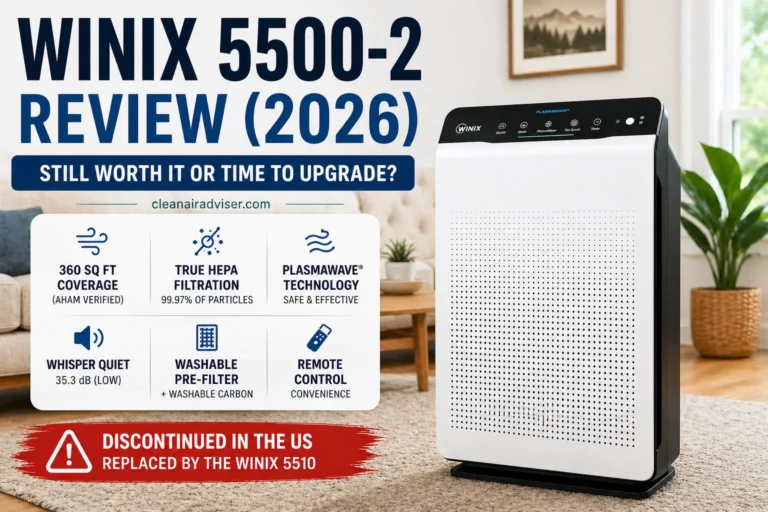
Limitations: Maximum speed is loud, quiet-speed airflow is lower, and the optional ionizer requires attention. The current Filter Q is different from the filter used by the discontinued Winix 5500-2.
Best for: a medium room where a washable prefilter, separate pellet-carbon media, and app control outweigh the ionizer-management issue.
Read the Winix 5510 review for measured noise and airflow, then use our Filter Q guide to avoid buying a 5500-2 filter by mistake.
Where should the purifier go?
Start in the room where the cat sleeps or spends the longest uninterrupted period. A purifier in a hallway cannot pull air efficiently through several closed doorways. One correctly sized unit in the main room is usually more useful than a small device placed far from the cat.
- Leave clearance around the air inlets and outlet according to the manual.
- Keep it away from curtains, bedding, and the litter dust plume.
- Do not point a strong outlet directly at the cat’s bed.
- Route the power cord so it cannot be chewed, pulled, or wrapped around a leg.
- Use the floor unless the manufacturer permits elevated placement and the surface is wide, stable, and inaccessible to jumping.
- Do not hide the purifier behind a sofa where airflow is restricted.
Placing the machine immediately beside the litter box can load the filters quickly and may blow dust across the room when the cat digs. Source control at the box matters more. Put the purifier elsewhere in the same room with a clear path for circulation.
Household changes that matter as much as the purifier
Work with the veterinarian on suspected triggers
Cornell lists dusty litter, tobacco smoke, household-cleaner vapors, aerosol sprays, pollen, mold, dust mites, fireplace smoke, and candle smoke among suspected allergens. That list is a starting point, not proof that one item caused an individual cat’s asthma. Ask the veterinarian which environmental changes make sense alongside the treatment plan.
Change litter carefully
Owner discussions repeatedly mention litter dust as a concern, and Cornell includes dusty litter among suspected triggers. A lower-dust product may reduce the visible plume, but a sudden change can cause litter-box avoidance. Transition gradually, keep enough clean boxes, and ask the veterinarian about an appropriate litter if the cat has respiratory or urinary issues.
Do not rely on labels such as “99 percent dust free” without observing the product in use. Pour gently, avoid shaking dusty litter indoors, and clean the surrounding floor with methods that do not launch dust back into the air.
Remove smoke and scented aerosols
Do not smoke or vape around the cat or inside the home. A purifier can reduce some airborne particles, but it cannot make ongoing indoor smoking harmless. Stop using scented candles, incense, aerosol air fresheners, and strongly fragranced sprays in the cat’s environment if the veterinarian considers them possible irritants.
Clean without creating another plume
Damp dusting and a sealed vacuum with effective filtration help contain debris. Move the cat to another room during vacuuming if the activity visibly stirs dust or causes distress. Wash bedding with an appropriate unscented product and allow cleaned surfaces to dry before the cat returns. Never mix household cleaners.
Address moisture and mold at the source
An air purifier cannot solve a mold problem. EPA advises fixing the moisture source and cleaning up the mold. Filtration may capture some airborne particles, but it will not dry a leak, remove growth from porous material, or prevent recurrence.
Warning signs that should not wait for a purifier
Feline coughing can be mistaken for trying to bring up a hairball. Cornell describes asthma signs that can include coughing or hacking, wheezing, rapid breathing, and difficulty breathing. Open-mouth breathing, gasping, blue lips or gums, pronounced abdominal effort, weakness, or collapse can signal an emergency.
Record a video if it is safe and does not delay care. It can help the veterinarian see what happens outside the clinic. Do not give human asthma medication or change a cat’s prescribed dose based on an article, merchant review, or Reddit comment.
Filter maintenance in a cat household
Check the prefilter more often than the calendar reminder at first. Fur load, litter dust, room size, fan speed, and outdoor pollution can change the interval. Vacuum a reusable prefilter only as directed, let any washable component dry completely, and never run a purifier with the main filter still in its shipping bag.
A filter reminder usually measures operating time rather than directly testing filter capacity. Replace the filter when the manual says, when airflow stays reduced after prefilter cleaning, when the media is damaged, or when persistent odor remains in the filter. Keep a spare if availability is unreliable, but do not stock several years of carbon filters in an unsealed location because adsorbent media can take up chemicals from storage air.
Our filter-replacement timing guide explains how to combine the indicator, inspection, airflow, odor, and actual environment instead of following one universal schedule.
Frequently asked questions
Can an air purifier cure feline asthma?
No. Cornell states that indoor-air purification has not been rigorously tested or proven to work in feline asthma patients. Veterinary treatment commonly focuses on controlling airway inflammation, sometimes with medication to dilate the airways. A purifier is only a possible environmental support.
Does the purifier need to say True HEPA?
No label can replace whole-machine airflow data. Look for verified CADR and appropriate room sizing. A high-efficiency filter with enough airflow and repeated room passes can reduce airborne particles effectively. Avoid claims that discuss filter efficiency without showing what the assembled purifier delivers.
Should I choose a purifier with an ionizer?
It is not necessary for mechanical particle filtration. EPA notes that ionizers and some electronic air cleaners may emit ozone. The simplest choice is a mechanical-only model. If you buy a purifier with an optional ionizer, leave it off if that matches the plan you discussed with your veterinarian and verify its setting after power interruptions.
Will activated carbon help a cat with asthma?
Carbon can adsorb some gases and odors, but there is no standard consumer CADR for gases and performance varies with the media and pollutant. It does not treat asthma. Remove smoke, sprays, fragrance, and other suspected sources rather than asking a thin carbon layer to control them continuously.
Should the purifier run all day?
Continuous operation at a tolerable manual speed usually provides more predictable filtration than brief sessions. Higher speed can be useful after cleaning or when outdoor particle levels rise, provided the outdoor air is not being brought inside through open windows. Follow the manual and monitor whether noise or airflow stresses the cat.
Is one purifier enough for the whole house?
Usually not. Portable purifiers are room devices. Closed doors and separate floors limit circulation. Start in the cat’s main room, then add another correctly sized unit if the cat spends long periods elsewhere.
Can a purifier replace vacuuming and lower-dust litter?
No. It captures only what reaches its air intake. Hair, settled dust, and litter debris still require source control and careful cleaning. For a broader explanation of particle filtration limits, see do air purifiers actually work?
Bottom line: choosing an air purifier for cats with asthma
The best first purifier for most cats with asthma is the Levoit Vital 200S-P because it pairs useful measured airflow with a removable prefilter, quiet practical settings, a control lock, and no ionizer. The Core 400S is the compact alternative. The AirFanta 3Pro delivers more airflow per dollar but needs careful placement. The Coway AP-1512HH and Winix 5510 remain capable mechanical filters when their optional ionization features are kept off.
The purchase is the easy part. The responsible air purifier for cats with asthma plan is veterinary care, removal of suspected irritant sources, a lower-dust routine, correct CADR sizing, safe placement, continuous operation, and filter maintenance. No purifier should delay care for a cat that is struggling to breathe.
Sources
- Cornell University College of Veterinary Medicine: Feline Asthma, What You Need To Know
- Cornell Feline Health Center: Feline Asthma, A Risky Business for Many Cats
- US Environmental Protection Agency: Guide to Air Cleaners in the Home
- US Environmental Protection Agency: Ozone Generators That Are Sold as Air Cleaners
- AHAM Verifide: Room Air Cleaner Directory and CADR Sizing
- California Air Resources Board: List of CARB-Certified Air Cleaning Devices
- Levoit: Vital 200S-P Official Product Page
- HouseFresh: Levoit Vital 200S Purchased-Unit Review and Test Data
- Levoit: Core 400S Official Product Page
- HouseFresh: Levoit Core 400S Purchased-Unit Review and Test Data
- AirFanta: 3Pro Official Product Page and Specifications
- HouseFresh: AirFanta 3Pro Purchased-Unit Review and Test Data
- Coway: Airmega Mighty AP-1512HH Official Product Page
- HouseFresh: Coway AP-1512HH Purchased-Unit Review and Test Data
- Winix America: Winix 5510 Official Specifications
- HouseFresh: Winix 5510 Purchased-Unit Review and Test Data
- Reddit r/AirPurifiers: Owner Discussion About an Asthmatic Cat, Room Size, and Ionizers
- Reddit r/CatAdvice: Owner Discussion About Purifiers for Cats With Asthma