Winix 5510 vs 5500-2: Which Should You Buy in 2026?
Disclosure: Clean Air Adviser may earn a commission when you buy through links on this page. This does not change what you pay. We have not personally owned or lab-tested either purifier. This comparison separates Winix specifications, independent measurements, and reported manufacturer support information.
Quick answer: This Winix 5510 vs 5500-2 guide highlights the evidence, practical fit, and buying limits that matter before you decide.
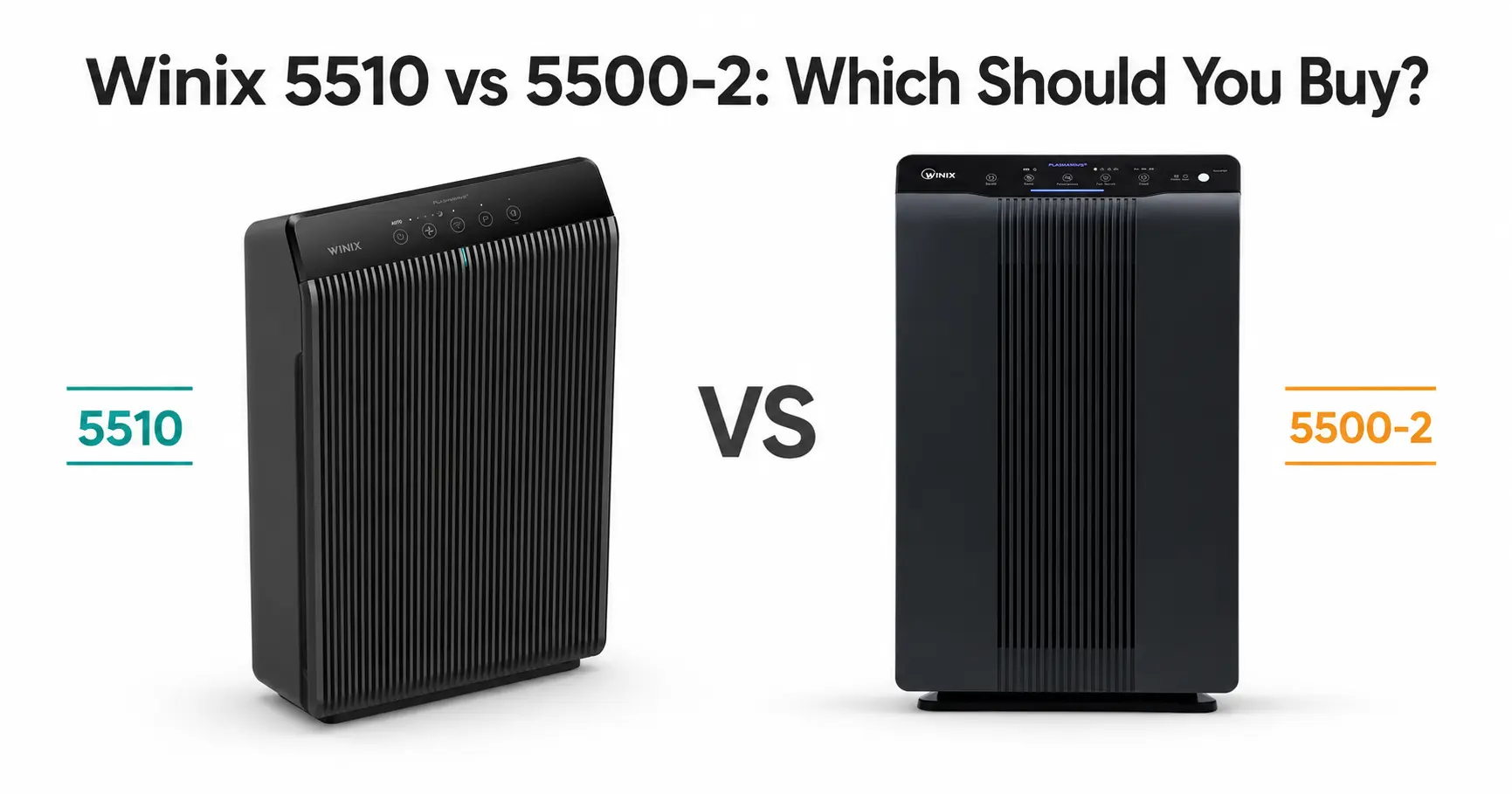
Winix 5510 vs 5500-2 specifications
| Feature | Winix 5510 | Winix 5500-2 |
|---|---|---|
| AHAM room size | 392 sq. ft. at 4.8 air changes per hour | 360 sq. ft. at about 4.8 air changes per hour |
| CADR: dust / pollen / smoke | 252 / 247 / 253 CFM | 243 / 246 / 232 CFM |
| Particle filter | True HEPA | True HEPA |
| Carbon filter | Separate AOC pellet-carbon filter, not washable | Separate washable AOC pellet-carbon filter |
| Replacement set | Filter Q, 1712-0123-00 | Filter H, 116130 |
| Filter compatibility | 5510, 5520, and 5530 | 5500-2 and AM80 |
| PlasmaWave | Yes, user can switch it off | Yes, user can switch it off |
| Wi-Fi and app | Yes | No |
| Physical remote | No | Yes |
| Dimensions | 13.59 x 8.27 x 22.17 in. | 15 x 8.2 x 23.6 in. |
| Weight | 13.3 lb. | 15 lb. |
| Rated power | 65 W | 70 W |
| Warranty | 2 years | 2 years when applicable to a qualifying original purchase |
The current Winix 5510 product page lists a 392-square-foot AHAM room rating and CADR values of 252 for dust, 247 for pollen, and 253 for smoke. ENERGY STAR reports the same 392-square-foot size and 253 CFM smoke CADR. The older 5500-2 manual lists 360 square feet, while ENERGY STAR data identifies dust, pollen, and smoke CADR values of 243, 246, and 232 CFM.
Those room ratings are based on roughly five air changes per hour, which is a useful target for allergies, smoke particles, and continuous cleaning. Winix also advertises much larger one-hour coverage figures for the 5510. That larger number describes one air change per hour, not the faster circulation represented by the AHAM room size. For a real comparison, use 392 versus 360 square feet.
Independent particle tests: almost a tie at full power
HouseFresh bought both purifiers and tested them in the same 728-cubic-foot room using incense smoke and a PurpleAir sensor. The Winix 5510 reached zero PM1 in 24 minutes on its highest speed. HouseFresh estimated a top-speed PM1 CADR of about 249 CFM. The Winix 5500-2 completed the same test in 23 minutes with PlasmaWave enabled and 24 minutes with it disabled.
| HouseFresh test | Winix 5510 | Winix 5500-2 |
|---|---|---|
| PM1 zero at maximum speed | 24 minutes | 23 minutes with PlasmaWave, 24 without |
| Useful setting below 45 dBA | Speed 2 at 40.8 dBA | Speed 2 at 42.5 dBA |
| PM1 zero below 45 dBA | 47 minutes | 45 minutes with PlasmaWave, 46 without |
| Maximum measured noise | 67.2 dBA | 58.9 dBA |
The result is more useful than a marketing claim. The newer purifier does not clean HouseFresh’s test room faster, even though its certified smoke CADR is 21 CFM higher. Test methods and particle sizes are not identical to AHAM’s procedure, so both results can be valid. The practical conclusion is that both provide strong mid-size particle removal and that neither has a decisive speed advantage.
Air Purifier First ran a different 60-minute particle test in a 320-square-foot room. Its Winix 5510 test reported a 96% improvement, from 104.9 to 4.7 micrograms per cubic meter of PM2.5. Its 5500-2 review also reported strong particle performance. Results from two laboratories should not be combined into one ranking because the rooms, starting pollution, sensors, and protocols differ. They do support the same broad conclusion: both models are capable particle purifiers when sized appropriately and run at a useful fan speed.
Noise is the 5500-2’s biggest remaining advantage
The Winix 5510 is not loud at every setting. HouseFresh measured 35.2 dBA in Sleep, 36.8 on speed 1, 40.8 on speed 2, 51.6 on speed 3, and 67.2 on speed 4. Its room had a background level near 35 dBA, so the first two settings were close to the test floor.
The 5500-2 measured 38.8 dBA on speed 1, 42.5 on speed 2, 47.5 on speed 3, and 58.9 on speed 4 in the same HouseFresh setup. The old model is about 8 dBA lower at maximum, a difference most listeners will notice. It also delivers slightly more particle cleaning at its under-45-dBA setting in this test.
Air Purifier First measured different absolute numbers because its procedure and room were different, but its 5510 result also showed a large jump at Turbo. It recorded 40.2 dBA in Sleep and 65.7 dBA on Turbo. This reinforces the decision rule without pretending every sound meter will produce the same reading.
If the purifier will stay in a bedroom, office, or TV room, expect to use speed 1 or 2 most of the time. The 5510 remains comfortable there. If you regularly need maximum speed for wildfire smoke, cooking particles, or a quick cleanup, the 5500-2’s smoother top setting is a real benefit.
The filter difference matters, and the parts do not interchange
The 5510 uses genuine Filter Q, part 1712-0123-00. The set contains a True HEPA filter and a separate AOC carbon filter. The permanent fine-mesh pre-filter sits in front of them. Winix lists Filter Q for the 5510, 5520, and 5530, and recommends replacing the HEPA and carbon filters about every 12 months under normal conditions.
The 5500-2 uses genuine Filter H, part 116130. Winix lists it for the 5500-2 and AM80. It also includes a True HEPA filter and a separate AOC carbon filter, but the older model’s carbon layer is washable. Winix still recommends replacing both main filters yearly and warns that carbon-filter performance may decrease after washing.
Filter H and Filter Q are not interchangeable. The frames are different sizes. Avoid listings that claim one replacement fits both the 5510 and 5500-2. Match the model and part number before ordering.
Correct replacement parts
- Winix 5510: Filter Q, 1712-0123-00
- Winix 5500-2: Filter H, 116130
See our Winix 5510 Filter Q guide or Winix 5500-2 Filter H guide for replacement steps and current buying options.
Can you wash the carbon filters?
You can wash the 5500-2’s AOC carbon filter because Winix explicitly labels Filter H’s carbon layer washable. You cannot wash the 5510’s Filter Q carbon filter. The official 5510 manual says the activated carbon and True HEPA filters cannot be washed. Only its permanent pre-filter may be vacuumed or rinsed, then dried completely before reinstalling.
Washing Filter H removes surface dust, but it does not make used activated carbon chemically new. Winix says performance may decrease after each wash and still calls Filter H a one-year replacement set. Rinse only as directed, let it dry completely, and replace the set when odors return or the annual indicator and inspection point to replacement.
Does discontinuation make Filter H risky?
Winix’s current filter store still lists genuine Filter H in stock, and the official product page names the 5500-2 and AM80 as compatible models. HouseFresh reports that Winix directly confirmed Filter H production would continue until 2032. That date is reported manufacturer support information, not a guarantee from Clean Air Adviser, but it gives existing owners a reasonable service horizon.
The older model also has a mature aftermarket. That can reduce annual cost, but a low price does not prove equal airflow, carbon mass, sealing, or HEPA performance. The most defensible comparison uses genuine filters for both models. Treat third-party sets as a separate value decision and check fit, return terms, and recent model-specific reviews.
Wi-Fi and controls: modern app or physical remote
The 5510 works with the Winix Smart app and Alexa. The app can control the purifier remotely, show air-quality information, set schedules, and provide the timer function listed on Winix’s specifications. Wi-Fi is optional. The front panel still provides power, fan-speed, PlasmaWave, and pairing controls, so the purifier can clean air without an account or internet connection.
The 5500-2 has no Wi-Fi. It includes a small physical remote plus front-panel fan, timer, Auto, Sleep, and PlasmaWave controls. Some buyers prefer this because there is no app setup or cloud dependency. Others will find the 5510’s scheduling more useful, especially when the purifier runs in another room.
The 5510 also has a light sensor that automatically enters Sleep mode in a dark room and returns to Auto when light increases. That behavior can be convenient in a bedroom, but it can also lower airflow when you want the room dark and still need stronger cleaning. Choose a manual fan speed when sustained smoke or allergy control matters more than automatic nighttime behavior.
PlasmaWave and ozone: what the certifications mean
Both purifiers include PlasmaWave, Winix’s optional bipolar ionization feature. You can turn it off on either model. HouseFresh found only a one-minute difference between the 5500-2’s speed-2 particle tests with PlasmaWave enabled and disabled, so buyers who prefer mechanical filtration can leave it off without losing most of the machine’s measured performance.
ENERGY STAR’s record for the product family containing the 5500-2 lists ozone emissions at 0.0 ppb under its test. Winix’s 5510 product page reports an eight-hour time-weighted ozone result of 0.22 parts per billion in a 30-cubic-meter chamber. The California Air Resources Board also lists the 5510 as a certified electronic air cleaner. CARB explains that certification addresses the state’s ozone and electrical-safety requirements, not overall cleaning effectiveness or a medical-health endorsement.
If you do not want an ionizer operating, switch PlasmaWave off. The HEPA, carbon, pre-filter, and fan continue to function.
Energy use and ownership cost
HouseFresh measured the 5510 at 0.65 watts in standby, 3.51 in Sleep, 4.59 on speed 1, 6.58 on speed 2, 15.68 on speed 3, and 52.62 on speed 4 with PlasmaWave off. With PlasmaWave on, its maximum reading was 53.94 watts. Air Purifier First measured a similar 53.4 watts at maximum.
The 5500-2 has a 70-watt rated motor, but real use depends on speed. It will spend far less than 70 watts on its lower settings. The 5510 has the efficiency advantage at maximum output and is easier to schedule, but electricity alone is unlikely to repay a large purchase premium in a home that mainly uses low or Auto speeds.
Filter prices change often. At the time of this update, Winix’s official pages showed genuine Filter Q and Filter H on promotion, with their regular prices displayed as $79.99 and $84.99 respectively. That is a much smaller genuine-filter difference than older versions of this comparison claimed. Do not assume the 5500-2 automatically saves hundreds of dollars unless you have already chosen a specific aftermarket Filter H and are willing to accept the quality tradeoff.
Who should buy the Winix 5510?
- You are buying new in 2026. The 5510 is current, readily supported, and easier to find through normal retail channels.
- You want Wi-Fi. Remote control, schedules, Alexa, and timer functions are useful when the unit is not beside you.
- You need a smaller cabinet. It is narrower, shorter, and lighter while carrying a slightly higher AHAM room rating.
- You care about maximum-speed efficiency. Independent measurements put Turbo around 53 to 54 watts.
- The two models cost about the same. Current support and smarter control outweigh the old model’s remote and quieter Turbo mode for most shoppers.
Read our complete Winix 5510 review if you want the model’s strengths and limitations without the comparison format.
Who should buy the Winix 5500-2?
- You already own one. Keep using it if the motor, sensor, and seals are healthy. Filters remain available.
- You find a genuine clearance deal. A discount of about $50 or more can compensate for buying a discontinued model.
- You regularly use Turbo. HouseFresh measured the 5500-2 much quieter at maximum speed.
- You prefer a remote to an app. The included controller works without Wi-Fi, accounts, or software support.
- You want the washable Filter H carbon layer. It can be rinsed as Winix directs, although it still needs periodic replacement.
Read our refreshed Winix 5500-2 review for a closer look at the older purifier and the implications of discontinuation.
Winix 5510 vs 5500-2: final decision
Use this Winix 5510 vs 5500-2 guide to match the option to your room, usage, and maintenance needs.
A sound Winix 5510 vs 5500-2 decision accounts for real-world fit, ongoing costs, and the limits of the product category.
When comparing choices, keep this Winix 5510 vs 5500-2 goal in view rather than relying on a single headline claim.
This Winix 5510 vs 5500-2 guide is designed to support a practical choice, not replace source control or the manufacturer instructions that apply to your model.
The Winix 5510 is the safer purchase for most new buyers in 2026. It is the current model, has slightly higher certified airflow, adds Wi-Fi control, takes up less floor space, and is easier to buy with a normal warranty. The older Winix 5500-2 remains an excellent purifier, but it now makes the most sense for someone who already owns one or finds genuine remaining stock at a meaningful discount.
There is one important twist. The 5510 is not a clean upgrade in every respect. Independent testing found that both machines clear particles at almost the same speed on maximum power, while the 5500-2 is noticeably quieter at its fastest setting. The 5500-2 also has an included remote and a washable AOC carbon filter. The 5510 replaces those conveniences with app control, a more compact cabinet, lower power use, and a current filter platform.
Simple buying rule
- New buyer: Choose the 5510 when prices are close.
- Clearance buyer: Consider the 5500-2 only when it is at least about $50 cheaper, sold as new by a trustworthy retailer, and includes a valid return policy.
- Existing 5500-2 owner: Keep it if it runs normally. The 5510 is not a large enough performance jump to replace a healthy unit.
- Noise-sensitive buyer: The 5500-2 is the better high-speed machine. The 5510 is comfortable at low speeds but loud on Turbo.
- Smart-home buyer: Choose the 5510 for Wi-Fi, scheduling, and Alexa support.
Frequently asked questions
Is the Winix 5510 better than the 5500-2?
It is the better new purchase for most people because it is current, smaller, more efficient at maximum speed, Wi-Fi enabled, and rated for a slightly larger room. The 5500-2 remains better for quieter maximum-speed operation, a physical remote, and a washable carbon layer.
Should a 5500-2 owner upgrade to the 5510?
Usually no. HouseFresh’s maximum-speed particle tests were effectively tied, and the 5500-2 was quieter on Turbo. Upgrade only if the old purifier is failing or if Wi-Fi, a smaller body, and lower high-speed power use solve a specific problem.
Are Winix 5510 and 5500-2 filters compatible?
No. The 5510 uses Filter Q, part 1712-0123-00. The 5500-2 uses Filter H, part 116130. Buy the part number printed for your model.
Can the Winix 5510 carbon filter be washed?
No. The official 5510 manual says its activated carbon and True HEPA filters cannot be washed. Clean only the permanent pre-filter. Filter H’s carbon layer for the 5500-2 is washable.
Does the Winix 5510 work without Wi-Fi?
Yes. Wi-Fi is optional. You can power the unit, choose fan speeds, use Auto or Sleep behavior, and switch PlasmaWave from the purifier. Scheduling and remote app control require Wi-Fi.
Is the Winix 5500-2 discontinued?
Yes in the United States and Canada, according to HouseFresh’s direct confirmation from Winix and Winix’s own warranty page, which marks the model with its discontinued-model notation. Remaining retailer stock may still be available. Genuine Filter H remains listed by Winix.
Does PlasmaWave have to stay on?
No. It can be disabled on both machines. The fan and mechanical filters continue to operate.
Final verdict
Buy the Winix 5510 if you are shopping for a new purifier today. It delivers the same class of particle removal in a smaller, connected, more efficient package, and its current production status removes the uncertainty that comes with clearance inventory.
Buy the 5500-2 only when the deal is genuinely better or its specific strengths matter more to you. Its quieter Turbo mode, physical remote, and washable carbon layer remain excellent features. Existing owners should feel no pressure to replace it. A healthy 5500-2 is still competitive, and Filter H availability supports continued use.
Check today’s price before deciding
Retail availability changes quickly because the 5500-2 is discontinued. Compare the final checkout price, seller, return window, and whether the item is new or refurbished.
Sources
- Winix America: 5510 product page and specifications
- Winix America: 5510 user manual (PDF)
- Winix America: 5500-2 user manual (PDF)
- Winix America: Filter Q, 1712-0123-00
- Winix America: Filter H, 116130
- Winix America: warranty terms and discontinued-model notation
- HouseFresh: Winix 5510 independent review and test data
- HouseFresh: Winix 5500-2 independent review and test data
- Air Purifier First: Winix 5510 independent review
- Air Purifier First: Winix 5500-2 independent review
- ENERGY STAR: Winix 5510 certified record
- ENERGY STAR: room air cleaner data including Winix 5500-2
- California Air Resources Board: certified air-cleaning device list
Last fact-checked August 14, 2026. Prices and remaining 5500-2 stock can change. Performance figures belong to the named laboratories and should be interpreted within each source’s test method.
For the model-specific details, HouseFresh test context, and a 5520 versus 5510 buying rule, read our Winix 5520 review.