Levoit Core 400S Review (2026): Smart, Fast, but Costly to Run?
Disclosure: Clean Air Adviser may earn a commission when you buy through links on this page. This does not change what you pay. We have not personally owned or lab-tested the Core 400S. This review separates official specifications, independent measurements, and public owner reports.
Quick answer: This levoit core 400s review guide highlights the evidence, practical fit, and buying limits that matter before you decide.
Verified Core 400S specifications
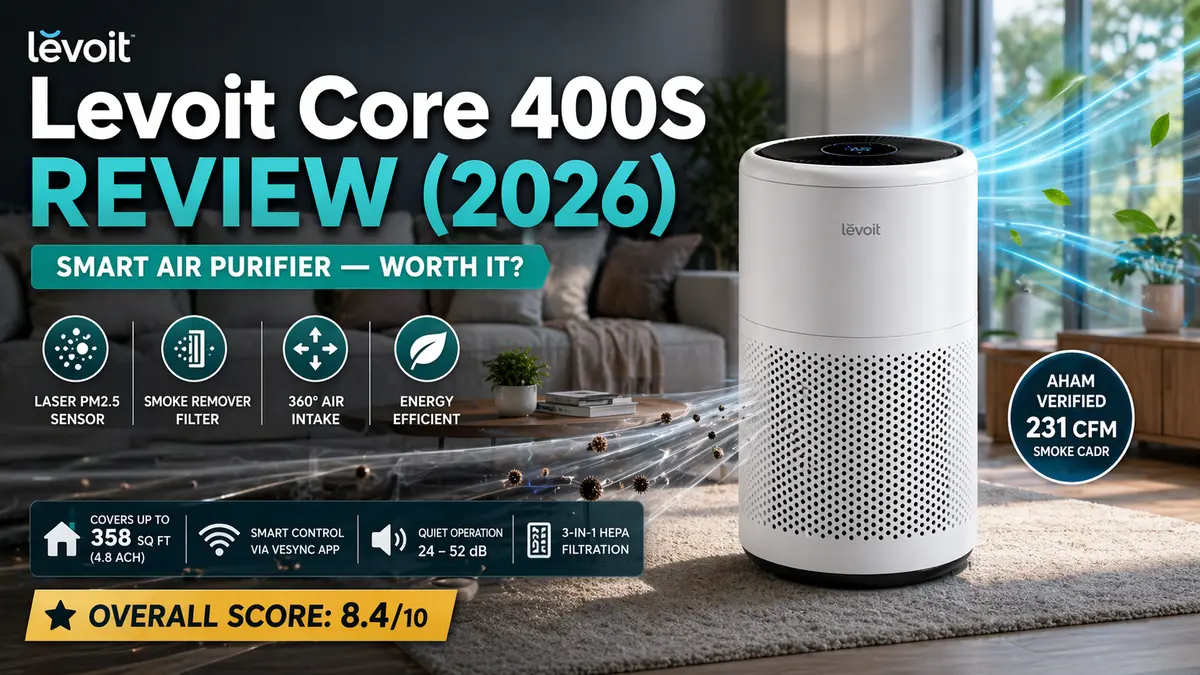
The most useful room rating is 358 square feet, not a four-digit marketing number based on one air change per hour. ENERGY STAR currently certifies the U.S. Core 400S for 358 square feet with smoke CADR 231, dust CADR 240, pollen CADR 259, and PM2.5 CADR 236 CFM.
| Specification | Verified figure | Why it matters |
|---|---|---|
| Recommended room size | 358 sq. ft. | A practical target for frequent particle cleaning in a normal room |
| Smoke CADR | 231 CFM | Very close to the Coway AP-1512HH on current certification data |
| Dust / pollen CADR | 240 / 259 CFM | Strong airflow for its compact footprint |
| Filtration | Mesh pre-filter, particle filter, activated carbon | All three layers are bonded into one replacement cylinder |
| Sensor | AirSight Plus laser PM2.5 sensor | Controls Auto mode and displays a particle estimate |
| Smart controls | VeSync, Wi-Fi, Alexa, Google Assistant | Remote control, schedules, history, and custom Auto settings |
| Dimensions | 10.8 x 10.8 x 20.5 in. | Narrower floor footprint than many box-shaped purifiers |
| Weight | About 11.2 lb. | Manageable to move between rooms, although one-room use is better |
| Ozone | 0 ppb in ENERGY STAR record | The standard Core 400S is fan-and-filter only, with no ionizer |
| Warranty | 2 years | Keep the receipt and follow Levoit’s registration terms |
Older reviews often quote 260 CFM and 403 square feet. Use the current ENERGY STAR record when buying a current U.S. unit. Regional product pages may also use different air-change assumptions, so CADR is a safer comparison than the largest room number on a retailer listing.
Independent particle performance
HouseFresh bought and tested both American and European Core 400S units in its 728-cubic-foot test room. The U.S. unit reduced its PM1 reading to zero in 24 minutes. The European unit needed 30 minutes. HouseFresh estimated PM1 CADR at 213 CFM for the U.S. unit and 198 CFM for the European version.
The difference matters because listings in different countries can look like the same product. Levoit told HouseFresh that the European model was optimized with noise reduction in mind. If you live outside the United States, verify the local power rating, CADR, and room recommendation instead of copying U.S. figures.
For the U.S. model, the overall result is strong. A 24-minute clean-air test puts it among capable medium-room purifiers. It is appropriate for smoke particles, pollen, airborne dust, and small dander fragments when sized correctly. It will not remove settled dust or pet hair from floors, and its PM2.5 sensor cannot measure gases.
Realistic room sizing
Use roughly 358 square feet as the upper target with an eight-foot ceiling. Choose a smaller room allowance if ceilings are high, doors remain open, outdoor smoke leaks in, or you want faster recovery after cooking. A one-air-change rating can be useful for gentle background circulation, but it is not the number we would use during wildfire smoke or allergy season.
The cylindrical intake needs open space around it. Avoid squeezing the unit between furniture or pressing the intake against a wall. Keep the top exhaust clear. A central location with normal airflow is more valuable than placing it beside the wall just because an outlet is convenient.
Noise and usable performance
Manufacturer sleep-mode numbers come from controlled conditions. HouseFresh measured the U.S. Core 400S from three feet away at 35.5 dBA in Sleep, 38.3 on speed 1, 43.2 on speed 2, 51.2 on speed 3, and 60.3 on speed 4. Its room had a 35 dBA background level, so the quietest modes may be lower in a silent lab.
| Setting | HouseFresh U.S. noise | Practical use |
|---|---|---|
| Sleep | 35.5 dBA | Overnight background cleaning |
| Speed 1 | 38.3 dBA | Quiet work and continuous use |
| Speed 2 | 43.2 dBA | Best comfort-to-cleaning balance for many rooms |
| Speed 3 | 51.2 dBA | Faster daytime cleaning |
| Speed 4 | 60.3 dBA | Short cleanup bursts when noise is less important |
HouseFresh also tested the U.S. unit below 45 dBA and estimated 134 CFM at that quieter operating point. This is the more useful number for buyers who cannot tolerate maximum fan noise. Larger purifiers can often deliver similar airflow without working as hard, so oversizing can be worthwhile for a bedroom or office.
Some Reddit owners report a high-pitched tone, fan squeak, or sensor-related noise. These are individual reports, not a known failure rate. If a new unit produces a mechanical sound beyond normal airflow, record it, contact support during the return window, and do not assume every example behaves that way.
Power use and running cost
HouseFresh measured 0.93 watts in standby, 3.05 in Sleep, 5.28 on speed 1, 8.51 on speed 2, 16.41 on speed 3, and 39.64 on speed 4 for the U.S. model. ENERGY STAR lists 237 kWh of annual energy use under its standardized method. Those figures answer different questions, so a single “annual electricity cost” without a stated setting is not useful.
At 15 cents per kWh, running the measured 8.51-watt speed 2 continuously would cost about $11.18 per year. Maximum speed around the clock would cost about $52.09. Real use changes as Auto mode adjusts the fan, and your local electricity rate may be higher or lower.
The bonded-filter tradeoff
The Core 400S uses a cylinder with the pre-filter, particle media, and carbon bonded together. Replacement is simple, but maintenance is less convenient than on the Vital 200S, Coway AP-1512HH, or Winix 5510. You must remove the entire cylinder to clean the outer mesh, and you cannot replace a saturated carbon layer separately.
HouseFresh uses a six-month replacement assumption and a $49.99 filter price in its running-cost calculation, resulting in roughly $99.98 per year for filters. That is a conservative heavy-use estimate, not a universal schedule. The manual, filter reminder, visible loading, odors, airflow, pets, and pollution level should all inform the timing.
One Reddit owner reported reminders about every three months while running continuously in a carpeted bedroom with a dog. Other owners report longer use. The reminder is not a laboratory measurement of remaining filtration capacity, so inspect the filter rather than treating the date as exact. Never wash the main filter unless Levoit’s current instructions explicitly say to do so.
Standard, pet, toxin, or smoke filter?
HouseFresh weighed or documented meaningful carbon differences among Core 400S filter variants. Its review reports about 240 grams of carbon in the Original filter, 400 grams in the Pet Allergy and Toxin Absorber versions, and 450 grams in the Smoke Remover filter.
More carbon can improve useful capacity for some odors and gases, but it adds airflow resistance and is still modest compared with specialist machines containing pounds of carbon. Choose the Original filter for particle-first use. Consider Smoke Remover when wildfire or cooking odor matters, while keeping expectations realistic. No consumer PM2.5 display tells you when carbon is exhausted because it does not measure gases.
The HEPA wording issue, without the drama
Levoit’s marketing language changed after a 2023 National Advertising Division challenge brought by Dyson. BBB National Programs says the challenged models were the EverestAir, Core 300, and Core 300S, not the Core 400S. VeSync voluntarily discontinued certain HEPA claims, and NAD did not rule on their merits.
Current ENERGY STAR data calls the Core 400S filter “HEPA-Type.” That is the safest term for this review. The wording dispute does not erase the strong whole-machine particle results measured by HouseFresh or the current CADR certification. Buyers should judge the complete purifier by verified clean-air delivery, not by a label on filter media alone.
Sensor, Auto mode, and the VeSync app
The AirSight Plus laser sensor displays an estimated PM2.5 concentration and drives Auto mode. That is more helpful than a color alone, but it remains a consumer sensor. It can react to particles from cooking, candles, cleaning, and ultrasonic humidifiers. Tap water in an ultrasonic humidifier can create airborne mineral particles that make a purifier show poor air quality even when there is no smoke.
If the number seems stuck, clean the sensor opening as the manual directs and compare the response with another monitor if accuracy matters. Do not spray cleaners into the sensor. Remember that a low PM2.5 number says nothing about carbon dioxide, carbon monoxide, radon, or most household gases.
VeSync adds remote speed control, schedules, air-quality history, filter reminders, and adjustable Auto mode behavior. Alexa and Google Assistant support are useful for voice control. The app also contains shopping and promotional elements that some users find busy.
Wi-Fi setup requires a compatible 2.4 GHz network. The old article incorrectly suggested the purifier would later work on either Wi-Fi band. A 2.4 GHz device remains a 2.4 GHz device, although a dual-band router can serve both 2.4 and 5 GHz clients under one network name. If pairing fails, confirm the router exposes 2.4 GHz and follow Levoit’s current setup instructions.
What owners report
Owner comments are helpful for spotting daily-use patterns, not for calculating performance or reliability rates. Positive reports commonly mention fast reactions to cooking particles, useful app schedules, quiet lower speeds, and help during smoke events. Recurring complaints include filter expense, a high-pitched sound in some units, confusing sensor readings, and 2.4 GHz setup problems.
One useful lesson from these reports is to separate particle control from odor control. The machine may reduce a PM2.5 number quickly while a smell remains because the tasks use different filter media. Likewise, a sensor reading of 001 does not prove that all indoor air risks are absent.
Core 400S vs Vital 200S, Coway Mighty, and Winix
| Choose | Best reason | Main compromise |
|---|---|---|
| Levoit Core 400S | Compact cylinder, live PM2.5 display, strong app | Bonded filter and higher long-term filter cost |
| Levoit Vital 200S | Removable pre-filter and easier pet-hair maintenance | Wider box-shaped footprint |
| Coway AP-1512HH | Simple controls and mature replacement-filter market | No app or numerical PM2.5 display |
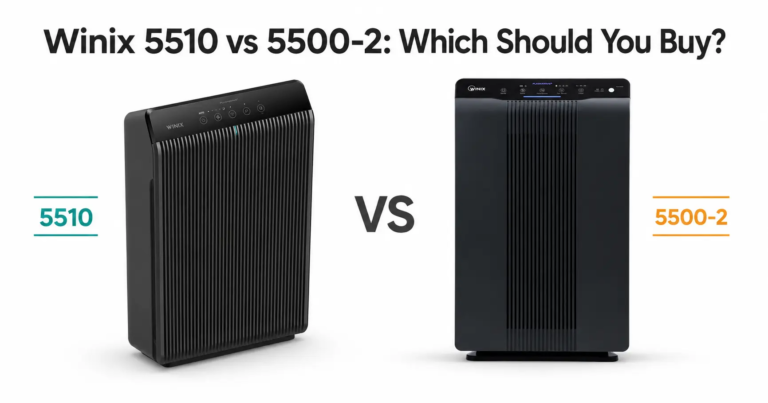
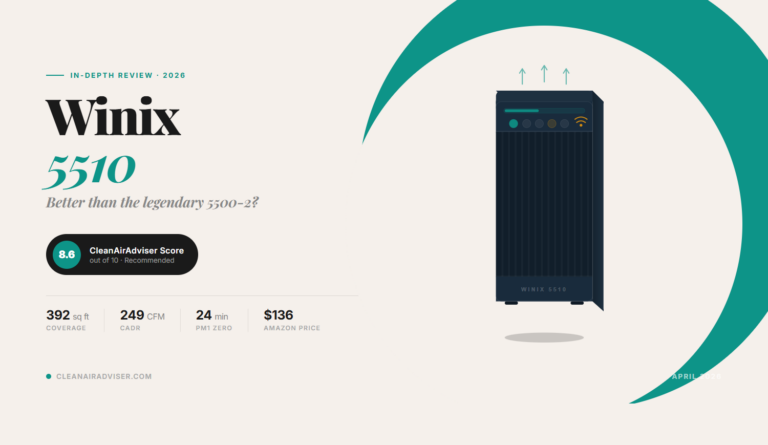
| Winix 5510 | Washable pre-filter and pellet-carbon design | Larger cabinet and optional ionization system |
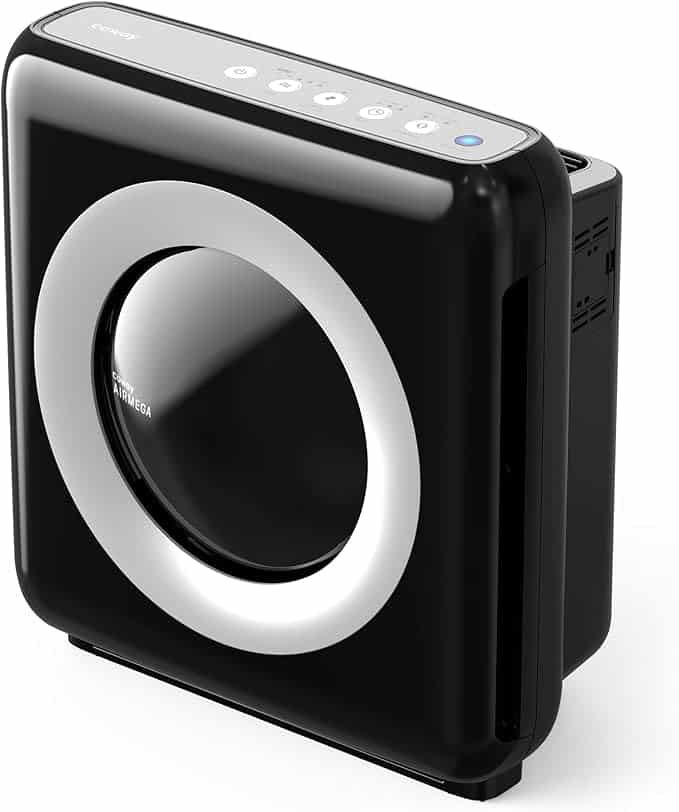
The Core 400S and current Coway AP-1512HH have nearly identical certified smoke CADR, so the decision is about controls, shape, filters, and price rather than a major airflow advantage. The Vital 200S is the easier Levoit to maintain around pets. Winix is appealing when you prefer separate washable parts and more conventional pellet carbon.
Pros and cons
What it does well
- Fast U.S. particle-removal result
- Current ENERGY STAR CADR certification
- Compact footprint
- Useful PM2.5 display and configurable Auto mode
- Good VeSync schedules and history
- No ionizer in the standard model
- Several carbon-filter choices
What to consider
- Maximum speed measured 60.3 dBA
- Bonded pre-filter is awkward to clean
- Potentially high annual filter cost
- Regional versions perform differently
- Sensor measures particles, not gases
- Some owners report high-pitched noise
- Requires 2.4 GHz Wi-Fi for smart setup
levoit core 400s review: final decision
Use this levoit core 400s review guide to match the option to your room, usage, and maintenance needs.
A sound levoit core 400s review decision accounts for real-world fit, ongoing costs, and the limits of the product category.
When comparing choices, keep this levoit core 400s review goal in view rather than relying on a single headline claim.
This levoit core 400s review guide is designed to support a practical choice, not replace source control or the manufacturer instructions that apply to your model.
The Levoit Core 400S is still one of the better smart air purifiers for a medium-size room. Its U.S. version moves particles quickly, the VeSync app offers genuinely useful control, and the PM2.5 display is more informative than a simple colored light. The tradeoff is a bonded cylindrical filter that is awkward to clean and can cost close to $100 per year if replaced every six months.
Our verdict: Buy the Core 400S if you want a compact cylindrical purifier, a numerical PM2.5 display, and app-based schedules. Choose the Levoit Vital 200S if easy pre-filter cleaning matters more. Choose a larger purifier if you need strong cleaning at a quieter fan speed. Do not buy the Core 400S for a marketed one-air-change room size or assume every regional version has the same performance.
Core 400S buying rule
- Buy it: for a room up to about 358 square feet when you want Wi-Fi, schedules, Auto mode, and a live PM2.5 number.
- Buy the Vital 200S instead: for pets, easier maintenance, and a removable washable pre-filter.
- Choose a carbon-heavy filter: if odors matter. The standard filter is not a substitute for deep activated-carbon media.
- Check your region: HouseFresh measured different performance from its U.S. and European units.
Frequently asked questions
Is the Levoit Core 400S worth it in 2026?
Yes for buyers who will use its PM2.5 display, schedules, and app controls. If you only need particle cleaning, compare simpler models and include replacement-filter cost in the decision. Our Core 400S replacement-filter guide compares the Original, Pet, Toxin, and Smoke options using Levoit’s current 12-month maintenance guidance.
What size room can the Core 400S clean?
Use the current 358-square-foot ENERGY STAR rating as a practical upper target for frequent particle removal in a normal room. Larger one-air-change claims describe slower cleaning.
Does the Core 400S produce ozone?
The standard Core 400S is listed by ENERGY STAR as fan-and-filter technology with 0 ppb ozone emissions. Do not confuse it with Levoit’s separate PlasmaPro 400S model, which adds bipolar ionization.
How often should I replace the filter?
HouseFresh models costs using a six-month interval, but actual life depends on pollution, fan speed, hours, pets, and maintenance. Inspect the filter and follow the current manual rather than assuming one date fits every home.
Can it remove smoke and odors?
Its smoke CADR and independent tests show strong smoke-particle removal in a suitable room. Odor and gas removal depends on carbon quantity. The Smoke Remover filter has more carbon than the standard option, but no compact purifier replaces source control and ventilation where safe.
Is the sensor an air-quality monitor?
It is a useful PM2.5 estimate and Auto-mode trigger, not a complete indoor-air monitor. It does not measure carbon dioxide, carbon monoxide, radon, or most gases.
Should pet owners buy the Core 400S?
It can capture airborne dander fragments, but the bonded mesh is less convenient to clean. The Vital 200S is usually the better Levoit choice when pet hair and frequent pre-filter maintenance are priorities.
Final verdict
The U.S. Levoit Core 400S combines strong particle performance with one of the more useful smart-control packages in its class. Its 231-CFM smoke CADR, 24-minute HouseFresh result, compact footprint, and numerical PM2.5 display make it easy to recommend for a medium-size room.
It is not automatically the best value. Maximum speed is loud, the bonded filter creates maintenance and cost compromises, and the European version tested slower. The right buyer wants the app and display enough to accept those tradeoffs.
Buy it for a smart medium-room setup. Buy the Vital 200S for easier pet maintenance. Buy a larger unit when quiet high airflow matters more than floor space.
Sources
- Levoit: Core 400S official product page
- Levoit: product manuals and instructions
- ENERGY STAR: Core 400S certification record
- HouseFresh: independently purchased U.S. and European Core 400S tests
- HouseFresh: air-purifier test methodology
- BBB National Programs: VeSync HEPA advertising claim decision summary
- Reddit r/AirPurifiers: owner discussion of Core 400S filter reminders and cost
- Reddit r/AirPurifiers: owner discussion of high-pitched fan noise