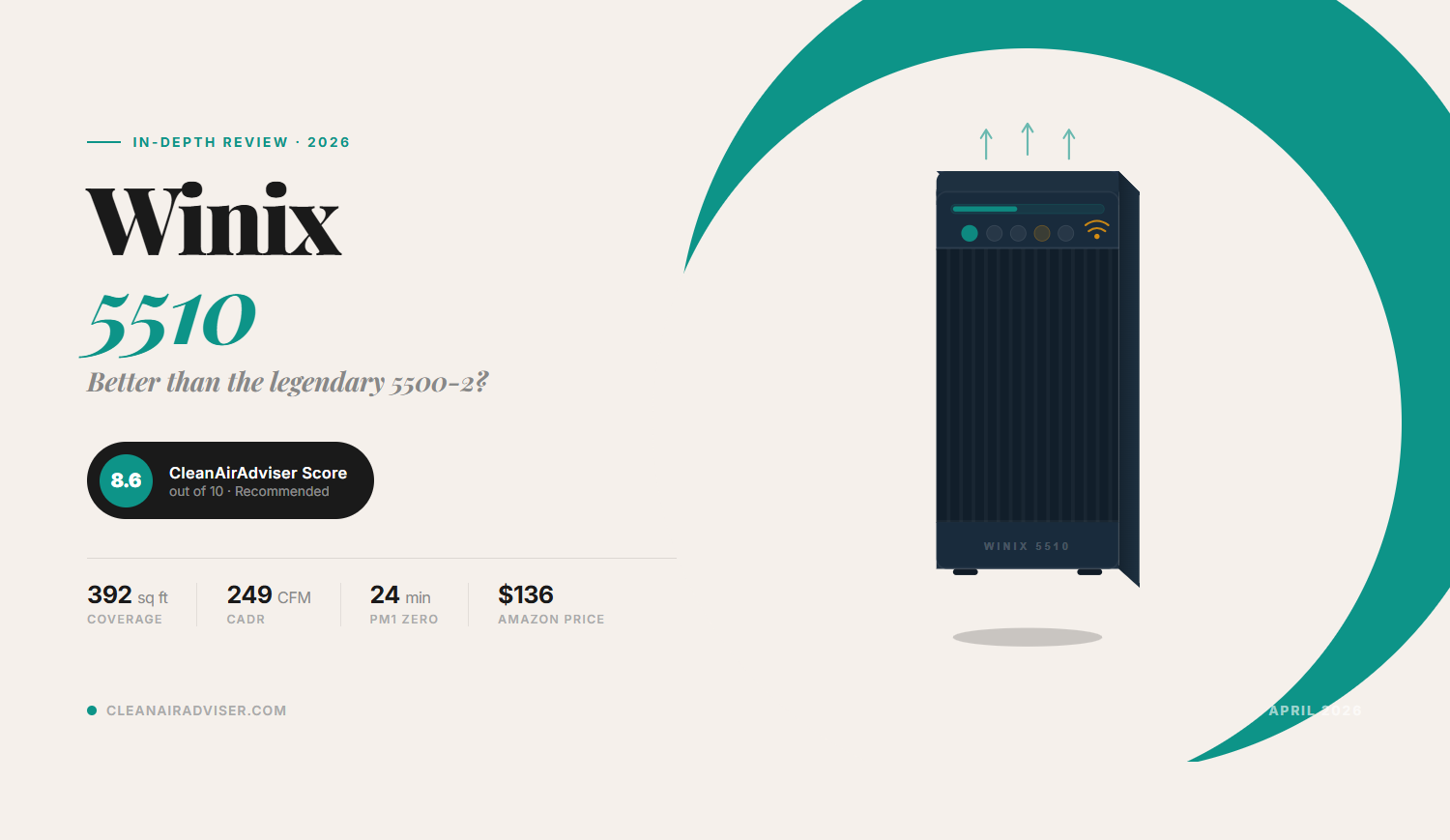
Winix 5510 Review: CADR, Noise and the Real Tradeoffs
Disclosure: Clean Air Adviser may earn a commission when you buy through links on this page. This does not change what you pay. We have not physically tested the Winix 5510. This review separates official specifications, independent test results, and owner reports so you can see where each conclusion comes from.
Quick answer: This winix 5510 review guide highlights the evidence, practical fit, and buying limits that matter before you decide.
Winix 5510 specifications: the verified numbers
| Specification | Verified detail | Why it matters |
|---|---|---|
| Smoke CADR | 253 cfm | The key sizing figure for fine smoke particles |
| Dust / pollen CADR | 252 / 247 cfm | ENERGY STAR certified values |
| Verified room size | 392 sq. ft. | Winix and ENERGY STAR current rating |
| HouseFresh PM1 CADR | 248 to 249 cfm at top speed | Independent result closely matches certification |
| HouseFresh quiet CADR | 125 cfm below 45 dBA | Shows the performance cost of quieter operation |
| Noise | 35.2 dBA Sleep to 67.2 dBA top speed | Independent measurements from three feet away |
| Filter system | Washable pre-filter, AOC carbon, True HEPA | Three separate physical layers plus optional PlasmaWave |
| Replacement filter | Filter Q, SKU 1712-0123-00 | Used by 5510 and 5520, not older 5500-2 |
| Filter interval | About 12 months | Environment can shorten the interval |
| Fan modes | Low, medium, high, turbo, Auto and Sleep | Auto uses air-quality and light inputs |
| Connectivity | Wi-Fi and Winix Smart app | Remote control and scheduling without a handheld remote |
| Dimensions | 13.59 x 8.27 x 22.17 inches | Current manual dimensions |
| Weight | 13.3 lb | Manageable, with a rear carrying handle |
| Rated power | 65 W | Actual draw depends on speed and features |
| Warranty | Two years | Valid in the USA and Canada under the manual terms |
These are current figures for the 5510 and its Filter Q set. The earliest stand-alone manual listed 380 square feet, but the newer combined 5510/5520 manual and ENERGY STAR certification list 392 square feet. Use the current documents for a new purchase.
Independent performance: fast on turbo, less impressive when quiet
ENERGY STAR and AHAM-style CADR
ENERGY STAR’s certification record lists 253 cfm smoke, 252 dust, and 247 pollen CADR. The small spread is useful: the 5510 delivers similar clean-air volume across the three particle test ranges instead of having one unusually weak category.
The 392-square-foot rating is a sensible medium-room target. AHAM’s two-thirds sizing rule also points in the same direction: a smoke CADR of 253 cfm supports roughly 380 square feet with an eight-foot ceiling. For wildfire smoke, AHAM recommends a more demanding smoke CADR close to the room area, which makes about 250 square feet the conservative target.
The advertised “up to 1,881 square feet in one hour” figure seen on retail listings represents roughly one air change per hour. One pass per hour is not equivalent to the repeated cleaning usually wanted for smoke, pollen, or respiratory particles. A 5510 belongs in one open room, not as the only purifier for several closed bedrooms.
HouseFresh: 24 minutes to PM1 zero
HouseFresh bought a 5510 and tested it in a 728-cubic-foot chamber filled with incense smoke. On top speed with PlasmaWave enabled, the monitor reached PM1 zero in 24 minutes. HouseFresh estimated 249 cfm from that run, nearly identical to the certified CADR.
The quiet-speed result changes the buying decision. Speed 2 produced 40.8 dBA and took 47 minutes in the same room, for an estimated 125 cfm below the site’s 45 dBA limit. That is roughly half the top-speed delivery. The 5510 remains useful when quiet, but its effective room size should be reduced.
| HouseFresh setting | Measured sound | What to expect |
|---|---|---|
| Sleep | 35.2 dBA | Low disturbance, lowest airflow |
| Speed 1 | 36.8 dBA | Background maintenance in a small room |
| Speed 2 | 40.8 dBA | 125 cfm estimate and reasonable daily-use balance |
| Speed 3 | 51.6 dBA | More cleaning, clearly audible |
| Turbo | 67.2 dBA | About 249 cfm, but difficult to ignore |
HouseFresh measured top-speed power around 53 to 54 watts rather than the manual’s 65-watt nameplate rating. At low and medium speeds it measured much less. Electricity cost therefore depends far more on the speed you actually use than on a single annual estimate.
TechGearLab: strong cleaning with high upkeep
TechGearLab ranked the 5510 highly for air-cleaning performance and reported that its test space was 99 percent clean after 32 minutes. Its review also praised the pellet carbon for odor and gas performance compared with thin carbon-coated sheets. The weaker categories were noise and operating cost.
Different test rooms and instruments mean the HouseFresh and TechGearLab times should not be compared minute for minute. Their shared conclusion is more important: top-speed cleaning is strong, high speed is loud, and annual filters are a meaningful cost.
The filter system: what each layer does
Washable fine-mesh pre-filter
The pre-filter catches hair, lint, and larger dust before it reaches the more expensive filters. The current manual says to clean it about every three months and identifies it as permanent. Check it more often if pet hair or visible dust builds quickly, but do not invent a rigid monthly replacement schedule.
Vacuum gently for routine cleaning. If you wash it, reinstall it only after it is completely dry. The pre-filter does not replace normal vacuuming because it catches only material drawn into the machine.
AOC pellet-carbon filter
The carbon layer uses pellets rather than a thin black coating. HouseFresh says Winix confirmed 226 grams of carbon in its unit. That is more substantial than the light carbon sheets found in many similarly priced purifiers, and the separate layer can be removed independently of the HEPA filter.
It is still not a deep carbon canister for industrial solvents, severe chemical exposure, or continuous tobacco smoke. Carbon capacity depends on the gas, concentration, humidity, airflow, and how long the source remains. Use exhaust and source removal first.
The 5510 carbon filter is not washable. Rinsing carbon pellets can damage the assembly and does not restore adsorption capacity. This is an important difference from the older 5500-2 instructions.
True HEPA filter
Winix markets 99.99 percent capture of particles as small as 0.01 microns. That is a media-efficiency claim, not a room-clearance rate. CADR tells you how much cleaned air the complete machine delivers and is the better tool for room sizing.
The current manual pairs the HEPA and AOC carbon stages in the annual Filter Q set. It says replacement frequency can vary with the environment. Replace when the indicator and condition call for it, and reset the filter-life reminder by holding the reset button for at least ten seconds after installing the new set.
Our Winix 5510 Filter Q guide covers the part number, fit checks, replacement steps, and what not to wash. For the broader timing logic, see how often to replace an air purifier filter.
Auto mode and the dark-room problem
The 5510 uses an air-quality sensor to change fan speed in Auto mode and a light sensor to trigger Sleep mode when the room darkens. Winix says Auto uses low speed when air quality is good, medium when fair, and high when poor. When the light sensor detects darkness, the unit reduces fan speed and dims the indicators.
Older versions of this article called Sleep mode “near-zero air cleaning.” That was overstated. Air still passes through the filters, but at the lowest airflow. The practical problem is that pollution can rise overnight while the light sensor keeps the fan quiet.
If you want more airflow while sleeping, select a manual speed before turning off the lights. HouseFresh’s speed-2 measurement gives a useful compromise at 40.8 dBA. Test it in your room during the return period because tolerance for fan noise is personal.
The air-quality light should also be interpreted correctly. HouseFresh identifies a gas sensor plus a light sensor, not a calibrated particle display. Cooking odor may trigger it while some particle events do not. The color is a control input and trend indicator, not a replacement for a separate PM2.5 monitor.
Wi-Fi and app controls
The Winix Smart app lets owners control the unit remotely. HouseFresh found the app clean and easy to use but less feature-rich than mature systems from Levoit and Xiaomi. It is useful for changing speed from another room and setting schedules without a physical remote.
Connection problems in owner reviews are usually more relevant than a long feature list. Set the purifier near the router for initial pairing, confirm the phone is on a supported network, and follow the current Wi-Fi setup guide. If you do not want a connected appliance, all essential cleaning controls remain on the top panel.
Voice-assistant support is not described consistently across current 5510 retail pages, regional app pages, and newer related models. We would not buy the 5510 solely for Alexa or Google Home without checking the current Winix listing for the exact unit and app region.
PlasmaWave: optional, certified, and easy to turn off
PlasmaWave is Winix’s optional ion-generation stage. It is separate from the three physical filters and can be disabled from the control panel. Particle filtration continues through the pre-filter, carbon, and HEPA media when PlasmaWave is off.
Two current records matter. California lists the 5510 as an electronic air cleaner that meets the state’s 0.050 ppm ozone limit. ENERGY STAR’s certification record reports 0.0 ppb ozone emissions for the tested model. That is stronger evidence than unsourced claims that the 5510 produces approximately 0.01 ppm.
Certification is not a medical recommendation. Anyone who prefers a filter-only setup can switch PlasmaWave off. If a clinician has given you specific indoor-air guidance, follow that advice rather than a product-review rule.
Winix 5510 versus 5500-2 and 5520
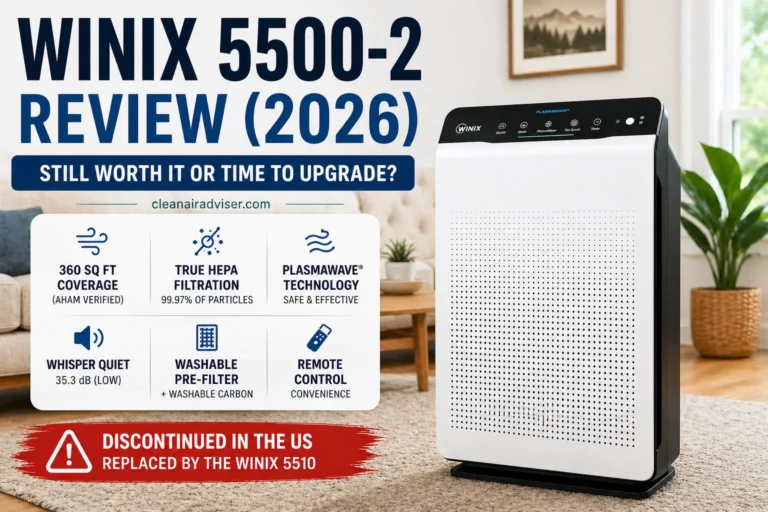
The 5510 and discontinued 5500-2 share the general Winix formula, but their filters and controls are not interchangeable. The 5510 adds Wi-Fi and a narrower body. Its certified smoke CADR is 253 cfm versus 232 cfm for the older 5500-2, but HouseFresh found the 5510 much louder at top speed. Filter Q is smaller than the old Filter A set, and its carbon layer is not washable.
If you already own a working 5500-2, there is little reason to replace it just to gain 21 cfm and app control. If choosing a current model, the 5510 has better availability and certified performance. Our Winix 5510 versus 5500-2 comparison lays out the filter and control differences.
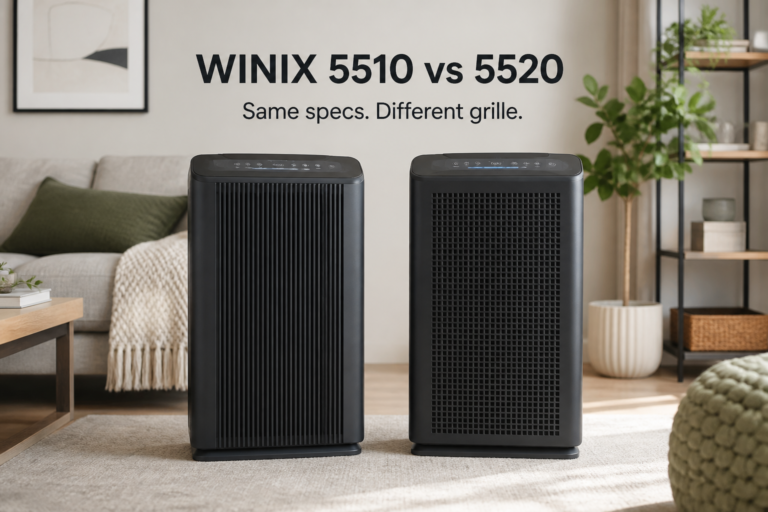
The 5510 and 5520 are certified together, use the same Filter Q, and have the same 392-square-foot rating and CADR values. Treat them as closely related variants and choose by verified listing, color, bundle, and price. Do not pay extra for what is mainly a cosmetic difference without checking the exact listing and bundle.
Better alternatives for specific priorities
| Priority | Consider | Why |
|---|---|---|
| Best 5510 strength | Winix 5510 | High certified CADR, pellet carbon, washable pre-filter, app control |
| Quieter high-speed operation | Coway AP-1512HH | Older but proven medium-room design without a required app |
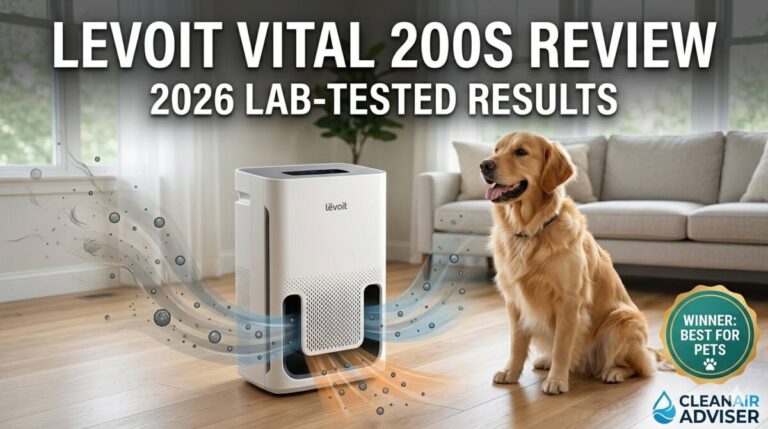
| Pet-focused intake and no ionizer | Levoit Vital 200S | Washable removable pre-filter and U-shaped pet inlet |
| Keep an existing purifier | Winix 5500-2 | No upgrade needed if it works and Filter A remains available |
See our Coway AP-1512HH review and Levoit Vital 200S review for the full tradeoffs.
What owner discussions add
Reddit threads and retailer reviews do not measure CADR, but they reveal repeated questions that lab tests miss. Owners like the compact shape, high airflow, washable pre-filter, and the ability to control the unit from a phone. Pet owners often appreciate that the carbon stage is a separate pellet tray.
The recurring complaints are the annual Filter Q price, loud turbo speed, the automatic drop to Sleep mode in darkness, and the need to disable PlasmaWave again after some power interruptions. Some users also expect the odor sensor to respond to visible dust or smoke particles in the same way as a PM sensor. It is not designed to provide a numeric PM reading.
Odor experiences vary. Pellet carbon gives the 5510 a better starting point than a thin carbon sheet, but one owner’s litter-box success does not guarantee control of another home’s smoke or chemical source. Carbon is finite and ventilation conditions differ.
Running cost without stale price guesses
The reliable recurring item is Filter Q, which the manual rates for about 12 months. Retail prices and electricity rates change, so use a formula instead of a fixed annual number:
Annual cost = Filter Q price + electricity used at your actual speed and local rate
Electricity cost = watts divided by 1,000 x hours used x price per kWh
HouseFresh measured about 54 watts on turbo, 15.7 watts on speed 3, 6.6 watts on speed 2, and 4.6 watts on speed 1. A purifier left on a moderate speed can therefore use far less electricity than one assumed to run at nameplate power all year. The annual filter set is likely to be the larger predictable expense.
winix 5510 review: final decision
Use this winix 5510 review guide to match the option to your room, usage, and maintenance needs.
A sound winix 5510 review decision accounts for real-world fit, ongoing costs, and the limits of the product category.
When comparing choices, keep this winix 5510 review goal in view rather than relying on a single headline claim.
This winix 5510 review guide is designed to support a practical choice, not replace source control or the manufacturer instructions that apply to your model.
Quick verdict: The Winix 5510 is a strong-value purifier for a medium room when you want high particle-cleaning power, a separate pellet-carbon filter, washable pre-filter, and phone control. ENERGY STAR certifies it at 253 cfm for smoke, 252 for dust, and 247 for pollen, with a 392-square-foot room rating. HouseFresh independently estimated 249 cfm for PM1, which closely supports the certified figures.
It is not a perfect successor to the 5500-2. The 5510 is more compact and adds Wi-Fi, but HouseFresh measured a loud 67.2 dBA at top speed and only 125 cfm below 45 dBA. Its light sensor also reduces fan speed when the room goes dark in Auto mode. Buy it for powerful daytime or manually controlled cleaning, not for silent maximum airflow.
Is the Winix 5510 right for you?
- Yes: your room is up to about 390 square feet, high CADR matters, and you will use medium or turbo when pollution rises.
- Compare first: you need very quiet high airflow, dislike automatic Sleep mode, or want the cheapest annual filter.
- PlasmaWave is optional: you can turn the ion generator off and still use the pre-filter, carbon, and HEPA stages.
Frequently asked questions
Is the Winix 5510 worth buying?
Yes, if you want roughly 250 cfm of certified particle cleaning, pellet carbon, a washable pre-filter, and app control in a medium room. Compare alternatives if quiet high airflow or low filter cost matters more.
What room size is the Winix 5510 for?
Winix and ENERGY STAR list 392 square feet. HouseFresh’s top-speed result supports a similar area. For wildfire smoke, about 250 square feet is the more conservative target based on AHAM’s smoke-sizing guidance.
Does the 5510 detect particles?
Its Auto mode uses an air-quality sensor described by HouseFresh as a gas sensor, plus a light sensor. It does not display a numeric PM2.5 concentration. Use a separate particle monitor if numeric PM data matters.
Can PlasmaWave be turned off?
Yes. The three physical filters continue working. ENERGY STAR reports 0.0 ppb ozone emissions for the certified test model, and CARB lists the 5510 as meeting its electronic-air-cleaner limit.
Is Filter Q washable?
No. Only the pre-filter is washable. Replace the AOC carbon and True HEPA filters as a Filter Q set at about 12 months or when condition and the indicator call for it.
Why does the fan slow down when the lights go out?
In Auto mode, the light sensor triggers Sleep mode in darkness. Choose a manual fan speed if you want steady overnight airflow.
Does the 5510 use the same filter as the 5500-2?
No. The 5510 and 5520 use Filter Q, SKU 1712-0123-00. The 5500-2 uses the larger Filter A set.
Final verdict
The Winix 5510 earns its place on a medium-room shortlist because the numbers agree. ENERGY STAR certifies about 250 cfm across smoke, dust, and pollen, while HouseFresh independently estimated 249 cfm. The pellet-carbon layer, washable pre-filter, and Wi-Fi controls add practical value.
The catch is not cleaning ability. It is how you will run it. Turbo is loud, quiet-mode CADR is about half as high, and darkness pushes Auto mode into low-speed Sleep operation. Size it for the speed you can tolerate, budget for Filter Q, and decide whether you want PlasmaWave on or off. With those expectations, the 5510 is a strong current replacement for buyers who can no longer find the 5500-2.
Sources
- Winix America: current 5510 and 5520 user manual
- ENERGY STAR: Winix 5510 certification record
- AHAM Verifide: CADR and room-sizing guidance
- HouseFresh: Winix 5510 independent test
- TechGearLab: Winix 5510 tested review
- California Air Resources Board: certified air-cleaning devices
- Reddit r/AirPurifiers: 5510 bedroom sizing discussion
- Reddit r/HouseFresh: 5510 sensor and smoke discussion
- Reddit r/AirPurifiers: disabling PlasmaWave discussion
For a side-by-side buying rule and the shared-filter details, see our Winix 5510 vs 5520 comparison.