Air Purifier for Dog Dander and Allergies (2026)-Best Picks
Disclosure: CleanAirAdviser.com is a participant in the Amazon Associates Program. If you purchase through our links, we may earn a small commission at no extra cost to you. This helps us continue researching and reviewing air purifiers. Our opinions are our own. Read how we review.
If you’re searching for the best air purifier for dog dander, you’ve probably already learned that dog hair isn’t actually what’s triggering your allergies — and most buying guides skip the one detail that determines whether your purifier will actually work in a dog household. This guide covers the real allergen, the 1.5× CADR sizing rule for dog homes, and the separate-versus-bonded filter decision that decides your annual running cost. Five picks at the end, each chosen for a different scenario.
Picks below are based on independent lab data from HouseFresh, RTINGS, AirPurifierFirst, and Tom’s Guide, AHAM-verified CADR ratings, and aggregated owner sentiment from Amazon and Reddit r/AirPurifiers. We don’t physically test units — we synthesize the data from labs that do, and check it against what real dog owners actually report. For a deeper breakdown of HEPA grades, H13 vs H14 differences, and how to evaluate filtration quality across brands, read our post: Best HEPA Air Purifier Buying Guide 2026.
Who this guide is NOT for: If your main issue is dog hair on furniture, carpets, or clothing, an air purifier won’t solve that — you need a vacuum (we recommend HEPA-filtered for allergy households). Air purifiers target airborne allergens only. If you also have heavy odor or visible airborne dander, a purifier paired with vacuuming and weekly bathing is the actual fix.
Table of Contents
Quick Picks — Best Air Purifiers for Dog Allergies (2026)
If you want the short version, here’s the recommendation list. Each pick targets a different dog-household scenario.
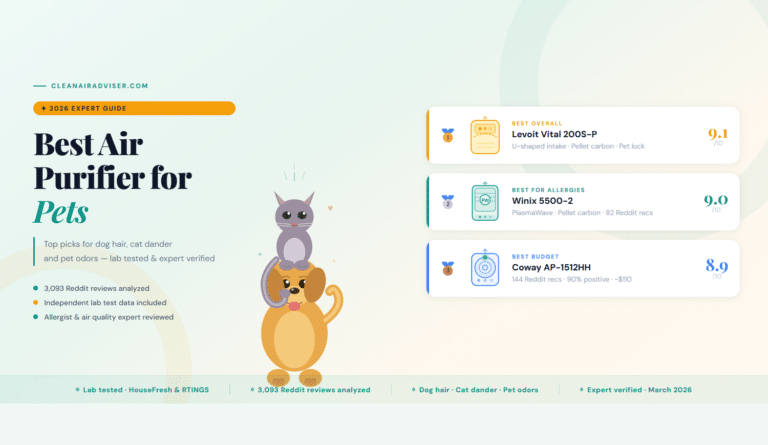
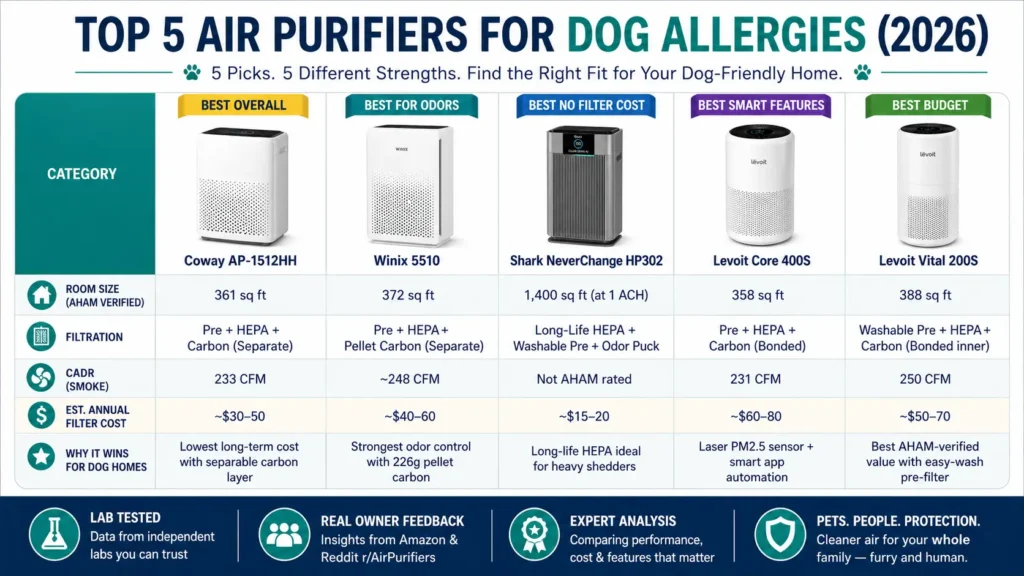
- Coway AP-1512HH: Best overall for lowest long-term filter cost in dog households.
- Winix 5510: Best for strong dog odors thanks to 226g of pelleted carbon.
- Shark NeverChange HP302: Best for heavy shedders and minimal filter maintenance.
- Levoit Core 400S: Best for smart features and laser PM2.5 sensor responsiveness.
- Levoit Vital 200S: Best budget pick — 388 sq ft AHAM-verified with an easy-wash pop-off pre-filter.
| Best For | Pick | Why It Wins | Price |
|---|---|---|---|
| Best Overall | Coway AP-1512HH | Separate carbon layer = lower long-term cost in dog homes | ~$229 |
| Best for Heavy Odors | Winix 5510 | 226g pellet carbon outlasts fibrous carbon for dog smell | ~$180 |
| Best No Filter Cost | Shark NeverChange HP302 | Permanent HEPA + washable pre-filter for heavy shedders | ~$399 |
| Best Smart Features | Levoit Core 400S | Laser PM2.5 sensor responds faster to dander spikes | ~$182 |
| Best Budget | Levoit Vital 200S | 388 sq ft AHAM-verified at the lowest entry price | ~$190 |
For broader pet coverage including cats, rabbits, and multi-pet households, see our guide: Best Air Purifier for Pets. For cat-specific allergy coverage, see our Best Air Purifier for Cat Allergies guide — cats produce a different allergen (Fel d 1) that’s smaller and stickier than dog dander.
Why Dog Dander Is the Real Problem (Not Dog Hair)
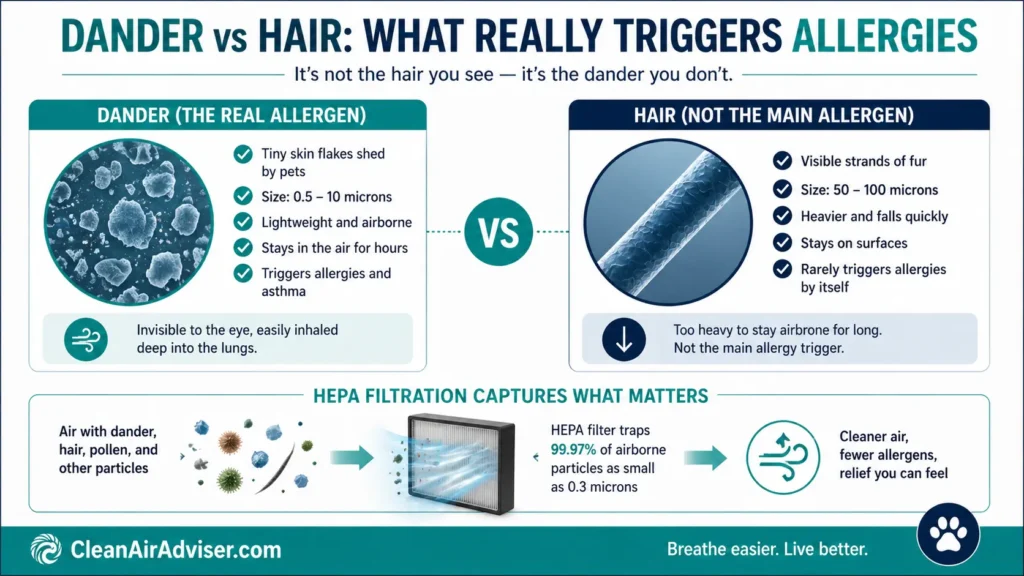
The single biggest misunderstanding in this category: most people buy an air purifier for dog dander thinking it captures dog hair. Hair isn’t the allergen. The allergen is Can f 1 — a salivary lipocalin protein produced primarily in your dog’s tongue epithelial tissue and salivary glands, secreted onto fur during grooming, then dried and shed into the air on microscopic skin flakes called dander. Per peer-reviewed research (Konieczny et al., 1997; Thermo Fisher allergen database), Can f 1 is a “major allergen” — approximately 50–70% of dog-allergic patients have IgE antibodies that react to it. Per the ACAAI and EPA, dander particles measure 2 to 10 microns — small enough to remain airborne for hours and pass through standard furnace filters.
What most guides miss: a meaningful fraction of airborne dog allergen rides on much smaller particles. Custis et al. (1997) found that approximately 20% of airborne Can f 1 is associated with particles under 5 microns — particles small enough to penetrate deep into the lower airways and trigger asthma symptoms. This is why HEPA filtration matters for dog allergies even though dander itself is “2 to 10 microns”: the inhalable fragment that drives respiratory symptoms is smaller than the visible dander, and HEPA’s 0.3-micron capture rating is what actually matters.
Dog hair is too large and heavy to trigger allergic reactions directly. It settles on furniture and carpets within minutes. Hair itself isn’t an allergen — it acts as a carrier, transporting dander, saliva proteins, and outdoor allergens like pollen into your home. This distinction matters when choosing a purifier:
- The pre-filter handles hair — it should be washable and easy to clean, since dog hair clogs it fast.
- HEPA-grade filtration handles dander — typically rated at 99.97% efficiency at 0.3 microns per EPA guidance, well within range to capture dog dander at 2–10 microns.
- The carbon filter handles dog odor — a separate problem from dander, with separate physics.
So when shopping for an air purifier for dog dander, all three layers matter — but HEPA is what determines whether your symptoms actually improve. For a deeper explanation of how HEPA filtration works against airborne allergens, see our pillar guide: Do Air Purifiers Actually Work?
Do Air Purifiers Actually Help With Dog Allergies?
Short answer: yes, with caveats. The longer answer matters because expectations affect satisfaction with any air purifier for dog dander.
The American College of Allergy, Asthma & Immunology (ACAAI) explicitly recommends HEPA-filtered air purifiers as part of a pet allergy management strategy, citing the EPA standard that True HEPA filters capture 99.97% of particles at 0.3 microns. Important nuance worth knowing: ACAAI notes HEPA is “very helpful” for cat allergy specifically, and “a little bit less so” for dog allergy — but still effective. Dog dander at 2–10 microns falls comfortably within HEPA’s capture range. The American Lung Association similarly recommends HEPA filtration for households with allergy and asthma sufferers, with one critical warning we’ll cover below: avoid ionizers and ozone generators.
Independent lab testing from HouseFresh and RTINGS shows quality HEPA purifiers can rapidly reduce airborne fine particles in correctly sized rooms — typically reaching PM1 zero within 30–60 minutes. Because airborne dog allergens attach to particle fractions that HEPA can capture, this supports their use for dog dander, though most labs test particle reduction (PM2.5/PM1) rather than dog dander concentrations directly. “Correctly sized” is doing a lot of work in that sentence — get the sizing wrong and your particle-reduction numbers crater regardless of filter quality. (We’ll cover the 1.5× CADR rule below.)
Peer-reviewed clinical evidence backs this up. Sublett (2011, Current Allergy and Asthma Reports) concluded that HEPA portable room air cleaners provide significant benefit in allergic respiratory diseases by lowering indoor PM2.5 and allergen concentrations. Kang et al. (2020) demonstrated that HEPA use significantly reduced medication requirements for allergic rhinitis patients. Most importantly for dog households: a controlled 1999 trial in asthmatic children sensitized to pet allergens found that HEPA air cleaners in living rooms and bedrooms improved airway hyperresponsiveness and peak-flow amplitude — even though floor-dust allergen levels did not change. This is the strongest possible evidence that purifiers help by reducing the airborne allergen fraction specifically, independent of settled dander.
One critical warning from the ACAAI applies specifically to ionic and electrostatic air cleaners — the kind sometimes marketed alongside HEPA units. The ACAAI states ionic cleaners don’t remove all the particles from the air
, and the ozone byproduct is a known irritant
. For dog allergy sufferers, especially those with asthma or COPD, this means avoiding ionizer-only units entirely. Hybrid units like the Coway AP-1512HH and Winix 5510 include optional ionizers that can (and should) be toggled off — both default to ionizer-on, so verify after unboxing.
What air purifiers can’t do is remove dander already settled on carpets, furniture, or bedding — that’s a vacuum’s job (ideally HEPA-filtered). Air purifiers handle the airborne fraction (typically 30–50% of total dander load) continuously. The combination of filtration plus regular cleaning produces meaningful symptom relief, not air filtration alone.
What to Look for in an Air Purifier for Dog Dander
Five features matter for dog households. Get these right and any of our top picks will work. Get them wrong and even the best air purifier for dog dander will underperform.
1. True HEPA filtration — non-negotiable
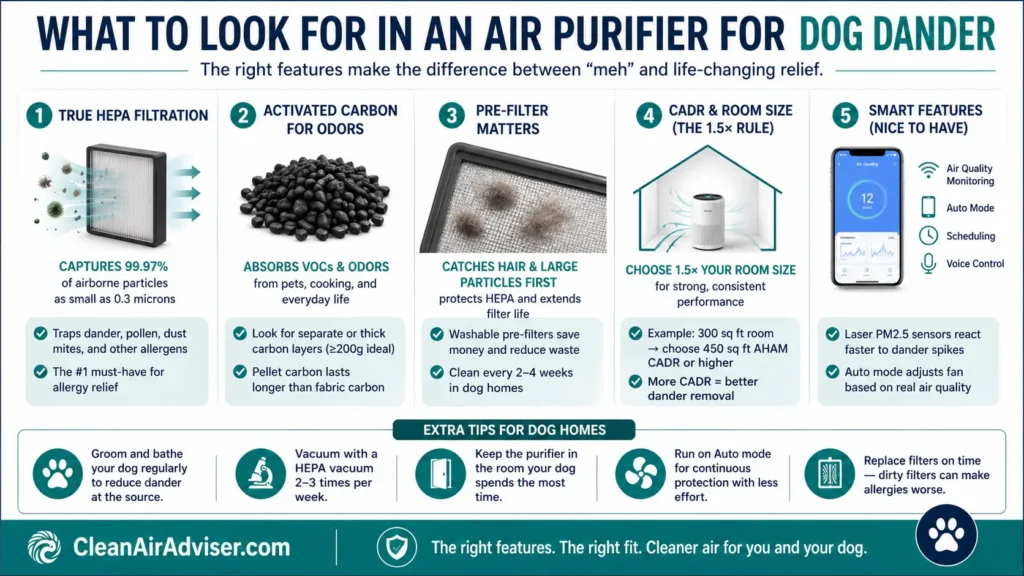
“True HEPA” generally means filtration designed to capture 99.97% of particles at 0.3 microns — though the term itself is a marketing label, not a regulated certification. Avoid units labeled “HEPA-type” or “HEPA-like” — these are uncertified and may capture only 85–90%, which makes a real difference in symptom relief for sensitive allergy sufferers. All five picks use high-efficiency particle filtration suitable for airborne dog dander; where certification language varies by model, we rely on manufacturer specifications and independent performance data from labs like HouseFresh and RTINGS.
2. Separate vs bonded filter design — the dog-household cost factor
This is the most under-discussed buying decision for dog owners. Dogs create two filtration problems: airborne dander (HEPA layer captures) and odor and VOCs (carbon layer adsorbs). These layers saturate at different rates. In a heavy dog home, carbon typically saturates in 3–4 months while HEPA still has 6–8 months of life left.
- Separate-layer purifiers (Coway AP-1512HH, Winix 5510): replace just the carbon when odors return — typically $15–25 — without discarding the still-functional HEPA. Lower annual cost.
- Bonded-filter purifiers (Levoit Core 400S, Vital 200S): replace the entire 3-in-1 filter together when carbon saturates — $40–50 — including HEPA media that may have months of life left. Higher annual cost.
Over a 5-year ownership window in a dog household, this design difference can mean a $150–250 cost gap. For full filter replacement schedules, see our guide: How Often Should You Replace Your Air Purifier Filter?
3. The 1.5× CADR sizing rule — most guides skip this
AHAM’s official sizing standard is the “Two-Thirds Rule”: your air purifier’s CADR (smoke rating) should be at least 2/3 of your room’s square footage. So a 300 sq ft room needs a CADR of at least 200 CFM. That works for typical homes — but in pet households, independent air-quality experts and the r/AirPurifiers enthusiast community recommend going further: oversize to a 1-to-1 or 1.5× CADR-to-square-footage ratio to keep up with continuous dander production. So a 300 sq ft bedroom with one large dog ideally needs a purifier rated for 300+ sq ft — or, more safely, 450 sq ft — at the standard 4.8 ACH.
Why oversize: standard CADR ratings assume 4.8 air changes per hour. High-allergen environments benefit from 6+ ACH for meaningful symptom relief. Buying a purifier matched exactly to your room size in a dog household typically results in disappointment — owners report “it doesn’t work” when really it’s working at the wrong rate. This sizing nuance alone explains why many cheap purifiers underperform for allergy sufferers despite legitimate HEPA filtration.
4. Pre-filter for hair capture
A washable pre-filter dramatically extends HEPA life in heavy-shedding homes. Without one, dog hair collects directly on the HEPA filter, blocking airflow and forcing premature replacement. The Coway, Winix 5510, and Shark NeverChange all have washable pre-filters that pop off for cleaning. Some bonded-filter Levoit models (like the Core 400S) make pre-filter cleaning less convenient — you can vacuum the outer mesh but the carbon and HEPA layers are bonded into a single replaceable unit. The Vital 200S is an exception: it has an easy-access washable pre-filter that pops off the front for rinsing, even though the inner carbon+HEPA layers are bonded.
5. Activated carbon for dog odors
Carbon density and form matter. Pelleted carbon (Winix 5510 has 226g) lasts significantly longer than fibrous carbon-coated mesh in cheaper alternatives. For households with persistent dog smell — wet dog, accident-prone puppies, multi-dog homes — pelleted carbon is the meaningful upgrade.
Best Air Purifier for Dog Dander and Hair — Full Picks
Here are the five picks in detail, each scored against the criteria above with verified specs and the honest trade-offs every dog owner should know before buying.
1. Coway AP-1512HH — Best Overall for Dog Households
Coverage: 361 sq ft | CADR: 246 dust / 240 pollen / 233 smoke (AHAM verified) | Filter: Separate HEPA + carbon | Price: ~$229
Best for: dog owners who want the lowest long-term running cost without compromising filtration quality.
The Coway AP-1512HH (also known as the Coway Mighty) wins our top pick for dog households because of its separate-layer filter design. When dog odors saturate the carbon at 4–6 months, you replace just the $15–20 carbon filter — keeping the HEPA running until it’s actually spent. Over a 5-year window in a single-dog home, this typically saves $150–200 versus bonded-filter alternatives.
The unit’s washable pre-filter catches the bulk of dog hair before it reaches the HEPA layer. HouseFresh’s lab testing shows the AP-1512HH reaching PM1 zero in 29 minutes (ionizer disabled) — competitive with units twice the price. AHAM-verified CADR (rare among budget purifiers) and the long-running Wirecutter “best overall” recommendation back its industry-wide consensus.
Honest trade-offs: includes an optional ionizer that can be toggled off (recommended for sensitive users). No app or smart features. For our full breakdown, see: Coway AP-1512HH Review.
2. Winix 5510 — Best for Heavy Dog Odors
Coverage: Up to 372 sq ft | Performance: ~248 CFM equivalent airflow in independent testing (HouseFresh) | Filter: Separate HEPA + 226g pellet carbon | Price: ~$180
Best for: multi-dog homes, kennel-style households, or any dog owner where odor is the primary concern.
If your dog complaint is more about smell than dander — wet dog after baths, accident-prone puppies, persistent kennel odors — the Winix 5510 is the meaningful upgrade. Its activated carbon layer contains 226 grams of pelleted carbon, which adsorbs gas-phase odors more effectively and for longer than fibrous carbon-coated mesh used in most budget alternatives. Frequently recommended by long-term users on Reddit r/AirPurifiers as a strong choice for dog odor control.
The 5510 also includes PlasmaWave technology — Winix’s bipolar ionization that breaks down VOCs at the molecular level. Like Coway’s ionizer, this is optional and can be toggled off. PlasmaWave is CARB-certified, producing ozone well below regulatory limits.
Honest trade-offs: louder at higher fan speeds than the Coway (60 dB vs 53 dB on max). Slightly higher up-front price. No app or smart features. For the full review, see: Winix 5510 Review.
3. Shark NeverChange HP302 — Best for No Filter Cost
Coverage: Up to 1,400 sq ft (at 1 ACH) | Filter: Permanent HEPA (5-year rated) + washable Debris Defense pre-filter + replaceable Odor Neutralizer | Price: ~$399
Best for: heavy-shedding breeds (Golden Retrievers, Huskies, Labradors), large open-plan living rooms, and dog owners who want zero ongoing HEPA replacement cost.
The Shark NeverChange uses a long-life HEPA filter system marketed by Shark as lasting up to 5 years under normal use, assuming regular pre-filter maintenance — no replacement needed during typical ownership. For heavy-shedding dog breeds, this is the most cost-efficient option on the market. The washable pre-filter catches the bulk of dog hair before it reaches HEPA — rinse it monthly. The only ongoing cost is the Odor Neutralizer puck (every 6–12 months, $15–20).
The 1,400 sq ft coverage rating also makes it the largest unit on this list — important if you have a Golden Retriever–sized dog in a 300+ sq ft living room and need the 1.5× CADR rule covered without buying two units. Reddit owners consistently praise the Shark for hair specifically — pre-filter design captures dog hair effectively before it can reduce HEPA airflow.
Honest trade-offs: Shark’s “5-year filter life” claim assumes the washable pre-filter is maintained on schedule — neglect that and effective HEPA life drops significantly. Carbon filtration is via Odor Neutralizer puck rather than dedicated carbon layer, so it’s less effective on heavy ongoing odor than the Winix 5510. For our full review, see: Shark NeverChange HP302 Review.
4. Levoit Core 400S — Best Smart Features for Dog Owners
Coverage: 358 sq ft (current 400S-P) | CADR: 231 CFM smoke (AHAM) | Filter: Bonded 3-in-1 | Price: ~$182 (currently 17% off)
Best for: smart home users who want app control and the ability to monitor air quality remotely while at work.
The Levoit Core 400S is the smart-feature pick for dog owners. Its AirSight Plus laser PM2.5 sensor is meaningfully more sensitive than optical sensors in cheaper units — auto mode ramps up within seconds when your dog enters the room, rather than minutes after dander has accumulated. The VeSync app lets you check air quality remotely, schedule on/off times, and integrate with Alexa or Google Assistant.
Levoit also offers a dedicated Pet Allergy filter variant (Yellow, Core 400S-RF-PA) optimized for dander and pet odors with higher carbon content than the standard filter.
Honest trade-offs: the bonded 3-in-1 filter design means higher long-term cost in dog households than the Coway or Winix — you replace the entire $50 filter every 6–8 months in heavy-shedding homes, even when HEPA still has life left. Wi-Fi setup requires 2.4GHz network. For full details: Levoit Core 400S Review.
5. Levoit Vital 200S — Best Budget for Dog Households
Coverage: 388 sq ft at 4.8 ACH | CADR: 250 CFM smoke / 254 dust / 289 pollen (AHAM Verified) | Filter: Removable washable pre-filter + bonded HEPA+carbon | Price: ~$190
Best for: dog owners on a budget who want strong AHAM-verified performance plus the easiest-to-clean pre-filter design Levoit makes.
For dog owners shopping on a budget, the Levoit Vital 200S-P is genuinely competitive — AHAM-verified at 250 CFM smoke CADR and 388 sq ft coverage at 4.8 ACH (matching the Coway and Winix). Its U-shaped front intake and easy-access washable pre-filter are actually more pet-friendly than the Core 400S — you can pop the pre-filter off and rinse it without disassembling the unit. Independent lab testing from AirPurifierFirst clocks it at PM1 zero in 24 minutes, matching the Winix 5510.
Honest trade-offs: apply the 1.5× CADR rule for dog households and the effective coverage drops to ~260 sq ft for high-allergen environments — still solid for most bedrooms but undersized for large open-plan living rooms. Bonded HEPA+carbon inner filter means the same higher long-term cost issue as the Core 400S — when carbon saturates with dog odor at 6–12 months, you replace the whole inner filter. For full details: Levoit Vital 200S Review.
Best Air Purifier for Dog Smell and Odors
Dog odor and dog dander are technically two different filtration problems. Dander is solid particulate (HEPA’s job). Odor is gas-phase VOCs from saliva proteins, urine traces, sebaceous oils, and organic matter (carbon’s job). Most buyers don’t realize this distinction, then complain that their HEPA-only purifier “doesn’t help with the smell” — technically correct, since HEPA isn’t designed to capture gases.
For odor control specifically, three things matter:
- Carbon mass and form. Pelleted carbon (Winix 5510’s 226g) outperforms thin fibrous carbon-coated mesh. Higher mass means longer adsorption capacity before saturation.
- Separate carbon layer. Replaceable independently of HEPA, so you can replace it on the schedule the carbon actually needs (3–4 months for heavy odor) rather than waiting for the HEPA cycle.
- Smell test as saturation indicator. Carbon doesn’t have a visible saturation indicator — when dog smell starts returning, the carbon is spent regardless of what the timer says.
For dog smell specifically: Winix 5510 first, Coway AP-1512HH second. Both have separate-layer designs; the Winix’s pellet carbon is meaningfully more effective per dollar over time.
Best Air Purifier for Pet Allergies and Asthma
If you or someone in your home has both pet allergies and asthma, the bar gets higher. Asthma symptoms are more sensitive to dander concentration than allergies alone — what’s a manageable dander level for a non-asthmatic allergy sufferer may still trigger asthma attacks.
The American Lung Association’s guidance for asthma sufferers in pet households recommends:
- Higher ACH than standard. Apply the 1.5× CADR rule consistently — a 300 sq ft bedroom needs a purifier rated for 450+ sq ft.
- True HEPA only — avoid ionizers and ozone generators. ALA explicitly warns ozone irritates airways and can worsen asthma. The Coway and Winix ionizers should be toggled off in asthmatic households (both default ionizer-on, so verify after unboxing).
- Continuous bedroom operation overnight. Asthmatic episodes spike during sleep when bronchial inflammation is highest. Sleep mode at 22–30 dB is genuinely quiet enough for uninterrupted sleep.
For asthmatic dog owners: Coway AP-1512HH (with ionizer disabled — separate filter layers, AHAM-verified, 4.9W on Eco mode) or the Shark NeverChange (no ionizer at all, 1,400 sq ft coverage handles 1.5× rule comfortably). Avoid units marketed with “PlasmaWave,” “ionizer,” or “ozone” features unless you can confirm they default-off and stay off.
One important clarification on certification language: CARB certification only addresses ozone emission limits — it does NOT certify cleaning effectiveness or overall safety. The California Air Resources Board’s certification means a device produces ozone below regulatory thresholds; it doesn’t validate that ionizer/PlasmaWave technologies effectively clean the air, and it doesn’t make those features safe for sensitive respiratory patients. Don’t read “CARB-certified” as endorsement of the ionization function itself.
Where to Place Your Air Purifier for Maximum Dog Allergy Relief
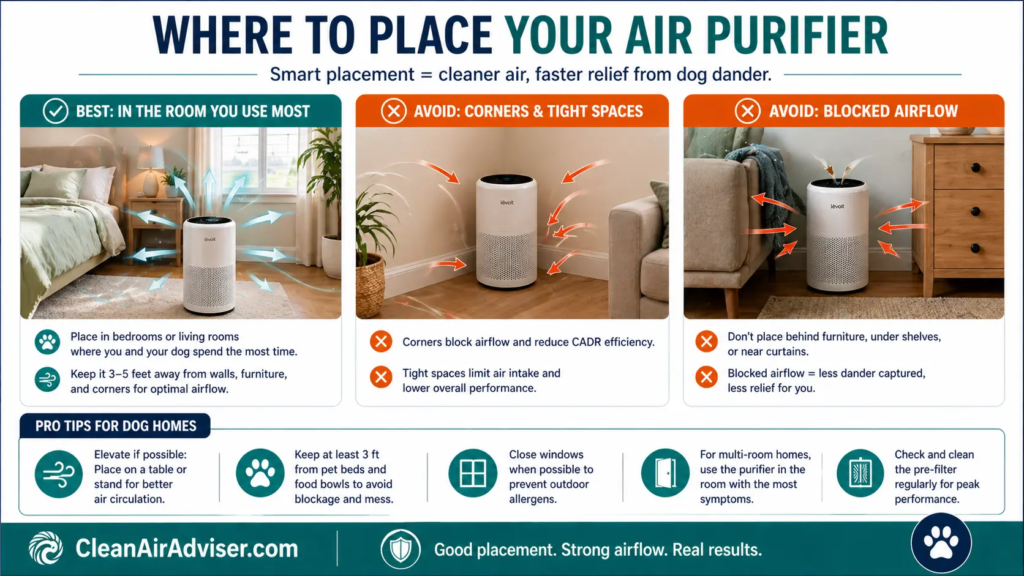
The most common placement mistake is putting the purifier in the living room. For allergy sufferers, the bedroom is higher priority: 7–8 hours overnight with no ventilation breaks, dander accumulates undisturbed in bedding, and bronchial tubes are most reactive during sleep. Bedroom overnight use produces meaningfully more symptom relief than living room daytime use.
This bedroom-priority approach is supported by the AAAAI (American Academy of Allergy, Asthma & Immunology), which recommends keeping pets out of the bedroom and running a HEPA-filtered air purifier — giving your immune system an 8-hour recovery window from continuous allergen exposure. The ACAAI echoes this guidance, noting HEPA cleaners “run continuously in a bedroom or living room can reduce allergen levels over time.” For sensitive sufferers, this single change often produces more symptom relief than any other intervention.
Three placement rules that matter:
- Bedroom first, living room second. If you can only afford one purifier, put it in the bedroom of the most allergy-sensitive person.
- Distance from where the dog sleeps. Counterintuitively, don’t place it right next to the dog bed — the pre-filter saturates faster, and high-dander source areas overwhelm auto-mode response. Place it across the room from the dog’s main resting spot.
- Clearance on all sides. Front-intake units (Coway, Vital 200S) need 6–12 inches of front clearance. 360° intake units (Levoit Core 400S) need 12–18 inches on all sides. Tucking a purifier into a corner against the wall measurably reduces airflow.
How Often to Replace Filters in a Dog Household
Filter replacement in dog households runs significantly faster than manufacturer recommendations assume. Manufacturer specs are written for “average” homes — not for homes with a Golden Retriever shedding year-round. Realistic schedules:
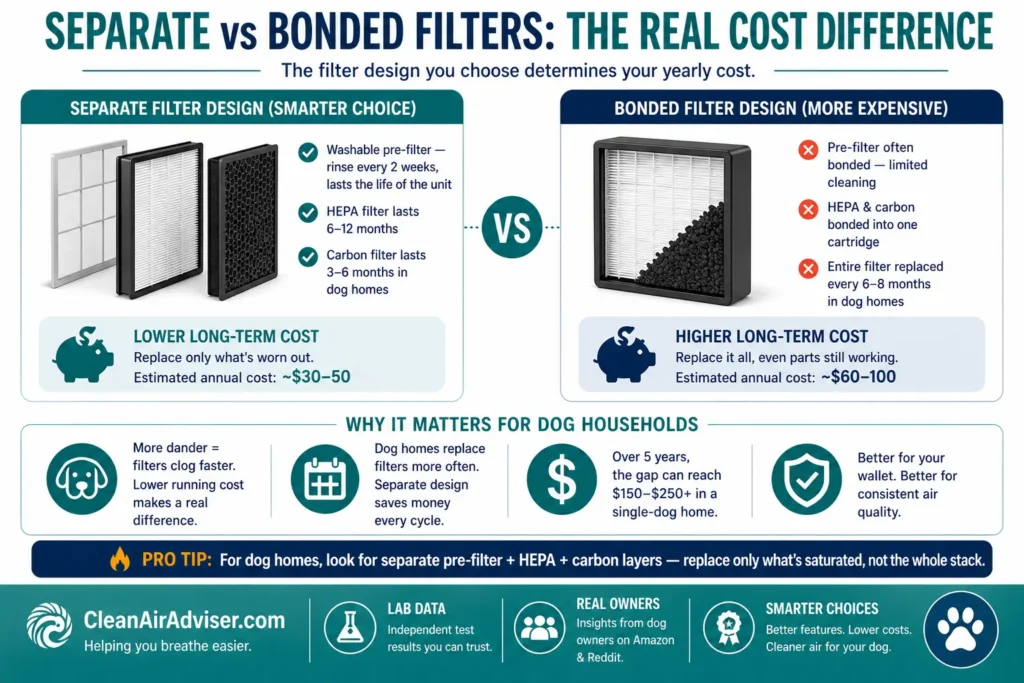
- Pre-filter (washable): rinse or vacuum every 2 weeks in heavy-shedding homes. Highest-impact maintenance task — a clogged pre-filter dramatically reduces airflow to downstream HEPA and carbon layers.
- Activated carbon: 3–4 months for heavy odor households. Use the smell test rather than the timer — if dog odor returns to the room, the carbon is spent.
- True HEPA filter: 6–8 months in heavy-shedding homes; up to 12 months with diligent pre-filter maintenance. The dust-cake on HEPA media surface is your visual indicator — when grey-to-dark, replacement time has arrived.
For a complete replacement schedule across all major brands, see our dedicated guide: How Often to Replace Your Air Purifier Filter.
FAQ: Air Purifiers for Dog Allergies and Dander
Quick answers to the most common questions readers send us about choosing an air purifier for dog dander-
Do air purifiers actually help with dog allergies?
Yes — with HEPA-grade filtration. HEPA filters are typically rated to capture 99.97% of particles at 0.3 microns per EPA guidance, well within the range of dog dander (2–10 microns). The ACAAI confirms HEPA reduces allergy symptoms when used correctly. The keys: 1.5× CADR sizing for dog households, regular filter changes, and bedroom placement where you spend the most time.
Do air purifiers get rid of dog dander?
They remove airborne dog dander — not dander settled on surfaces. Dander has to be airborne for the purifier to capture it. Regular vacuuming (ideally HEPA-filtered) removes settled dander from carpets, furniture, and bedding. Worth knowing: peer-reviewed studies show airborne dog allergens are detectable even in homes without dogs, in cars, and in schools — they’re transported on clothing and persist longer than most owners realize. The air purifier handles the airborne fraction continuously; vacuuming handles settled dander. Together they significantly reduce total dander load.
What gets pet dander out of the air?
HEPA-grade air purifiers are the most effective tool. Dog dander particles range 2–10 microns — well within HEPA’s 0.3-micron capture range per EPA guidance. Compounding measures: HVAC filters rated MERV 13+, regular HEPA-vacuum use, washing pet bedding weekly in hot water, and regular grooming
How effective are air purifiers for pet allergies?
Quality HEPA purifiers can rapidly reduce airborne fine particles in a correctly sized room within 30–60 minutes, per HouseFresh and RTINGS testing. Because airborne dog allergens travel on particle fractions that HEPA can capture, this supports their use for dog dander — though lab tests typically measure particle reduction rather than dander specifically. The ACAAI recommends HEPA purifiers as part of a pet allergy management strategy. Effectiveness depends heavily on correct sizing — apply the 1.5× CADR rule for dog households.
Is it okay to sleep with an air purifier on all night?
Yes — and recommended for allergy and asthma sufferers. Running overnight on Sleep mode keeps your bedroom air continuously clean during the 7–8 hours when bronchial tubes are most reactive. Energy cost: $3–15 per month. Most modern units run at 22–30 dB on sleep mode — quieter than a whisper.
Will an air purifier help with dog dander?
Yes — HEPA-grade filtration captures airborne dog dander effectively (typically 99.97% efficiency at 0.3 microns per EPA guidance). Keys to symptom relief: correct room sizing (1.5× CADR for dog households), continuous operation rather than only during flares, and bedroom placement overnight. Dog hair itself isn’t the allergen — Can f 1 protein bound to dander particles is, which is exactly what HEPA filters target.
What are the best air purifiers for pet dander?
Based on independent lab data and verified owner sentiment: Coway AP-1512HH for best overall (separate carbon layers reduce long-term cost), Winix 5510 for heavy odors (226g pelleted carbon), Shark NeverChange HP302 for no ongoing filter cost (long-life HEPA system + washable pre-filter), and Levoit Core 400S for smart features (laser PM2.5 sensor). All four use high-efficiency particle filtration suitable for airborne dog dander.
Would an air purifier help my COPD?
Air purifiers can reduce airborne COPD triggers including pet dander, dust, and smoke particles. The American Lung Association recommends HEPA purifiers for households with respiratory conditions. Important caveat: avoid ionizers and ozone generators — these can worsen COPD by irritating already-inflamed airways. Stick with HEPA-grade units (no ionizer/ozone features). Consult your physician for personalized guidance.
Sources and Methodology
This buying guide aggregates findings from the following authoritative sources. We do not physically test units — we synthesize independent lab data and cross-reference it with verified owner sentiment.
- HouseFresh — independent lab testing, Coway and Winix performance data
- RTINGS — independent lab scores and test methodology
- AirPurifierFirst — energy consumption and performance benchmarks
- Tom’s Guide and Consumer Reports — reliability and buyer satisfaction data
- ACAAI (American College of Allergy, Asthma and Immunology) — pet allergy management recommendations, HEPA endorsement, ionizer warning
- AAAAI (American Academy of Allergy, Asthma & Immunology) — pet allergy management guidance; recommends keeping pets out of bedroom + HEPA filtration
- American Lung Association — HEPA purifier recommendation for respiratory conditions, ozone warnings for COPD
- EPA — HEPA standard definition (99.97% capture at 0.3 microns)
- AHAM (Association of Home Appliance Manufacturers) — Two-Thirds Rule sizing standard and CADR verification
- Konieczny et al. (1997), Immunology — Can f 1 and Can f 2 identified as salivary lipocalin proteins (peer-reviewed)
- Custis et al. (1997) — peer-reviewed evidence that ~20% of airborne dog allergen is on particles <5 microns (key for HEPA effectiveness)
- van der Heide et al. (1999) — controlled clinical trial: HEPA improved airway hyperresponsiveness in asthmatic children even when settled dust unchanged
- Cross-environment allergen study (2016) — pet allergens detectable in homes without pets, cars, and schools
- Thermo Fisher Scientific Allergen Encyclopedia — Can f 1 IgE sensitization data (50–70% of dog-allergic patients)
- 2022 air filtration study — modern peer-reviewed evidence that filtration removes mite, cat, and dog allergens plus PM
- Sublett, J.L. (2011), Current Allergy and Asthma Reports — peer-reviewed clinical evidence for HEPA effectiveness in allergic respiratory disease
- Kang et al. (2020) — peer-reviewed evidence that HEPA use reduces medication requirements for allergic rhinitis
- Reddit r/AirPurifiers — aggregated dog-owner sentiment and long-term ownership feedback