Best Air Purifier for Cigarette Smoke (2026): Honest Picks and Limits
Disclosure: Clean Air Adviser may earn a commission from qualifying purchases made through Amazon links, at no extra cost to you. Product selection and conclusions are based on the evidence described above.
How to use the best air purifier for cigarette smoke
- The best air purifier for cigarette smoke should run continuously when residual smoke or drift is present.
- Place the best air purifier for cigarette smoke away from the source and keep its intake unobstructed.
- Choose the best air purifier for cigarette smoke as a supporting measure after removing the smoking source, not as a substitute for it.
Quick answer: This best air purifier for cigarette smoke guide explains the evidence, the limits of air cleaning, and how to choose particle airflow and carbon for residual smoke.
Best air purifiers for cigarette smoke at a glance
| Model and filter | Carbon information | Independent particle result | Best use | Main drawback |
|---|---|---|---|---|
| Levoit Core 400S Smoke Remover filter | 450 g measured by HouseFresh | US unit reached PM1 zero in 24 minutes | Balanced particle and odor control | Bonded filter is replaced as one piece |
| Alen BreatheSmart 45i VOC/Smoke filter | 2.38 lb, or 1,079 g, measured by HouseFresh | PM1 zero in 30 minutes; estimated 198 cfm | More carbon in a medium-room purifier | Higher price and filter-specific warranty terms |
| Austin Air HealthMate | Up to 15 lb carbon and zeolite | PM1 zero in 52 minutes; estimated 156 cfm | Persistent odor and gaseous pollution | Expensive, power-hungry, and slower for particles |
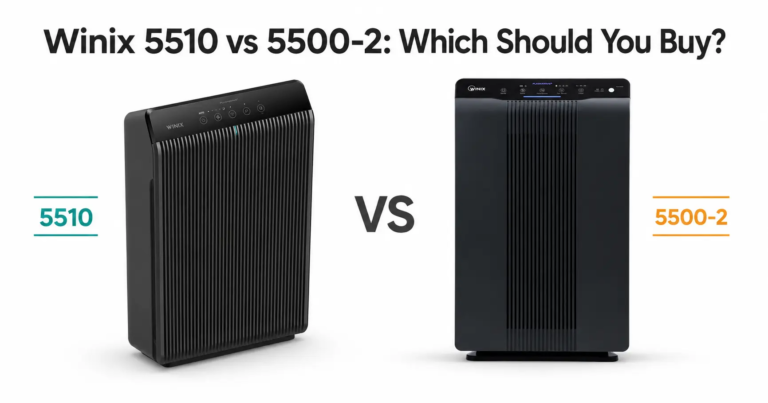
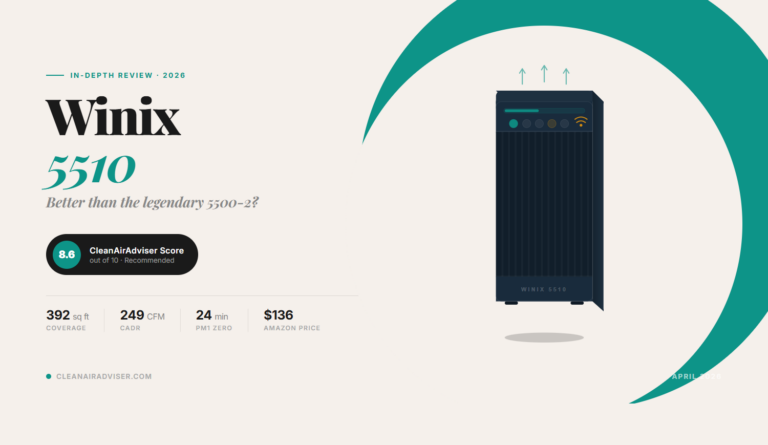
| Winix 5510 | 226 g confirmed by Winix to HouseFresh | PM1 zero in 24 minutes; estimated 249 cfm | Intermittent drift and value | Less gas capacity and loud Turbo setting |
Independent test times come from different products tested in the same HouseFresh room, but particle tests do not measure complete removal of tobacco gases. Carbon figures describe media quantity, not a universal odor rating.
1. Levoit Core 400S with Smoke Remover filter: best overall
The Core 400S combines useful particle airflow with an optional filter that contains more carbon than the standard filter. HouseFresh measured about 450 grams in the Smoke Remover filter, compared with about 240 grams in the Original. That difference is why the filter variant must be part of the recommendation.
In HouseFresh’s testing, the US Core 400S cleared PM1 from the room in 24 minutes. The reviewer measured sound from 35.5 to 60.3 dBA and noted that the US and European versions performed differently. US buyers should still verify that they are buying the current model and the intended Smoke Remover replacement filter.
This is a good match for a bedroom or living room receiving occasional smoke drift. Its 450-gram gas stage is more substantial than the light carbon layers in many mainstream purifiers, but it is not comparable to the Austin Air’s multi-pound bed. Because the filter is bonded, the particle and carbon sections are replaced together.
Buy it for: a practical mix of smoke-particle CADR, moderate gas capacity, smart controls, and normal household size.
Our Core 400S review and replacement-filter guide explain the current airflow figures and filter variants.
2. Alen BreatheSmart 45i with VOC/Smoke filter: best carbon upgrade for a medium room
Alen sells several filters for the 45i. The Pure version has no gas carbon, the Fresh version has less, and the VOC/Smoke version has the most. HouseFresh measured 2.38 pounds, or 1,079 grams, of activated carbon in the VOC/Smoke filter. Ordering the correct version is essential.
The purchased 45i reached PM1 zero in HouseFresh’s room in 30 minutes, with an estimated particle CADR of 198 cfm. It measured 36.2 to 56.1 dBA across the four fan speeds. That supports a room of about 300 square feet at five air changes per hour before allowing for imperfect mixing.
The 45i includes an optional ionizer. HouseFresh found the particle-clearance result unchanged with the ionizer off, so this recommendation does not depend on it. The warranty also has conditions involving registration and use of OEM filters or a subscription. Read the current terms before treating “lifetime warranty” as unconditional.
Buy it for: substantially more carbon than a typical mainstream purifier without moving to the very large Austin Air cabinet.
3. Austin Air HealthMate: best deep-carbon option
Austin Air lists up to 15 pounds of activated carbon and zeolite in the HealthMate. HouseFresh purchased the machine, confirmed that media amount, and tested both particles and gas-sensor response. It is the clear choice here when gas capacity matters more than price, app features, or maximum particle speed.
The tradeoff is airflow through a dense filter. HouseFresh measured an estimated top-speed particle CADR of 156 cfm, a 52-minute PM1 clearance time, 61.5 dBA, and about 148 watts on high. The same review showed VOC readings falling over several hours. That is useful evidence, but it does not predict a fixed removal time for the complex mixture from cigarette smoke in another room.
The HealthMate makes the most sense after indoor smoking has stopped or where recurring smoke enters despite reasonable source-control efforts. It does not clean nicotine residue from walls or make a smoking room safe for occupants.
Buy it for: maximum gas-media quantity among these picks and simple long-term operation.
4. Winix 5510: best value
The Winix 5510 delivers strong particle removal at a lower cost than the Alen or Austin Air. HouseFresh’s unit reached PM1 zero in 24 minutes and produced an estimated 249 cfm. Winix confirmed 226 grams of carbon in its separate AOC filter.
That carbon stage is useful for ordinary odor, but regular indoor smoking can overwhelm a few hundred grams quickly. The benefit of the separate filter is that you can inspect and replace the complete Filter Q set according to its condition and the manual. Do not assume the approximate one-year schedule will hold under a heavy tobacco load.
The odor sensor can trigger Auto mode when it detects some gases. It is not a tobacco-safety monitor. PlasmaWave can be disabled, and our recommendation rests on the purifier’s physical filters and airflow, not a claim that the electronic stage neutralizes smoke chemicals.
Buy it for: intermittent apartment drift, a lower purchase price, and fast particle cleaning with a real pellet-carbon stage.
See our Winix 5510 review and Filter Q guide for sound and maintenance details.
Why cigarette smoke needs two filter stages
Secondhand tobacco smoke is a mixture of particles and gases. A particle filter can capture airborne fine particles that pass through the machine. Activated carbon or another gas sorbent can adsorb some gaseous compounds. Neither filter stops the cigarette from continuing to add pollution.
Smoke CADR is the best common metric for particle cleaning. The EPA recommends choosing a purifier with enough smoke CADR for the room. For an 8-foot ceiling, a useful five-air-change target is roughly:
Room area in square feet × 0.65 = minimum smoke CADR in cfm
A 300-square-foot room therefore needs about 195 cfm. For a different ceiling height:
Room area × ceiling height × desired air changes per hour ÷ 60 = required CADR
CADR does not rate gases. EPA says there is no widely used performance rating for residential gas filters and that activated carbon is more useful when a large amount is present. Carbon quantity is still only a screening clue. Media chemistry, depth, airflow, humidity, the chemicals present, and saturation all change performance.
What a purifier can and cannot do
A capable purifier can lower some airborne smoke particles and gases. It can be helpful after a brief event or as one layer of defense against smoke entering from somewhere you do not control.
It cannot:
- make smoking indoors safe for the smoker or other occupants;
- eliminate every particle and gas in secondhand smoke;
- remove residue embedded in walls, carpet, furniture, bedding, or clothing;
- replace a working smoke alarm or carbon-monoxide alarm;
- prove safety through an odor sensor, PM2.5 reading, or blue indicator light;
- prevent smoke from continuing to enter through a shared building.
CDC guidance is explicit that opening windows, using fans, air conditioners, air purifiers, air fresheners, or ventilation systems does not get rid of secondhand smoke. These measures can change concentrations, but they do not create a risk-free indoor smoking area.
What to do when smoke comes from a neighboring apartment
EPA says secondhand smoke can move between apartment units through doorways, light fixtures, electrical outlets, wall cavities, and other paths. Air cleaning cannot completely control that transfer.
- Document when and where it enters. Note dates, duration, rooms, and visible or measurable effects without confronting anyone in an unsafe way.
- Read the lease or condominium rules. Look for smoking, nuisance, and indoor-air provisions.
- Report the issue in writing. Ask property management to inspect transfer pathways and enforce any applicable policy.
- Seek local guidance. EPA suggests contacting a local health department, housing organization, or legal resource because rights and building codes vary.
- Use filtration as interim reduction. Put a correctly sized purifier in the room where smoke enters or where a vulnerable occupant spends time.
Do not seal combustion-appliance vents or modify building ventilation on your own. Any air-sealing work in a multi-unit building should respect fire safety, ventilation, and lease requirements.
Thirdhand smoke: why the odor returns
Chemicals from smoking can remain on hard surfaces and become embedded in soft materials. EPA notes that some can later return to the air. This is why a former smoker’s room can smell again after the purifier is turned off.
Light contamination may improve with laundering washable fabrics and cleaning appropriate surfaces. Heavy contamination can involve carpet, padding, upholstered furniture, walls, ceilings, and HVAC components. A professional assessment may be more appropriate than repeatedly buying carbon filters, especially before altering a rental property.
Our smoke-smell guide explains the difference between airborne odor and embedded residue in more detail. For wildfire particles, use the separate wildfire-smoke guide. The broader smoke purifier comparison covers cooking, tobacco, and wildfire scenarios together.
Filter maintenance in a tobacco environment
Smoke can shorten both particle-filter and carbon-filter life. Check the manual for the exact model, then look for declining airflow, recurring odor, visible loading, damage, or a filter indicator. A carbon filter may lose useful odor capacity before a combined filter looks dirty.
Do not wash carbon or particle media unless the manufacturer explicitly says that exact layer is washable. Many washable pre-filters must be dried completely before reinstallation. If the purifier itself smells like tobacco when the source is gone, the filter may be contaminated and due for replacement.
See our evidence-based filter replacement guide rather than relying on a universal three-, six-, or twelve-month rule.
What to avoid
- Ozone generators: EPA calls ozone a lung irritant and advises against using intentional ozone generators in occupied spaces.
- Air fresheners: fragrance can mask odor without removing smoke pollution.
- Small desktop purifiers: a filter label does not compensate for insufficient airflow.
- Fixed clearance times: a claim that one cigarette is gone in 20 minutes ignores room size, ventilation, carbon condition, and surface residue.
- Unverified carbon thresholds: 200 grams is not a scientific pass/fail line. More media may add capacity, but design and target gases matter.
- Sensor reassurance: a consumer particle or odor sensor cannot measure the complete toxic mixture in tobacco smoke.
Best air purifier for cigarette smoke: final decision
The best air purifier for cigarette smoke has meaningful particle airflow and carbon, but it cannot make indoor smoking safe or replace source control.
If cigarette smoke is being produced indoors, no air purifier makes the room safe. The Centers for Disease Control and Prevention says there is no safe amount of secondhand-smoke exposure, and the US Environmental Protection Agency says air cleaning can reduce exposure but cannot eliminate it. A smoke-free home or car is the only reliable protection.
A purifier still has a supporting role when smoke drifts from another apartment, comes in briefly through a doorway, or remains after the source has stopped. Choose one that can handle both sides of tobacco smoke: a high smoke CADR for fine particles and a meaningful gas filter for odor compounds. The product should be sized for the room, run continuously, and used alongside source control.
For most buyers, the Levoit Core 400S with its Smoke Remover filter is the best balance. The Alen BreatheSmart 45i with the VOC/Smoke filter adds more carbon for a smaller room, while the Austin Air HealthMate is the heavy-carbon choice for persistent gaseous pollution. The Winix 5510 is the lower-cost option for intermittent smoke and everyday odor.
We have not personally tested these machines. This ranking uses current manufacturer information, public-health guidance, and independent measurements from HouseFresh. We do not promise that a purifier will prevent a health effect or remove tobacco odor within a fixed time.
Quick picks
- Best overall: Levoit Core 400S with Smoke Remover filter
- Best medium-room carbon upgrade: Alen BreatheSmart 45i with VOC/Smoke filter
- Best for deep gas filtration: Austin Air HealthMate
- Best value: Winix 5510
Important: If someone is smoking inside, move smoking outdoors and away from doors, open windows, and air intakes. Do not use a purifier as permission to continue exposing other occupants.
Frequently asked questions
What is the best air purifier for cigarette smoke?
The Core 400S with Smoke Remover filter is the best balance for most rooms. The Alen 45i VOC/Smoke filter provides more carbon, and the Austin Air HealthMate provides far more again. Choose enough smoke CADR for the room and the gas-filter depth that matches the exposure.
Will a HEPA purifier remove cigarette odor?
A particle filter removes airborne smoke particles, not gaseous odor compounds. The purifier needs activated carbon or another suitable gas medium as a separate stage.
How close should the purifier be to the smoker?
There should not be a smoker indoors. If smoke is entering from elsewhere, place the purifier in the affected room with open space around its intake and outlet. Do not put it where the filter could receive hot ash or create a trip hazard.
Can the purifier protect children from someone smoking in another room?
No. CDC says smoking in another room does not protect children or other occupants. Smoke moves through the home, and air cleaning does not eliminate exposure.
How long should I run the purifier?
Run it continuously while smoke intrusion is possible and after a brief event, using a higher speed when pollution is elevated. There is no universal safe stopping time. Eliminate the source and follow public-health guidance.
Can I use a PM2.5 monitor to know when the tobacco smoke is gone?
A PM2.5 monitor can show particle trends, but it does not measure the full gas mixture or surface contamination. A low reading is useful information, not proof that secondhand or thirdhand exposure has been eliminated.
Bottom line
Buy the Core 400S with Smoke Remover filter for a balanced mainstream option, the Alen 45i with VOC/Smoke filter when you want about a kilogram of carbon in a medium-room unit, the Austin Air HealthMate when deep gas filtration is the priority, or the Winix 5510 for intermittent smoke on a lower budget.
Then keep the limits clear. A purifier reduces some airborne pollution. It does not make indoor smoking safe, solve a neighboring source, or clean thirdhand residue from a building. Smoke-free space, source control, and appropriate remediation come first.
Sources
- CDC: Preventing Exposure to Secondhand Smoke in the Home
- US EPA: Secondhand Tobacco Smoke and Indoor Air Quality
- US EPA: Secondhand smoke from a neighboring apartment
- US EPA: Guide to Air Cleaners in the Home
- US EPA: Ozone Generators Sold as Air Cleaners
- National Cancer Institute: Secondhand Smoke and Cancer
- HouseFresh: Levoit Core 400S independent test
- Levoit: Core 400S Smoke Remover filter
- HouseFresh: Alen BreatheSmart 45i independent test
- Alen: BreatheSmart filter selection guide
- HouseFresh: Austin Air HealthMate independent test
- Austin Air: HealthMate product specifications
- HouseFresh: Winix 5510 independent test
- Winix America: Filter Q specifications