Levoit Core 300 Replacement Filter: 4 Options Compared
Disclosure: Clean Air Adviser may earn a commission when you buy through links on this page. This does not change what you pay. We have not personally tested these replacement filters. Manufacturer claims and independent test results are identified separately below.
Quick answer: The Core 300 uses a model-specific cylindrical filter. Choose the Original filter for normal particle filtration, then move to Pet Allergy, Toxin Absorber, or Smoke Remover only when the additional odor media matches a real household problem.
Choosing a Core 300 replacement filter
Confirm the purifier model and the filter’s compatibility label before ordering. A specialty filter can change odor support, but it does not increase the purifier’s airflow or remove the need for source control.
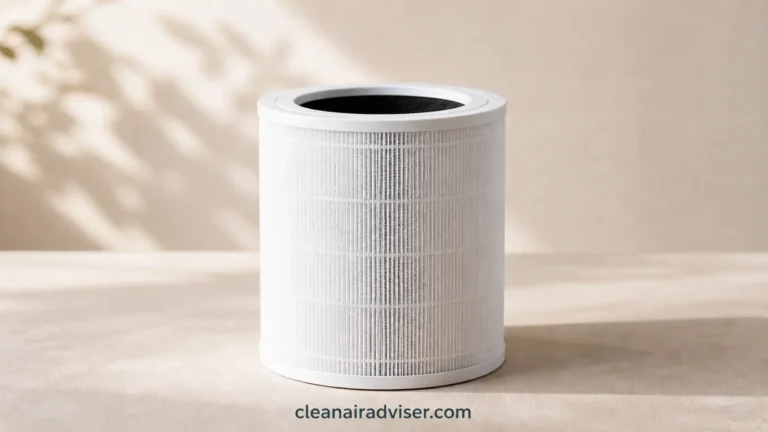
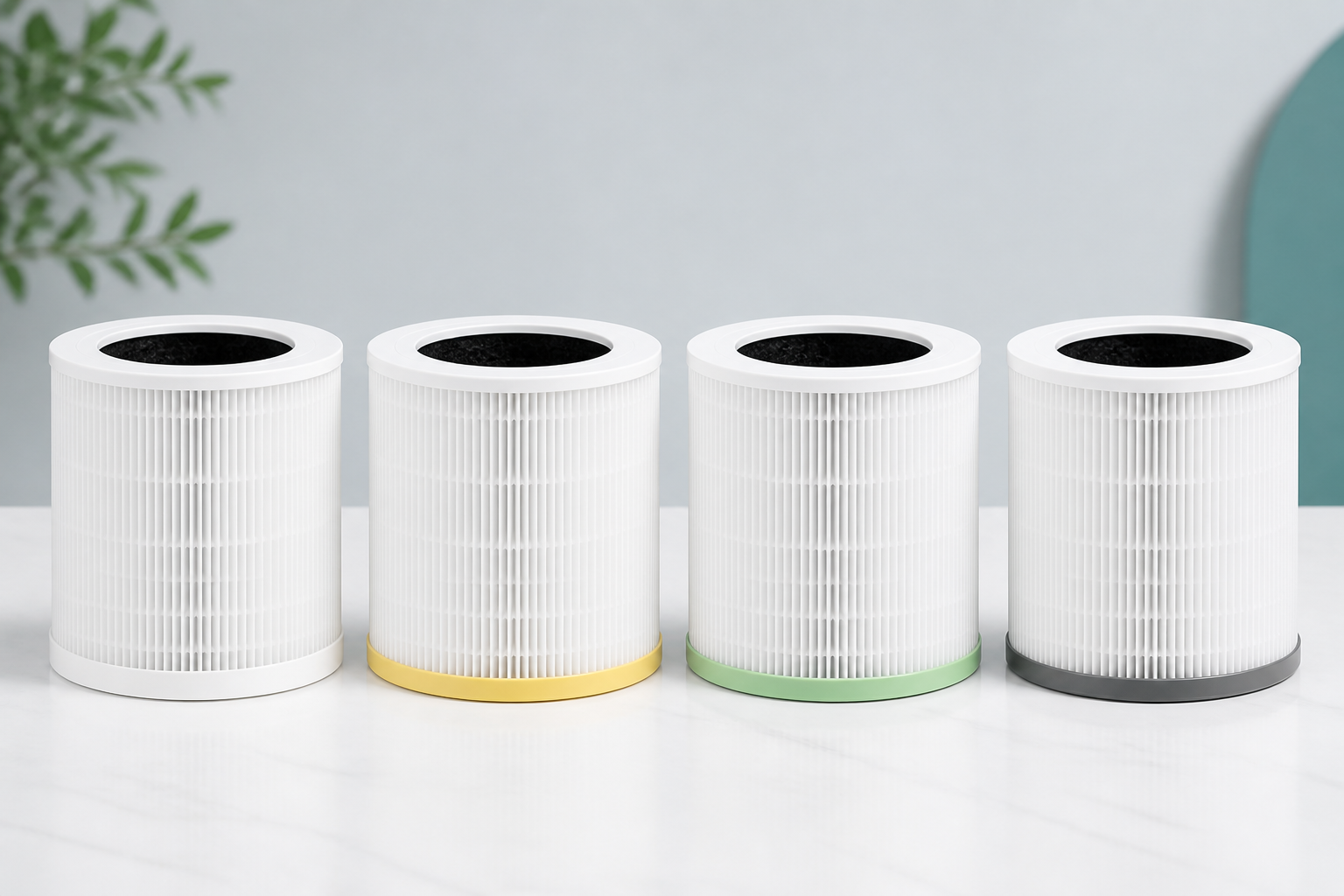
The Levoit Core 300 replacement-filter family currently has four genuine choices in the United States: Original, Pet Allergy, Toxin Absorber, and Smoke Remover. All four are sold for the Core 300 family, but their odor-control layers and intended uses differ.
For most homes, the Original filter is the sensible buy. Choose Pet Allergy when pet odor is a continuing problem, Toxin Absorber for traffic or chemical fumes, and Smoke Remover for wildfire smoke, tobacco smoke, or heavy cooking. Do not pay more for a specialty filter unless its extra carbon treatment matches a problem you actually have.
Quick filter finder
- Dust, pollen, dander, and normal household odors: Original.
- Pet hair, dander, and persistent pet odor: Pet Allergy.
- Traffic exhaust, renovation fumes, or urban pollution: Toxin Absorber.
- Wildfire, tobacco, or strong cooking smoke: Smoke Remover.
Core 300 filter options compared
| Filter | Best for | Official US price checked | Buying note |
|---|---|---|---|
| Original | Everyday particles and light household odors | $29.99 | The best default for most rooms |
| Pet Allergy | Pet dander, hair, and pet odors | $35.99 | Worth the premium only when pets are the main concern |
| Toxin Absorber | Vehicle exhaust, fumes, smoke, and urban pollution | $35.99 | Filtration cannot replace source removal or ventilation |
| Smoke Remover | Wildfire, tobacco, and heavy cooking smoke | $39.99 | The costliest option and still a modest carbon filter |
Prices above were displayed in Levoit’s United States store on August 14, 2026. Prices and stock can change. Levoit also lists a two-pack of Original filters, so compare the per-filter price rather than assuming a multipack is automatically cheaper.
Which Core 300 filter should you buy?
Original: the right choice for most rooms
The Original is the general-purpose three-stage filter. Levoit says its outer pre-filter catches hair, dust, and other large debris; its main filter removes 99.97% of particles down to 0.3 micrometers; and its activated-carbon layer helps with gases and odors. The company’s current wording is “HEPA-grade performance in Sleep Mode.” We use that wording instead of describing the filter as H13 or True HEPA.
Buy the Original when dust, pollen, dander, and ordinary household particles are the main problems. It still contains activated carbon, so it is not an odor-free version. It simply lacks the more targeted carbon treatment used in the specialty variants. A bedroom with no smoker, no major pet odor, and no recurring wildfire exposure usually does not need anything more expensive.
The Original is also the easiest benchmark when comparing genuine and third-party filters. If the room’s main need is particle removal, fit, sealing, and airflow matter more than a specialty label printed on the box.
Pet Allergy: for dander plus odor
Pet hair and pet dander are different. Hair is large and usually collects on the outer pre-filter. Dander is much smaller and reaches the main particle filter. The Pet Allergy version targets both that particle load and pet-related odors through Levoit’s ARC Formula carbon treatment.
A pet owner does not automatically need this variant. The Original also captures pet hair and dander. The premium makes more sense when a litter box, dog bedding, or a heavily shedding animal produces a consistent odor burden. If the only issue is visible fur, cleaning the outer pre-filter more often may help more than changing the filter color.
Our best air purifiers for pets guide explains why intake design and pre-filter access matter in a home with animals. The compact Core 300 can work in a small room, but its entire cylindrical filter is one bonded assembly, so you cannot replace only the carbon layer when odor control declines.
Toxin Absorber: for exhaust and fumes
Levoit markets the Toxin Absorber for vehicle exhaust, smoke, fumes, and urban or industrial pollution. That makes it the most relevant Core 300 variant for a bedroom beside a busy road, an attached garage odor that occasionally enters the home, or temporary smells from painting and new furnishings.
Set realistic expectations. The Core 300 is a small particle purifier with a relatively thin carbon layer, not a deep-bed gas purifier. It can reduce some odors and gases that pass through the carbon, but it cannot make an active gas leak, unsafe chemical exposure, or continuous indoor pollution source acceptable. Stop the source and ventilate when safe, then use filtration as an additional control.
Smoke Remover: for particles and smoke odor
Smoke contains particles and gases. The main filter handles smoke particles, including much of the PM2.5 that drives outdoor air-quality alerts. Activated carbon helps with part of the gas and odor mixture. The Smoke Remover adds a more smoke-focused carbon stage, which gives it the clearest role during wildfire season, in a smoker’s room, or near frequent high-heat cooking.
It does not remove carbon monoxide, and a blue air-quality reading on a separate monitor would not prove that all smoke gases are gone. Keep working carbon-monoxide alarms in the home and follow public-health instructions during a severe smoke event. For larger spaces or sustained smoke, see our air purifiers for smoke guide.
What happened to the Mold and Bacteria filter?
Older retailer pages and older versions of this guide may mention a fifth green or specialized “Mold and Bacteria” filter. Levoit’s current US replacement-filter catalog does not list that as a current Core 300 option. The active lineup displayed during this update is Original, Pet Allergy, Toxin Absorber, and Smoke Remover.
That does not mean old stock never appears online. It means buyers should not assume an old marketplace listing reflects the current official lineup. Check the date, seller, exact model compatibility, and return terms. We have removed the discontinued or unverified fifth option from our recommendations rather than presenting old inventory as a current Levoit product.
Compatibility: Core 300, 300-P, 300S, P350, and RAC
Levoit’s compatibility wording is not perfectly consistent across its current pages. The company’s manuals catalog groups the Original, Pet Allergy, Toxin Absorber, and Smoke Remover filters with Core 300, Core 300S, Core P350, and Core 300-RAC models. Individual filter pages sometimes display a shorter list such as Core 300-P, Core P350-P, and Core 300-P-RAC, while their summaries also name Core 300S-P.
The safest buying process is simple:
- Read the model label on the bottom of your purifier.
- Check that the listing explicitly names your model or its current “-P” equivalent.
- Compare the new filter’s diameter, height, and base shape with the filter already installed.
- Keep the packaging and receipt until the replacement is seated and running normally.
- Do not order by color alone. Levoit uses similar colors across several Core filter sizes.
A Core 200S, Core 400S, or Core 600S filter will not fit simply because it is round. The model number matters. International suffixes and retailer titles can also differ, so a US product link is not a substitute for checking a purifier bought in another region.
How long does a Levoit Core 300 filter last?
Levoit currently recommends replacement every 6 to 8 months. The Core 300S manual says the Check Filter indicator should illuminate within that range and also says the filter may not need replacement immediately when the light appears. Inspect it first.
Six to eight months is a starting range, not a promise. A filter in a lightly used bedroom can age differently from one running continuously beside a kitchen, litter box, busy road, or wildfire leak. The carbon layer may lose useful odor control before the particle layer looks heavily loaded. A severely clogged particle layer can also reduce airflow before the calendar reaches six months.
| What you notice | What it means | What to do |
|---|---|---|
| Reminder light, normal airflow, no returning odor | The scheduled inspection point has arrived | Inspect and clean the outer pre-filter; replacement may not be urgent |
| Airflow remains weak after pre-filter cleaning | The main filter may be loaded | Replace the complete filter |
| Smoke, cooking, or pet odors return quickly | The carbon may be saturated | Remove the source and consider replacement |
| Rubbing, rattling, or a new mechanical sound after installation | The filter or bottom cover may be mis-seated | Power off, reinstall, and return an incorrect or deformed filter |
| Visible moisture, mold-like growth, or damage | The filter should not remain in service | Replace it and address the moisture source |
Do not create an aggressive replacement schedule from odor alone while an active source remains. A new filter cannot keep up with indoor smoking, a solvent spill, or an unvented cooking plume forever. Source control usually saves more filter life than replacing early.
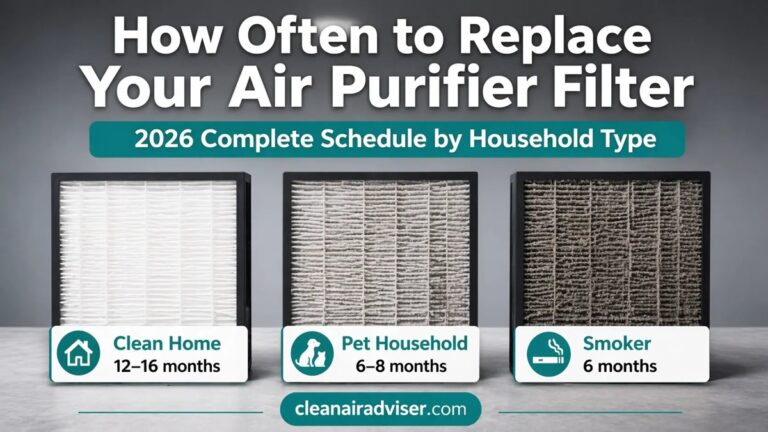
For a cross-brand maintenance framework, read our guide to how often air-purifier filters should be replaced.
What will replacements cost each year?
At the official prices checked for this update, replacing once every eight months means buying roughly 1.5 filters per year over the long run. Replacing every six months means two filters per year. The table below is simple purchase math, not a forecast of your exact filter life.
| Filter | One per year | Every 8 months, annualized | Every 6 months |
|---|---|---|---|
| Original | $29.99 | About $44.99 | $59.98 |
| Pet Allergy | $35.99 | About $53.99 | $71.98 |
| Toxin Absorber | $35.99 | About $53.99 | $71.98 |
| Smoke Remover | $39.99 | About $59.99 | $79.98 |
Taxes, shipping, discounts, multipacks, and marketplace prices change these totals. The real cost disadvantage is the bonded design. The outer pre-filter, main particle media, and carbon layer are part of one cylinder. If the carbon saturates early, Levoit does not sell a genuine carbon-only insert for you to replace while keeping the particle layer.
That simplicity is also a benefit. There is only one filter assembly to order and install. The tradeoff is that specialty carbon costs more and the layers cannot be renewed separately.
Can the Core 300 filter be cleaned?
The complete filter is not washable. The current Core 300S manual says to clean the outer pre-filter every two to four weeks with a soft brush or vacuum hose and not to use water or liquids. Moisture can damage the particle and carbon media and can create a separate microbial problem.
- Turn the purifier off and unplug it.
- Turn it upside down on a stable, soft surface.
- Remove the bottom cover and lift out the filter.
- Use a soft brush or low-suction vacuum on the outer mesh only.
- Vacuum loose dust from the empty housing.
- Reinstall the dry filter and lock the cover.
Do not wash, soak, spray, or add cleaning products or essential oils to the filter. Do not try to vacuum deeply between the pleats. The goal is to remove loose surface debris from the pre-filter, not to restore used main media to new condition.
How to replace the filter
- Power off and unplug the purifier.
- Turn the unit upside down. Use a stable surface that will not scratch the controls.
- Remove the bottom cover. Rotate it counterclockwise and lift it away.
- Lift out the old filter. Bag a dusty filter before carrying it through the home if allergies are a concern.
- Vacuum loose debris from the housing. Keep water out of the purifier.
- Remove all plastic packaging from the new filter. This is easy to miss and completely blocks normal airflow.
- Place the new filter into the housing. It should sit evenly without force.
- Replace and lock the bottom cover.
- Return the purifier upright, plug it in, and reset the indicator.
If a replacement rocks, leaves a visible gap, requires force, rubs the fan, or creates abnormal noise, turn the purifier off. Recheck its orientation and model compatibility. Return a wrong-size or deformed filter. Do not add foam tape, weatherstripping, or improvised shims inside the purifier.
How to reset the Core 300 or Core 300S filter light
For the current Core 300S, press and hold the Sleep Mode button for three seconds. The manual says to perform the same reset after replacing a filter before the indicator illuminates.
Levoit has sold several revisions and regional versions, and button layouts can differ. If your purifier has a dedicated filter-reset symbol or the three-second Sleep Mode method does not work, check the manual for the exact model number printed on the unit. Do not repeatedly press random controls or assume instructions for the Core 400S are identical.
The VeSync app can display estimated filter life on the smart Core 300S. Treat that percentage as a maintenance estimate, not a laboratory measurement of remaining particle or carbon capacity. Use the physical signs in the table above as well.
Genuine versus third-party filters
Genuine Levoit filters provide the clearest fit and specification trail. Levoit’s current pages say its filter-life function is designed around authentic filters. They also provide named Original, Pet, Toxin, and Smoke formulations rather than a generic colored label.
Third-party filters can cost less, particularly in two-packs. The uncertainty is that particle media, sealing, carbon amount, and airflow resistance are rarely supported by independent test data. A marketplace star rating does not prove filtration efficiency, and reviews may combine several sizes or variants.
| Genuine is the safer choice when | A third-party filter may be reasonable when |
|---|---|
| Allergies, wildfire smoke, or a health-sensitive household makes consistency important | Budget is the main constraint and you accept more uncertainty |
| You need the named Pet, Toxin, or Smoke formulation | The seller gives exact model compatibility, dimensions, and easy returns |
| You want the simplest manufacturer-support path | You can inspect the fit, seal, noise, and airflow during the return window |
Reject any replacement that is visibly crushed, smells strongly chemical after brief normal airing, leaves a gap, or sharply reduces airflow. Do not keep running a noisy or poor-fitting filter in the hope that it will settle. A returnable, correctly fitting filter is worth more than a cheap multi-pack you cannot use.
What independent testing tells us
Independent room tests evaluate the purifier as a complete system, not every filter variant separately. HouseFresh’s February 2026 Core 300 review measured a 54-minute clearance time in its 728-cubic-foot test room and described the machine as a capable but aging budget design. AirPurifierFirst’s updated review also reported strong particle performance and favorable operating costs.
Those results support the Core 300’s usefulness as a small-room particle purifier, but they do not prove that Pet Allergy, Toxin Absorber, or Smoke Remover has a specific gas-removal advantage in your room. Levoit provides the intended use for each variant. We did not find a current independent test that measures all four Core 300 filters under the same controlled gas challenge.
This distinction matters. Particle-cleaning speed is mainly described through CADR and room tests. Odor and gas performance depends on carbon type, mass, contact time, pollutant concentration, humidity, and whether the source continues. A specialty name alone is not a measured clean-air delivery rate for gases.
About Levoit’s current HEPA wording
Levoit’s current Core 300 filter pages say “HEPA-grade performance in Sleep Mode” and say the main filter removes 99.97% of ultrafine particles down to 0.3 micrometers. That is the wording we use here.
In 2023, BBB National Programs reported that VeSync voluntarily discontinued certain HEPA claims after a Dyson challenge involving the EverestAir, Core 300, and Core 300S and their filters. The National Advertising Division did not review the challenged claims on their merits. It would therefore be wrong to say that the decision proved the filters fail, or that it proved every current filter is certified H13. The clean approach is to quote the current manufacturer language and use whole-machine CADR or independent room tests to judge practical particle cleaning.
Frequently asked questions
What filter fits the Levoit Core 300?
Use a Core 300-series replacement explicitly listing your purifier model. Levoit’s current catalog groups the four genuine variants with the Core 300, Core 300S, Core P350, and Core 300-RAC families, although individual product-page compatibility lists are not perfectly consistent.
Do the Core 300 and Core 300S use the same filter?
Levoit’s current replacement-filter summaries name Core 300-P and Core 300S-P, and its manuals catalog groups both models with the same four variants. Check the exact label on your unit and the listing before ordering, especially for an international model.
How often should I replace it?
Levoit recommends every 6 to 8 months. Inspect the filter when the reminder appears. Lower airflow after pre-filter cleaning, returning odors, visible loading, damage, or moisture can justify earlier replacement.
Can I wash the filter?
No. Clean only the outer pre-filter with a soft brush or vacuum every two to four weeks. Keep the complete filter dry.
Which filter is best for pets?
Choose Pet Allergy when pet odors are persistent or shedding loads the pre-filter quickly. The Original still captures pet hair and dander and is adequate for many pet homes.
Which filter is best for wildfire smoke?
The Smoke Remover is the most relevant genuine option because it targets smoke particles and odors. Close outdoor-air leaks when advised, run the purifier continuously at the highest tolerable speed, and remember that no Core 300 filter removes carbon monoxide.
Why is the filter light still on after replacement?
On the current Core 300S, hold the Sleep Mode button for three seconds. If that does not match your controls, use the manual for the model number on your purifier.
Is the Mold and Bacteria variant still available?
It was not part of Levoit’s current US Core 300 catalog during this August 2026 check. Old listings may remain online, but the current active lineup shown by Levoit has four options.
Bottom line
Buy the Original Core 300 filter unless you have a specific odor or gas problem. Pet Allergy is for pet-heavy rooms, Toxin Absorber is for exhaust and fumes, and Smoke Remover is for wildfire, tobacco, or cooking smoke. Expect roughly 6 to 8 months, clean the outer pre-filter every two to four weeks, and inspect the filter instead of treating the reminder light as an automatic order button.
Check current availability
Verify that the listing names your exact Core 300-series model before ordering. Amazon results can mix the Core 200S, Core 300, Core 400S, and Core 600S.
Sources
- Levoit: Core 300 Series Original replacement filter
- Levoit: Core 300-P Pet Allergy replacement filter
- Levoit: Core 300-P Toxin Absorber replacement filter
- Levoit: Core 300-P Smoke Remover replacement filter
- Levoit: Core 300-P genuine replacement-filter two-pack and current variant prices
- Levoit: current Core 300-P product page and manual link
- Levoit: current Core 300S-P product page
- Levoit: current Core 300S-P United States user manual (PDF)
- HouseFresh: Core 300 independent review and performance tests
- AirPurifierFirst: Core 300 independent review
- BBB National Programs: VeSync HEPA advertising-claim decision summary
Last fact-checked August 14, 2026. Prices and availability can change. We have not personally tested the four replacement-filter variants side by side.