How Often to Replace an Air Purifier Filter (2026 Guide)
Disclosure: Clean Air Adviser may earn a commission when you buy through links on this page. This does not change what you pay. This guide is based on current manufacturer manuals and public-health guidance. We have not physically tested every filter discussed.
Quick answer: There is no single replacement interval for every air purifier. Check the manual for your exact model, inspect the filter when the indicator calls for it, and replace it early if airflow stays weak after approved pre-filter care, odors return, or the filter is wet, damaged, or moldy.
How often to replace an air purifier filter
Use the manufacturer’s schedule as a starting point. Run time, smoke, pets, renovation dust, and carbon loading can shorten service life, while a clean pre-filter can help preserve airflow.
Quick answer: There is no universal air-purifier filter replacement schedule. For a portable purifier, start with the interval in the manual for your exact model, then replace earlier when airflow remains weak after permitted pre-filter cleaning, odor control has clearly declined, or the filter is wet, damaged, badly clogged, or growing mold. Many popular complete filters fall somewhere between 6 and 12 months, but current models range from about 6 months to an advertised upper limit of several years.
Clean reusable pre-filters on their own schedule, often every two to four weeks. Do not assume every pre-filter is washable. Levoit tells Core 300S and Core 400S owners to use a soft brush or vacuum and keep the filter dry, while the Vital 200S has a removable pre-filter that may be washed and fully dried.
The 60-second decision
- Find the exact purifier model on its rating label.
- Read that model’s current manual, not a generic brand schedule.
- Clean only the parts the manual says are cleanable.
- Check airflow, odor control, noise, visible damage, and the indicator.
- Replace the specified filter when the manual interval or condition calls for it.
Why the usual 6-to-12-month answer is incomplete
The United States Environmental Protection Agency says filters need regular replacement and advises following the manufacturer’s recommendations. That is less catchy than a universal calendar, but it is more accurate. Filter area, carbon amount, fan speed, daily run time, pollution, pre-filter maintenance, and the manufacturer’s chosen service-life assumptions all differ.
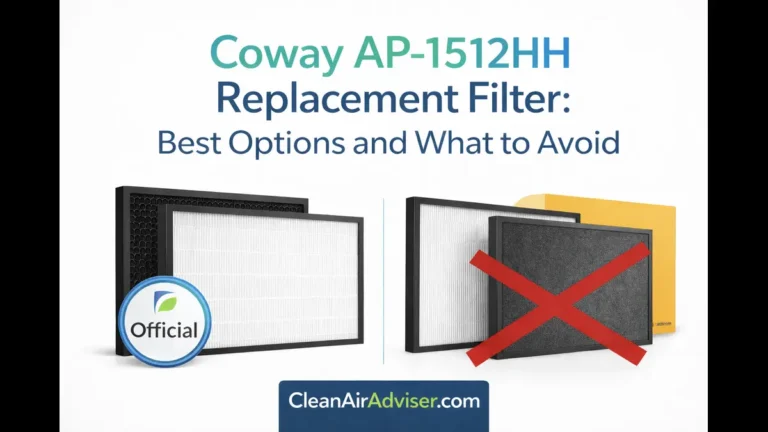
Even models from one brand can have different current guidance. Levoit recommends 6 to 8 months for the Core 300S, 6 to 12 months for the Vital 200S, and about 12 months for the current Core 400S. Coway splits the AP-1512HH schedule between a deodorization filter at about six months and a HEPA filter at about one year. Winix treats Filter Q in the 5510 as a complete one-year set.
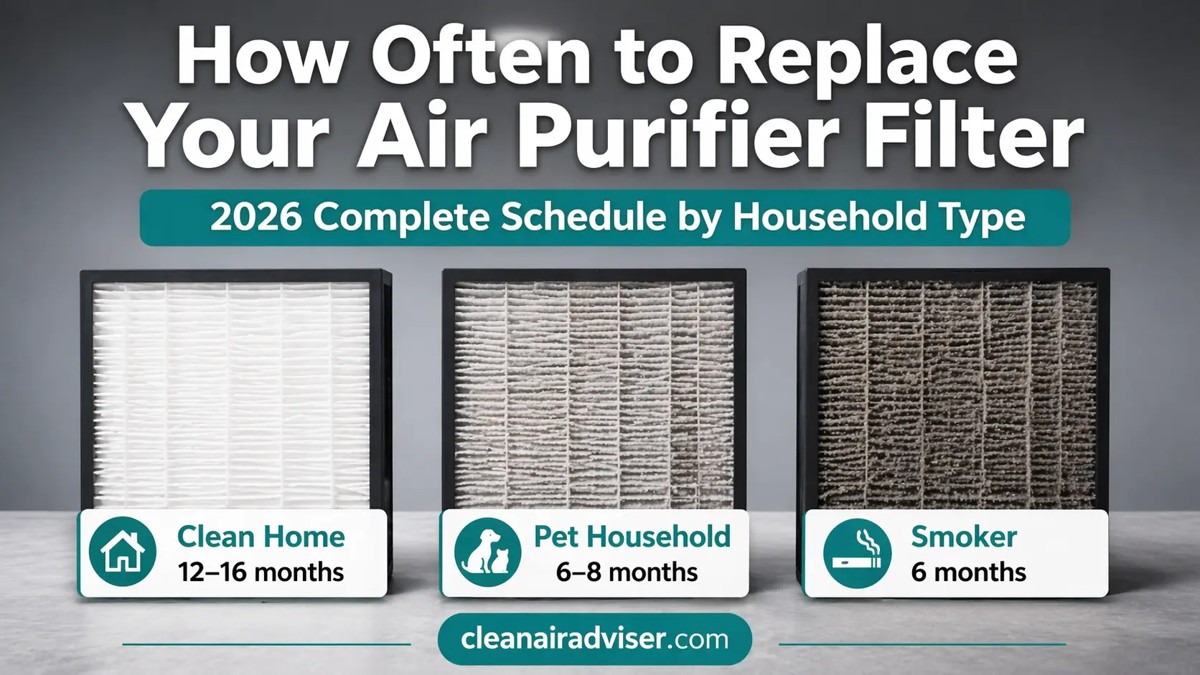
A household table that says every pet owner needs a HEPA filter at six months may look helpful, but it invents precision the manuals do not provide. Pets, wildfire smoke, renovation dust, indoor smoking, and long run times can shorten service life. They do not shorten every filter by the same percentage.
Current replacement schedules for popular models
| Purifier | Manufacturer starting point | Pre-filter maintenance | Important detail |
|---|---|---|---|
| Coway AP-1512HH / 200M | Deodorization filter about 6 months; HEPA about 1 year | Clean about every 2 to 4 weeks | Separate layers can be replaced on different schedules |
| Levoit Core 300 / 300S | Complete bonded filter about 6 to 8 months | Soft brush or vacuum every 2 to 4 weeks; no water | The indicator is a reminder to inspect and may not mean immediate replacement |
| Levoit Vital 200S | Complete bonded filter about 6 to 12 months | Clean every 2 to 4 weeks; removable pre-filter may be washed and fully dried | Particle and carbon stages are replaced together |
| Levoit Core 400S | Current US manual says about 12 months | Soft brush or vacuum every 2 to 4 weeks; no water | Older pages often repeat outdated 6-to-8-month guidance |
| Winix 5510 / 5520 | Filter Q HEPA and AOC carbon set about 12 months | Follow the manual revision supplied with the purifier | Winix says the interval can vary with the environment |
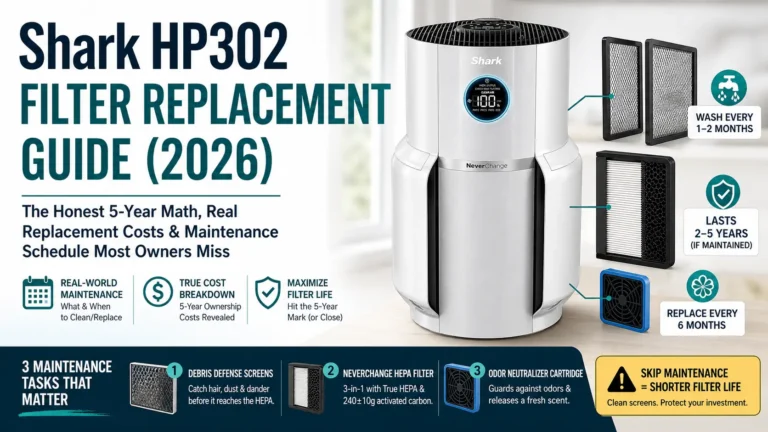
| Shark NeverChange HP302 | Advertised for up to 5 years | Follow HP302 cleaning and indicator instructions | “Up to” is a test-based upper limit, not a promise for every home |
These are United States schedules checked on August 14, 2026. Model revisions and regional manuals can differ. The label on your purifier and the current manual for that label take priority over this table.
Our detailed model guides explain the current instructions and compatibility checks for the Coway AP-1512HH, Levoit Core 300, Levoit Vital 200S, Levoit Core 400S, and Winix 5510.
How each filter type reaches the end of its useful life
Particle filters: airflow matters more than color alone
A particle filter captures dust, pollen, dander, smoke particles, and other aerosols as air passes through its fiber structure. As material accumulates, resistance to airflow usually rises. The practical result can be less clean air delivered to the room, even though the media is still capturing a high percentage of particles that pass through it.
This corrects a common myth: an aging HEPA filter does not necessarily develop a sudden invisible failure where captured particles start streaming through. Loading behavior depends on the media and seal. The more dependable consumer signals are the model’s service interval, reduced airflow after approved pre-filter cleaning, abnormal noise, physical damage, a poor seal, or a manufacturer indicator.
Color is useful context, not a laboratory capacity test. The upstream surface can become gray quickly because it is doing its job. A white-looking downstream face also does not prove a precise number of months remain. Do not open, cut, tap, or shake the filter to inspect deep layers.
Activated carbon: odor return is a clue, not a universal test
Activated carbon adsorbs some gases and odor molecules on its porous surface. Capacity depends heavily on how much carbon is present, what pollutants reach it, humidity, temperature, airflow, and whether a source continues. A thin carbon sheet in a small purifier cannot be assigned the same schedule as a deep pellet bed.
Returning cooking, pet, or smoke odor can indicate declining carbon performance after the source has been removed. Smell is not a complete VOC test, however. Some hazardous gases have little odor, people become accustomed to smells, and no common consumer purifier filter removes carbon monoxide. Use working carbon-monoxide alarms and address gas or chemical sources directly.
Carbon decline is not always a dramatic overnight cutoff. Treat returning odor as a reason to inspect the system, remove the source, verify airflow, and consider replacement within the model’s instructions.
Bonded filters: one stage can set the schedule
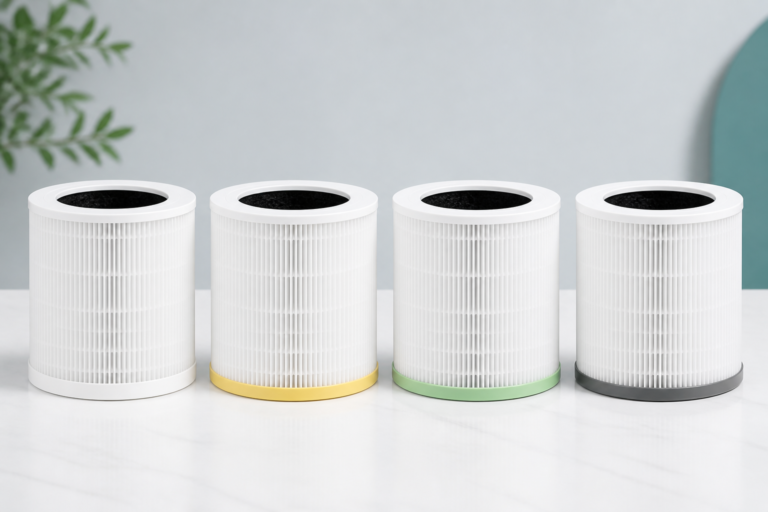
Levoit Core filters combine the pre-filter surface, particle media, and carbon layer into one cylindrical assembly. You may clean the outer surface as directed, but you cannot buy a genuine carbon-only insert. If odor control becomes inadequate while the particle layer still flows well, the complete cylinder must be replaced.
Coway and Winix models with separate carbon and particle layers can offer more flexibility. The Coway Mighty, for example, has a six-month deodorization schedule and a one-year HEPA schedule. This is one reason separate-layer designs can be economical in an odor-heavy home.
What the filter indicator actually tells you
There is no single indicator design used by every air purifier. Some are based mainly on elapsed operating time. Some smart models calculate an estimate using usage and other inputs. Consumer indicators generally do not perform a direct laboratory measurement of remaining particle capacity or carbon adsorption.
The manual determines how to interpret the light. The current Core 300S manual explicitly says the indicator should illuminate within 6 to 8 months and that the filter may not need replacement yet. The Winix 5510 manual says the lit Check Filter indicator means it is time to replace the HEPA and carbon filters. Those instructions are not interchangeable.
Reset the indicator only after doing what the manual requires. A reset restarts a reminder; it does not clean media, improve airflow, or verify that an aftermarket filter matches the genuine one.
| Indicator situation | Best response |
|---|---|
| Light appears near the published interval | Read the model manual, inspect the filter, and replace if the manual or condition calls for it |
| Light appears soon after a new filter | Confirm the reset procedure and installation before buying again |
| No light, but airflow is poor | Clean the permitted pre-filter and clear the inlet; replace a loaded main filter if airflow stays low |
| No light, but odors have returned | Remove the odor source, verify airflow, then consider carbon or complete-filter replacement |
| App percentage and physical signs disagree | Treat the percentage as an estimate and follow the manual plus physical condition |
Seven signs that justify replacement or immediate inspection
- The manual interval has arrived. This is the planned inspection or replacement point for the exact model.
- Airflow remains noticeably lower. Clean the approved pre-filter and make sure furniture, curtains, and dust are not blocking the inlet or outlet first.
- A persistent odor returns. Remove cooking, smoke, litter, moisture, or chemical sources. If the purifier previously helped and adequate airflow remains, the carbon may be exhausted.
- The filter is wet or has mold-like growth. Replace it and solve the leak, condensation, or humidity problem. A new filter will not correct the moisture source.
- The media, frame, or seal is damaged. Crushed pleats, torn material, missing gaskets, or a loose fit can create bypass.
- Noise begins immediately after installation. Turn the purifier off, remove all packaging, reinstall the filter, and return a wrong-size or deformed replacement.
- The manufacturer indicator requires replacement. Follow the manual’s wording and reset procedure for that model.
Worsening allergy symptoms alone are not a reliable filter-life test. Symptoms have many possible causes, including outdoor pollen, humidity, dust reservoirs, illness, medication changes, and an undersized or poorly placed purifier. Check the equipment, but do not use symptoms to diagnose a filter or delay medical advice.
What not to use as a replacement rule
- “Every HEPA filter lasts 12 months.” Current manufacturer schedules vary.
- “Every pet home cuts life in half.” Pet count, shedding, floor cleaning, purifier size, pre-filter design, and daily use differ.
- “The back of the filter is white, so it has months left.” Color is not a calibrated capacity measurement.
- “I cannot smell anything, so the carbon still removes VOCs.” Human smell cannot verify broad gas removal.
- “The filter looks dark, so it has failed.” Surface dust can appear early. Check airflow, the manual, and the whole condition.
- “The app says 40%, so performance is exactly 40%.” Filter-life percentages are estimates, not direct efficiency measurements.
- “A wildfire happened, so every filter must be discarded.” Heavy smoke can shorten life, but inspect condition and follow public-health and manufacturer guidance rather than applying an automatic date.
How pets, smoke, cooking, and run time change the answer
Pets
Hair loads the pre-filter, while smaller dander reaches the particle media. Clean the approved pre-filter more often when hair accumulates rapidly. A large, accessible washable pre-filter can protect the main filter better than a small bonded mesh, but only wash it if the manual permits water.
Pet odor loads carbon independently of visible hair. A litter box or damp bedding is a source-control problem first. Cleaning the source and ventilating when appropriate can extend carbon life more effectively than buying a specialty label.
Wildfire and tobacco smoke
Smoke adds a large particle load and a mixture of gases. During an outdoor smoke event, close doors and windows when authorities advise it, reduce indoor sources, and run a properly sized purifier continuously at the highest tolerable speed. After the event, inspect the pre-filter and main filter. Replace for persistent odor, poor airflow, visible heavy loading, damage, or the model’s instruction.
Indoor smoking creates an ongoing source that can exhaust small carbon filters quickly. A portable purifier reduces some airborne pollution but does not make indoor smoking safe for other occupants.
Cooking and renovation
Use a vented range hood for cooking particles and gases. For painting, solvents, new flooring, or renovation dust, isolate the work, ventilate safely, and follow product-safety instructions. A consumer carbon filter is additional control, not a substitute for removing a strong source.
Long daily run time
Longer run time sends more room air through the filter, which improves total filtration but also increases the amount of material collected. EPA notes that higher speeds and longer operation generally increase filtration. That is not a reason to switch the purifier off when clean air is needed. It is a reason to inspect on schedule and budget for filters.
How to inspect a filter safely
- Turn the purifier off and unplug it.
- Open the filter compartment without shaking or striking the filter.
- Check for forgotten plastic packaging, a loose fit, torn media, moisture, mold-like growth, or heavy surface loading.
- Clean only the pre-filter and sensor areas named in the manual.
- Keep non-washable particle and carbon media dry.
- Bag a very dusty filter before carrying it through the home.
- Install the correct replacement, close the housing, and perform the model-specific reset.
EPA advises minimizing movement during filter changes so collected pollution is not released again. People dealing with heavily contaminated filters can consider gloves and a well-fitting respirator, particularly after severe smoke or dusty renovation exposure.
A simple maintenance log that works better than guessing
Write four items on a note, calendar, or phone reminder:
| Record | Example | Why it helps |
|---|---|---|
| Exact purifier and filter model | Core 300S-P, Core 300-RF | Prevents ordering a similar-looking wrong size |
| Installation date | August 14, 2026 | Gives the indicator and manual interval context |
| Pre-filter cleaning date | Every second Saturday | Prevents surface debris from becoming an airflow problem |
| Observed change | Odor returned; airflow normal | Separates carbon concerns from particle loading |
At about halfway through the manufacturer’s interval, begin a brief monthly check. You are not trying to calculate a scientifically exact remaining percentage. You are looking for a change from the purifier’s normal airflow, sound, odor control, fit, and cleanliness.
Replacement-filter buying checklist
- Match the purifier label, filter model, and dimensions.
- Confirm whether the box contains a complete bonded filter or separate layers.
- Check the seller, package condition, return policy, and current stock.
- Do not buy from a marketplace image alone; similar Core and Winix filters can look nearly identical.
- Keep one spare when smoke season or supply interruptions would make waiting risky.
- Leave the spare sealed until installation so the carbon is not exposed unnecessarily.
Popular genuine replacements
Confirm your exact model before ordering. These are affiliate links, and availability can change.
Frequently asked questions
How often should a HEPA air-purifier filter be replaced?
Use the schedule for the exact purifier. Popular consumer models commonly specify about 6 to 12 months, but that is not a universal HEPA rule. Replace earlier for persistent low airflow after approved cleaning, damage, moisture, heavy loading, or the model’s indicator and instructions.
Does a dark HEPA filter always need replacement?
No. The upstream surface can darken as it captures particles. Color is one piece of evidence, not a calibrated capacity test. Consider the manual interval, airflow, physical condition, seal, noise, and indicator together.
Can I wash or vacuum a HEPA filter?
Do not wash or vacuum the main particle media unless the manufacturer explicitly says it is washable or cleanable. Many manuals allow vacuuming or washing only the separate or outer pre-filter. Water can damage non-washable particle and carbon media.
How often should an activated-carbon filter be replaced?
Follow its model-specific schedule. Carbon sheets, pellet trays, and deep beds have very different capacity. Returning odor after the source is removed can be a practical clue, but smell does not verify removal of every gas or VOC.
Should I replace a filter immediately after wildfire smoke?
Not automatically. Severe smoke can shorten service life. Inspect the filter and replace if it is heavily loaded, damaged, smells persistently smoky, restricts airflow, or reaches the manufacturer’s replacement condition. Keep a spare during smoke season.
Why did the replacement light return so soon?
The previous replacement may not have been reset correctly, or the model may calculate life from usage. Confirm the filter is installed correctly and follow the exact reset procedure in the current manual before buying another filter.
Can I keep using a filter after the reminder appears?
Only when the manual treats the light as an inspection reminder and the filter remains in acceptable condition. The Core 300S manual makes that allowance. Other models, including Winix 5510, tell the owner to replace when the light appears. Follow your model.
Bottom line
The best answer to “how often should I replace my air-purifier filter?” is the current manual plus the filter’s real condition. Use the published interval as a starting point, maintain the approved pre-filter, and replace for low airflow, returning odor after source control, damage, moisture, heavy clogging, or the model’s indicator. Do not rely on a universal pet multiplier, a white-versus-gray photo, an app percentage, or your sense of smell alone.
Sources
- US EPA: Guide to Air Cleaners in the Home
- US EPA: longer run time, higher fan speed, pollution loading, and safe filter changes
- Coway: AP-1512HH product specifications and filter-life expectancy
- Coway: AP-1512HH user manual (PDF)
- Levoit: Core 300S-P United States user manual (PDF)
- Levoit: Vital 200S-P United States user manual (PDF)
- Levoit: Core 400S-P United States user manual (PDF)
- Winix: current 5510 and 5520 user manual (PDF)
- Winix: genuine Filter Q replacement schedule
- Shark: HP302 product page and up-to-five-year claim
Last fact-checked August 14, 2026. Manufacturer instructions can change. Confirm the manual for the model and region printed on your purifier.