Winix 5500-2 Review (2026): Still Worth It Before It’s Gone?
Disclosure: CleanAirAdviser.com is a participant in the Amazon Associates Program. If you purchase through our links, we may earn a small commission at no extra cost to you. This helps us continue researching and reviewing air purifiers. Our opinions are our own. Read how we review.
Quick Verdict — Is the Winix 5500-2 Still Worth Buying in 2026?
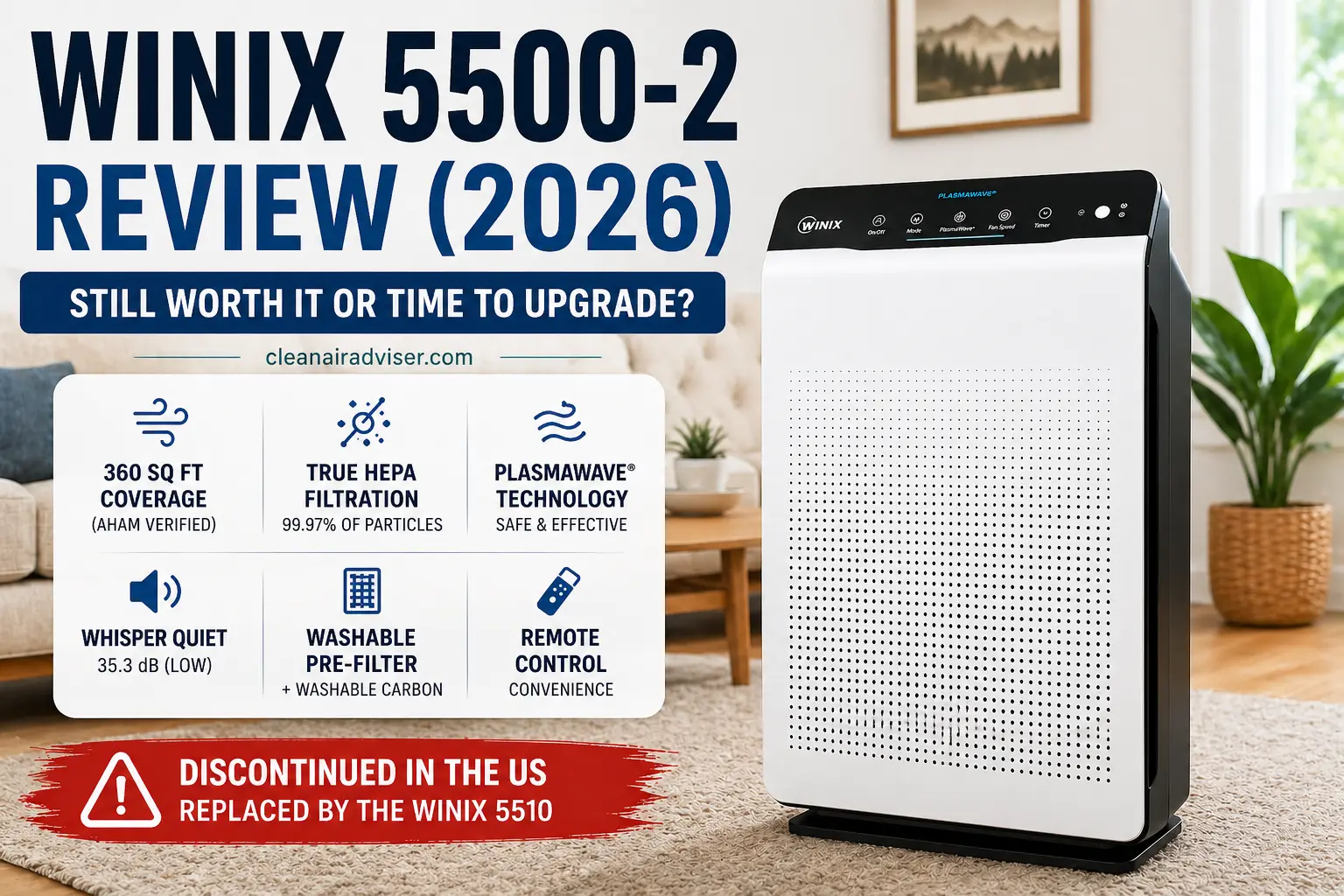
⚠️ Important: Winix America confirmed to HouseFresh in May 2025 that the Winix 5500-2 is officially discontinued in the US and Canada, replaced by the newer Winix 5510. The good news: Winix has also confirmed they will continue producing OEM filters for the 5500-2 until 2032, so existing owners and new buyers don’t need to worry about filter supply for the next 6+ years.
This winix 5500-2 review is for two groups of people: existing owners deciding whether to keep theirs running (yes, easily — OEM and third-party filters are abundant), and shoppers who’ve spotted a discounted unit on Amazon and want to know if it’s still worth grabbing before stock runs out (also yes, with caveats). Despite the discontinuation, the 5500-2 remains one of the best-performing mid-range air purifiers ever made, with independent lab data backing claims that competitors like the Coway AP-1512HH and Levoit Core 400S still struggle to match in odor removal.
Best for: Buyers who can grab a 5500-2 at meaningful discount vs the newer 5510, anyone who wants a remote control, heavy-odor households (cooking smells, pets), and owners who prefer not to deal with smartphone apps.
Not ideal for: Buyers who want Wi-Fi or smartphone control, anyone needing to cover more than 360 sq ft (look at the 5510 for 392 sq ft), and households highly sensitive to fan noise at high speeds (max 59.8 dBA — louder than class average).
Our take: If priced significantly below the Winix 5510 (~$199 sale, $259 list), buy the 5500-2. If priced within $20–30 of the 5510, the choice is more nuanced: the 5510 has Wi-Fi/app and a smaller footprint, but HouseFresh’s testing shows it runs significantly louder at top speed (67.2 dBA vs ~60 dBA) because the smaller body forces the fan to work harder. For quiet operation in heavy-use scenarios, the 5500-2 actually wins.
Table of Contents
The Winix 5500-2 Is Discontinued — What You Need to Know
This is the most important fact in any honest winix 5500-2 review, so let’s address it head-on. As of May 2025, Winix America officially confirmed to HouseFresh that the Winix 5500-2 (and the older 5300-2) have been discontinued in the US and Canada. Production has stopped; remaining stock on Amazon, Walmart, Target, Best Buy, and Home Depot will sell through and not be replaced.
The replacement model is the Winix 5510, which uses essentially the same filtration architecture in a smaller, modernised body with Wi-Fi and a smartphone app. We’ll cover that comparison in detail below.
The good news: filter supply is guaranteed through 2032
The biggest concern existing owners and prospective buyers have about a discontinued purifier is filter supply. Here’s the direct quote from Danny Ashton at HouseFresh after he reached out to Winix:
“We reached out to Winix and they confirmed that they will continue producing filters until 2032, so you could still get a 5500-2 and be able to keep it running with OEM filters.”
— Danny Ashton, HouseFresh founder
That’s six more years of guaranteed OEM filter availability — far longer than most owners would keep a single unit anyway. On top of that, third-party 116130 filters are everywhere on Amazon and Walmart at significantly lower prices than OEM, and they’ll likely keep producing as long as the installed base remains substantial. Filter supply is genuinely not a concern.
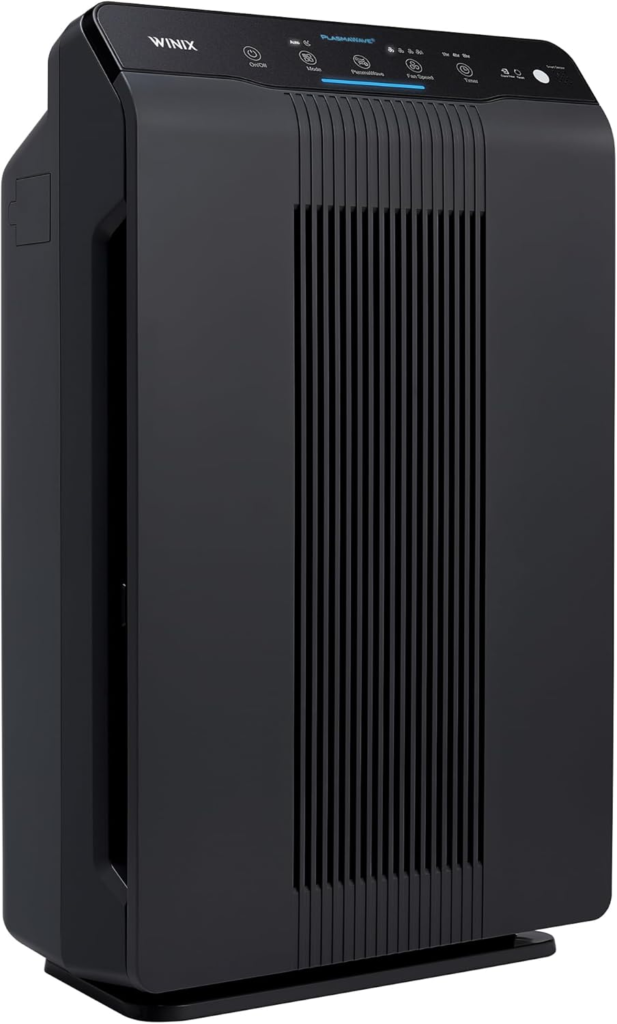
Winix 5500-2 Specs at a Glance
| Spec | Detail |
|---|---|
| Status | Discontinued May 2025 (US/Canada) — still available while stock lasts |
| Coverage (AHAM-verified) | 360 sq ft at 4.8 ACH |
| CADR (AHAM-verified) | 232 CFM smoke / 243 CFM dust / 246 CFM pollen |
| Filter system | 4-stage: washable mesh pre-filter + washable AOC carbon (pellet) + True HEPA + PlasmaWave |
| Carbon mass | ~226g pellet carbon (same as Winix 5510, per Winix support to HouseFresh) |
| OEM Replacement Filter | Filter H — Part Number 116130 (NOT 115115) |
| Motor rating | 70W (per Winix user manual) |
| Energy use (HouseFresh-measured) | 6.5W idle / ~53.46W actual at max (PlasmaWave on) / ~3.5W sleep mode / ~$4.82/month at 24/7 max ($0.174/kWh) |
| Noise (HouseFresh-measured) | 35.3 dBA on lowest / 59.8 dBA on max — above class average at high |
| Fan speeds | 4 manual + Auto mode + Sleep mode |
| Wi-Fi / App | ❌ None |
| Remote control | ✅ Included |
| PlasmaWave (bipolar ionization) | ✅ With on/off toggle (CARB-certified at 50 ppb ozone limit) |
| Certifications | AHAM Verifide, CARB certified, Energy Star certified |
| Dimensions | 15 × 8.2 × 23.6 inches; 15.4 lbs |
| Warranty | 2-year limited |
| Current price | ~$150–200 while stock lasts |
How It Performs — Independent Lab Data
The Winix 5500-2 has been independently lab-tested by more reviewers than almost any air purifier on the market. Here’s what they found:
- HouseFresh (Danny Ashton): Cleaned the test room in 23 minutes with PlasmaWave on, 24 minutes without. Calculated price-to-CADR ratio at 74¢ per CFM — among the best value-for-money on the market. Verdict: “one of my top recommendations” before discontinuation.
- AirPurifierFirst (Milan Antonic): 96% air quality improvement in a 320 sq ft test room over 60 minutes at max speed (AQI from 141 → 5). Smoke removal in roughly 20 seconds. CADR independently confirmed at 232/243/246.
- TechGearLab: 99.98% airborne particulate removal in a 150 sq ft room in 1 hour. “One of our top performances for user-friendliness.” Acknowledged con: “Louder than most on high settings.”
- Consumer Analysis: Reduced room concentration from 10,000 to 1,000 particles/ft³ in 9 minutes (150 sq ft test room), then to 100 particles/ft³ in 6 more minutes — total 15 minutes. Matched Coway Mighty’s particle removal performance directly.
- Tom’s Guide: “Above-average air purifier that stands out for PlasmaWave technology… one of our top recommendations.” Con noted: “More expensive filters than some competitors.”
- Consumer Reports: Rates the Winix 5500-2 with a high predicted reliability rating and confirms the AHAM CADR figures independently. Consumer Reports continues to list the 5500-2 in their air purifier ratings even after the discontinuation announcement, citing its strong long-term ownership data and consistent particle and smoke removal scores.
Bottom line on performance: this is a genuinely high-performing air purifier. The discontinuation isn’t because it underperformed — it’s because Winix wanted to consolidate around a more modern body design with Wi-Fi/app support. For context on the 5500-2’s reputation: it was a runner-up pick in NYTimes Wirecutter’s air purifier guide for years, sat as one of HouseFresh’s top recommendations until production ended, and remains on RTINGS’ “Best Large Room Air Purifiers” budget list as of late 2025.
The Washable Carbon Pellet Advantage
One of the 5500-2’s genuine technical advantages is its activated carbon filter. Where competitors like the Coway AP-1512HH use a thin impregnated carbon sheet (effective short-term but quickly saturates and isn’t washable), the 5500-2 uses an AOC carbon filter packed with activated carbon pellets. Per Winix support (verified by HouseFresh), this contains roughly 226g of carbon — the same amount used in the newer Winix 5510.
What this means in practice:
- Better odor adsorption — pellet carbon has more total surface area than a thin sheet, which translates to longer-lasting and more effective odor and VOC removal.
- Washable — Winix recommends washing the AOC carbon filter every 3 months and replacing it annually (along with the HEPA layer). Washing extends effective carbon life between replacements.
- Carbon “regeneration” — heavy odor households (cooking smells, pets, smoke) benefit substantially from washable carbon vs disposable sheet because you can refresh it without buying a new filter every time it gets saturated.
The catch: when reviewers say “washable carbon,” there’s debate in the Reddit r/AirPurifiers community about how much washing actually restores carbon’s adsorption capacity (rinsing surface debris ≠ desorbing trapped VOCs). The honest take: washing is good for prolonging functional life, but you should still plan to replace the AOC carbon filter annually for optimal performance.
PlasmaWave — Should You Turn It On or Off?
PlasmaWave is Winix’s branded ionization technology. Unlike traditional ionizers (which produce only negative ions), PlasmaWave generates both positive and negative ions — a process called bipolar ionization. The marketing claim: it “attacks pollutants at a molecular level” to neutralize viruses, bacteria, chemical vapors, and odors.
Is it safe?
Honest answer: yes, by regulatory standards — but reasonable people still disagree about whether to use it. The Winix 5500-2 is certified by the California Air Resources Board (CARB), meaning it meets the ozone emission limit of 0.050 parts per million (50 ppb). HouseFresh’s testing didn’t detect concerning ozone levels.
That said, the Reddit r/AirPurifiers community is genuinely divided on bipolar ionization technologies. Critics argue that any electrical air-treatment process (even bipolar) can produce small amounts of unintended byproducts, and that the actual filtration benefit comes from the HEPA + carbon layers anyway. Defenders point out that CARB certification, low ozone measurements in independent testing, and Winix’s published safety data make PlasmaWave acceptable for most users.
Our recommendation
- If you have asthma, COPD, chemical sensitivities, or are pregnant: Turn PlasmaWave off. The HEPA + carbon filtration alone is highly effective, and HouseFresh confirmed only a 1-minute difference in their cleaning test (24 vs 23 minutes) with PlasmaWave off.
- If you’re a healthy adult and want every available cleaning mechanism: Leave PlasmaWave on. The CARB certification provides reasonable assurance the unit meets ozone safety standards.
- If in doubt: Turn it off. The purifier works perfectly without it.
Note that the on/off toggle is on the unit itself — there’s no app or smart-home control. Once you set it, it stays.
The “buzzing sound” some owners report
One owner-reported quirk worth knowing about: when PlasmaWave is enabled, some units produce a faint buzzing or chirping sound. This is acknowledged in Winix’s own user manual: “When the unit is running, you may hear a chirping or buzzing sound. The sound is from large particles passing through PlasmaWave; it is normal and does not signify product failure.” Winix Japan’s documentation describes it similarly. If the sound bothers you in a quiet bedroom, the simple fix is the same: turn PlasmaWave off via the front panel button. The HEPA + carbon filtration is silent and continues working as normal.
Winix 5500-2 vs Winix 5510 — Which Should You Buy?
This is the #1 search query for the Winix 5500-2 family, so let’s settle it with verified data. Both models share the same internal filtration philosophy (washable mesh pre-filter + carbon pellet AOC filter + True HEPA + PlasmaWave), but they differ in several practical ways:
| Feature | Winix 5500-2 | Winix 5510 |
|---|---|---|
| Status | Discontinued (May 2025) | Current production |
| Smoke CADR | 232 CFM | 253 CFM |
| Coverage | 360 sq ft | 392 sq ft |
| Current price | ~$150–200 (while stock lasts) | ~$180–200 |
| Wi-Fi + smartphone app | ❌ | ✅ |
| Remote control | ✅ | ❌ |
| Carbon filter | ~226g pellets, washable | ~226g pellets, NOT washable |
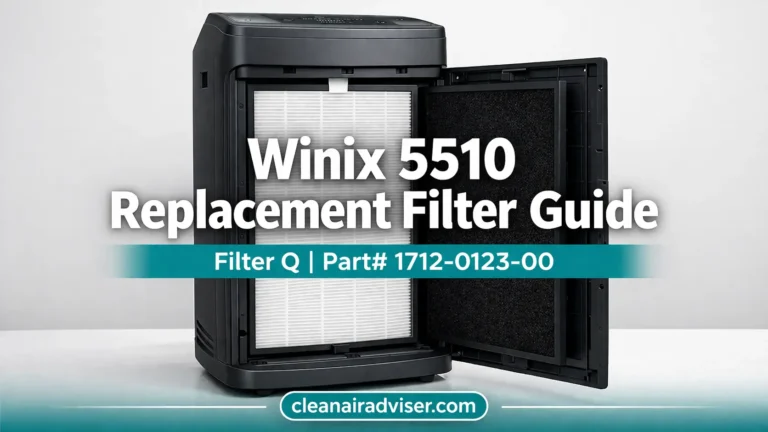
| OEM filter part | Filter H (116130) | Filter Q (1712-0123-00) — NOT cross-compatible |
| Third-party filter availability | Extensive (years of aftermarket maturity) | Limited (newer model) |
| Energy/month at 24/7 max | ~$4.82 (53.46W measured) | ~$4.85 (53.84W measured by HouseFresh) |
| Footprint | Larger (15 × 8.2 × 23.6 in) | More compact |
| Noise at max speed (HouseFresh) | ~60 dBA | 67.2 dBA — significantly louder |
| Sound at sub-45 dBA | Cleared test room in 43 min at speed 2 | 60 min at speed 2 (smaller filters work harder) |
Here’s the framing AirPurifierFirst’s Milan Antonic offered after testing both:
“Frankly I would get the Winix 5510, even though the Winix 5500-2 may be a better buying option and better value for the money, according to our data.”
— Milan Antonic, AirPurifierFirst
That tension is the honest answer. The 5500-2 has slightly better value-for-money math (especially on filter costs and at quieter speeds), but the 5510 is the future-proofed choice with active manufacturer support. Our take: buy the 5500-2 if it’s at least $30+ cheaper than the 5510. Buy the 5510 if the gap is smaller — modern app support, smaller footprint, and current production are worth $30 to most buyers.
The full side-by-side analysis covers all the technical and practical differences — see our complete Winix 5510 vs 5500-2 comparison for the detailed breakdown including 5-year cost projections and the $30 price-gap rule.
The filter-size trade-off most reviews miss
One detail almost no other 5510 vs 5500-2 review surfaces honestly: the 5510 is a smaller unit, which means its Filter Q (1712-0123-00) is physically smaller than the 5500-2’s Filter H. HouseFresh’s side-by-side photo comparison shows the size difference clearly. While both contain the same 226g of carbon (per Winix support to HouseFresh), the smaller Filter Q footprint has two practical implications:
-
- The 5510 fan has to spin faster to push the same volume of air through smaller media — which is why HouseFresh measured the 5510 at 67.2 dBA at top speed, considerably louder than other purifiers in its CADR class. The 5500-2’s max is closer to 60 dBA in the same testing methodology.
-
- Filter Q may saturate faster in heavy-pet households than Filter H, because there’s simply less surface area to capture dander and dust before resistance starts impacting airflow.
Reddit owners on r/AirPurifiers consistently flag this when comparing the two: “The 5510 unit is smaller, resulting in HEPA and carbon filters that are smaller than the 5500-2’s Filter H. Buy the 5500-2 if you can find it on clearance specifically because the 116130 filters are larger and third-party replacements are incredibly cheap.”
Practical takeaway: if your priority is the quietest possible operation in a heavy-pet or smoke-prone household, the 5500-2’s larger filter format is genuinely better-suited than the 5510’s compact design. If you want the quieter modern aesthetics, smartphone control, and future-proofed manufacturer support, the 5510 wins on those terms.
Winix 5500-2 vs Winix 5520 — what’s the difference?
This is a common comparison question, and the short answer: the 5520 is essentially the same hardware as the 5510 with a different-looking front grille. Per Ralph’s Way and confirmed by Reddit r/AirPurifiers owners: “5520 is the same as 5510 but it has a different style front grille.” Both share the same motor, filters (Filter Q / 1712-0123-00), CADR, sensors, and Wi-Fi/app integration.
So when comparing the 5500-2 to the 5520, all the same trade-offs from the 5500-2 vs 5510 comparison above apply directly:
-
- 5500-2 wins: washable AOC carbon filter, larger Filter H (more surface area), included remote, and quieter top speed (66.4 dBA vs 5520’s 64.9 dBA per HouseFresh — actually the 5520 edges out the 5510 here, but both are louder than the 5500-2 at sustained high)
-
- 5520 wins: Wi-Fi + Winix Smart App, smaller and lighter footprint, current production with active manufacturer support, gas/VOC sensor (auto-mode triggers from cooking odors and similar)
-
- Tied: Same 226g pellet activated carbon, same PlasmaWave technology, same 2-year warranty, AHAM-verified at 392 sq ft for 5520
The 5520’s list price is $189.99 (often discounted on Amazon). One Reddit owner who runs a 5520 noted: “I have been very happy with the auto air detection setting in the 5520 where it automatically cranks up the fan when cooking.” Practical takeaway: if the 5520 is on sale and you want a kitchen-adjacent purifier with VOC auto-detection, it’s a solid pick. If you want quieter operation in a heavy-pet bedroom, the 5500-2 still wins on the filter-size + noise dimensions covered above.
Winix 5500-2 vs Coway AP-1512HH
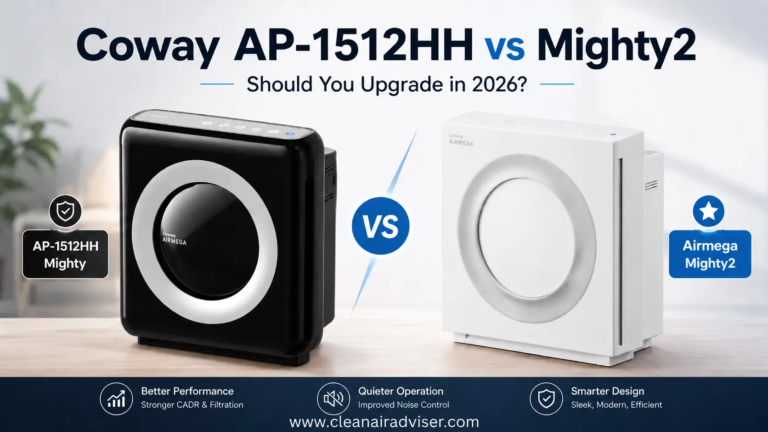
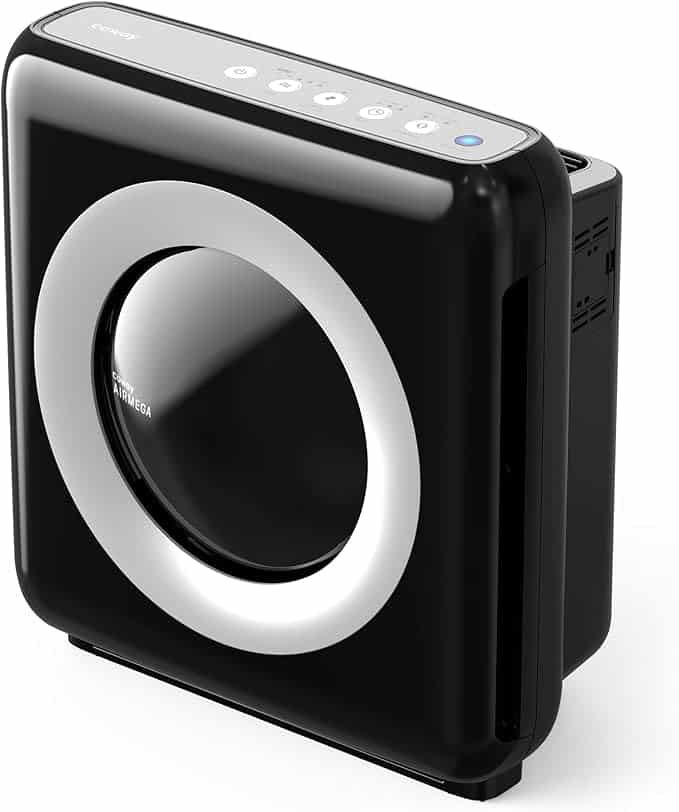
The other comparison buyers consistently ask about. The Coway AP-1512HH (also sold as the Coway Mighty) is the 5500-2’s closest direct competitor at this price point. Here’s how they stack up:
-
- 5500-2 wins on: pellet carbon (vs Coway’s thin sheet — meaningful for odor households), included remote control, slightly higher CADR (232 vs 233 CFM is essentially tied, but pollen and dust CADRs are higher).
-
- Coway wins on: energy efficiency (~$3.65/month vs ~$4.82/month at 24/7 max), quieter at high speeds, separate filter layers (replace carbon and HEPA independently — saves money long-term), smaller footprint.
-
- Tie: Both are AHAM-verified, both have ionizer toggles (Coway calls theirs “Ionizer,” Winix calls theirs “PlasmaWave”), both have CARB certification.
Buy the 5500-2 if: you have heavy odor needs (pets, cooking, smokers in household) and want a remote control. The pellet carbon is a real advantage here.
Buy the Coway AP-1512HH if: you prioritize lowest energy cost and quieter operation, and you don’t need a remote.
Filter Cost and Replacement Schedule (Including the Part Number Confusion)
⚠️ Important — read this before buying replacement filters: The Winix 5500-2 uses Filter H (Part 116130), NOT Filter A (Part 115115). Filter A is for the older 5300-2, C535, 6300-2, P300, AM90, and similar models. The two filters look similar but are physically different sizes. Always verify the part number says “116130” before clicking Buy.
This is genuinely the most confused topic in the entire winix 5500-2 review space — and most ranking articles get it wrong. Per Winix America’s current product page directly, the official replacement filter for the 5500-2 is Filter H (Part 116130). It includes both the True HEPA layer and the washable AOC pellet carbon filter that defines the 5500-2’s odor-removal capability. Filter A (Part 115115) is a different, physically distinct part for the 5300-2, C535, 6300-2, P300, and other older Winix models — it lacks the washable AOC carbon design. Always verify your replacement filter’s listing specifically references 116130 / Filter H / 5500-2 before purchasing.
💡 Need replacement filters? See our Winix 5500-2 Replacement Filter Guide — Filter A vs Filter H confusion explained, OEM vs third-party costs, off-gassing tips, Costco availability, and step-by-step replacement.
Replacement schedule and costs
| Component | Frequency | OEM cost | Third-party cost |
|---|---|---|---|
| Mesh pre-filter | Vacuum/wipe every 2 weeks; never replace | $0 | $0 |
| AOC carbon (pellet) | Wash every 3 months; replace ~annually | Included in Filter H set | Included in 116130 third-party set |
| True HEPA | Replace ~annually | ~$55/year (Winix 116130 OEM, $84.99 list / $54.99 on sale at Winix America) | ~$15–25/year (Funmit, Pulluty, PETOX, Nispira, Improvedhand 2-4 packs) |
| Annual filter cost | — | ~$55 | ~$15–25 |
For broader filter replacement guidance and budgeting across major air purifier brands, see our companion guide: How Often to Replace Your Air Purifier Filter.
What Reddit and Long-Term Owners Say
Aggregating Reddit r/AirPurifiers ownership data via RedditRecs gives a clear picture: 102 positive sentiment / 15 neutral / 11 negative. This is one of the most positively-reviewed air purifiers in the entire community, with the strongest themes being:
-
- Long-term durability. One owner reported running 11 separate Winix 5500-2 units around the same property — over six years, none have failed. Another: “Its been over ~6 years and they’re still running great.” This is the strongest product-longevity signal we’ve seen for any sub-$200 air purifier.
-
- Pet hair / heavy dander effectiveness. Reddit owners consistently recommend placing the 5500-2 directly next to pet beds or crates for maximum dander capture before it spreads. The washable mesh pre-filter handles dog and cat hair without clogging the HEPA layer prematurely.
-
- Affordable third-party filters. The mature aftermarket is consistently praised — multiple commenters note that the abundance of third-party 116130 options means actual annual filter cost can be as low as $15–20.
-
- Concerns about PlasmaWave. A vocal minority opposes any ionization technology on principle, regardless of CARB certification. Most who feel this way simply turn it off and report excellent results.
-
- Disappointment about discontinuation. Universal sentiment in the past 12 months — the 5500-2 had a near-cult following, and the community is genuinely sad to see it go.
For HEPA filtration context across the broader air-purifier landscape, see our pillar: Best HEPA Air Purifier Buying Guide 2026. For deeper context on whether HEPA purifiers actually work for allergies and respiratory health: Do Air Purifiers Actually Work?
What We Like and What We Don’t
What we like
-
- AHAM-verified CADR figures (232/243/246) — independently lab-tested by HouseFresh, AirPurifierFirst, TechGearLab, Tom’s Guide, and Consumer Reports
-
- Pellet activated carbon (~226g, same as 5510) — substantively better odor removal than thin-sheet competitors
-
- Washable AOC carbon filter saves money between annual replacements
-
- Included remote control — neither the Coway AP-1512HH nor Levoit Core 400S nor newer Winix 5510 includes one
-
- PlasmaWave can be turned off (CARB-certified for those who prefer to leave it on)
-
- Cheap third-party 116130 filters everywhere — ~$15–25/year vs $55 OEM
-
- Proven long-term durability — Reddit owners reporting 6+ years of no-failure operation
-
- Winix has confirmed OEM filter production through 2032
What we don’t like
-
- Discontinued — limited future production and eventual stock exhaustion (though filter supply is guaranteed through 2032)
-
- No Wi-Fi or smartphone app — feature gap vs the newer 5510, Levoit Core 400S, and most 2024–2026 launches
-
- Louder than class average at high speeds (59.8 dBA on max — closer to vacuum noise levels)
-
- Higher energy use than Coway and Levoit — about $1–2/month more if running 24/7
-
- Heavier (15.4 lbs) and bulkier than the newer 5510 — Tom’s Guide describes the design as resembling “an upright printer,” which is fair
-
- Filter part-number confusion (Filter H 116130 vs Filter A 115115) means you have to be careful when shopping for replacements
Final Verdict
The Winix 5500-2 was a top-tier mid-range air purifier for nearly a decade — Wirecutter’s top pick for years, HouseFresh’s top recommendation, AirPurifierFirst’s higher-value pick over the C535. Its discontinuation is a loss for the budget-to-mid market, not a sign that the product underperformed.
Buy the 5500-2 if
-
- You can find it discounted at least $30 below the current Winix 5510 (~$170 or below)
-
- You want a remote control (no other purifier in this price band has one)
-
- You have heavy odor needs and want washable pellet carbon
-
- You don’t care about Wi-Fi/app — you just want a purifier that works without setup
-
- You’re already an existing 5500-2 owner replacing filters or adding a second unit before stock disappears
Buy the 5510 instead if
-
- You want Wi-Fi/app control (real remote scheduling, real-time air quality monitoring)
-
- You want the smaller, more modern footprint
-
- The price gap between the 5500-2 and 5510 is less than $30
-
- You want active production support (warranty servicing is easier on current models)
FAQ: Winix 5500-2
Is the Winix 5500-2 discontinued?
What is the difference between Winix 5500-2 and 5510?
What filter does the Winix 5500-2 use?
Is PlasmaWave safe to use?
How often should I replace Winix 5500-2 filters?
What is the current price of the Winix 5500-2?
Is the Winix 5500-2 still worth buying in 2026?
Sources
-
- Winix America official product pages — 5500-2 specifications, Filter H (116130) compatibility, AOC carbon filter description, AHAM-verified CADR figures
-
- HouseFresh (Danny Ashton) — first-hand lab testing including 23-min cleaning time, 53.46W max power measurement, $57.82/year energy cost calculation, direct Winix America confirmation that filter production continues to 2032, CARB certification verification
-
- AirPurifierFirst (Milan Antonic) — comparative testing of 5500-2 vs 5510, 96% air quality improvement measurement in 320 sq ft test, confirmation of identical 226g carbon mass between models
-
- TechGearLab independent testing — 99.98% airborne particulate removal, “louder than most on high settings” verdict, $133/year cost estimate
-
- Consumer Analysis (consumeranalysis.com) — 15-minute particle reduction test, performance comparison vs Coway Mighty
-
- Tom’s Guide — review identifying it as one of their top recommendations
-
- Consumer Reports — high predicted reliability rating, independent CADR confirmation
-
- Amazon and Walmart listings (verified) — current ASIN B01D8DAYII for unit, B01JLT1OR8 for Filter H, third-party filter pricing and availability
-
- Best Buy product Q&A — Winix representative confirmation of Filter H (116130) as the correct OEM replacement, with note that Filter A (115115) physically fits but loses the washable-carbon design
-
- Reddit r/AirPurifiers (aggregated via RedditRecs) — 102 positive / 15 neutral / 11 negative sentiment over 6+ years; long-term durability reports including one owner running 11 units
-
- California Air Resources Board (CARB) — ozone emission certification database confirming the 5500-2 meets the 0.050 ppm (50 ppb) limit
Have a Winix 5500-2 ownership story or filter-replacement tip to share? Drop a comment — we update these reviews as new long-term owner data comes in.