Do Air Purifiers Actually Work? Evidence and Limits (2026)
Disclosure: Clean Air Adviser may earn a commission when you buy through links on this page. This does not change what you pay. We have not physically tested every purifier discussed here. This guide uses current EPA and CDC guidance, peer-reviewed studies, certified specifications, and clearly identified independent measurements. It is not medical advice.
Quick answer: This do air purifiers actually work guide highlights the evidence, practical fit, and buying limits that matter before you decide.
What air purifiers can and cannot do
| Problem | Do purifiers help? | Important limit |
|---|---|---|
| PM2.5, wildfire smoke particles | Yes, with enough smoke CADR | They do not remove every wildfire gas or stop outdoor infiltration |
| Cooking particles | Yes, as a supplement | An outdoor-venting range hood controls the source more directly |
| Pollen and airborne allergens | Yes, while particles remain airborne | Clinical symptom improvement varies and settled reservoirs remain |
| Respiratory-virus particles | Yes, as one cleaner-air measure | Filtration does not replace ventilation, vaccination, staying home when ill, or other guidance |
| Pet dander | Partly, for airborne allergen | Allergen in bedding, carpet, and furniture requires cleaning and access control |
| Visible surface dust | Limited | A purifier cannot capture dust after it settles |
| Odors and VOCs | Sometimes, with the right sorbent media | Thin carbon filters have limited capacity and no media removes every gas |
| Mold | Only airborne particles | Fix moisture and remove mold growth |
| Secondhand smoke | Can reduce some particles | EPA says filtration does not eliminate exposure |
| Carbon monoxide | No | Use working CO alarms, safe combustion appliances, ventilation, and emergency action |
| Radon | No recommended role | Test the building and use approved radon mitigation |
How an air purifier actually works
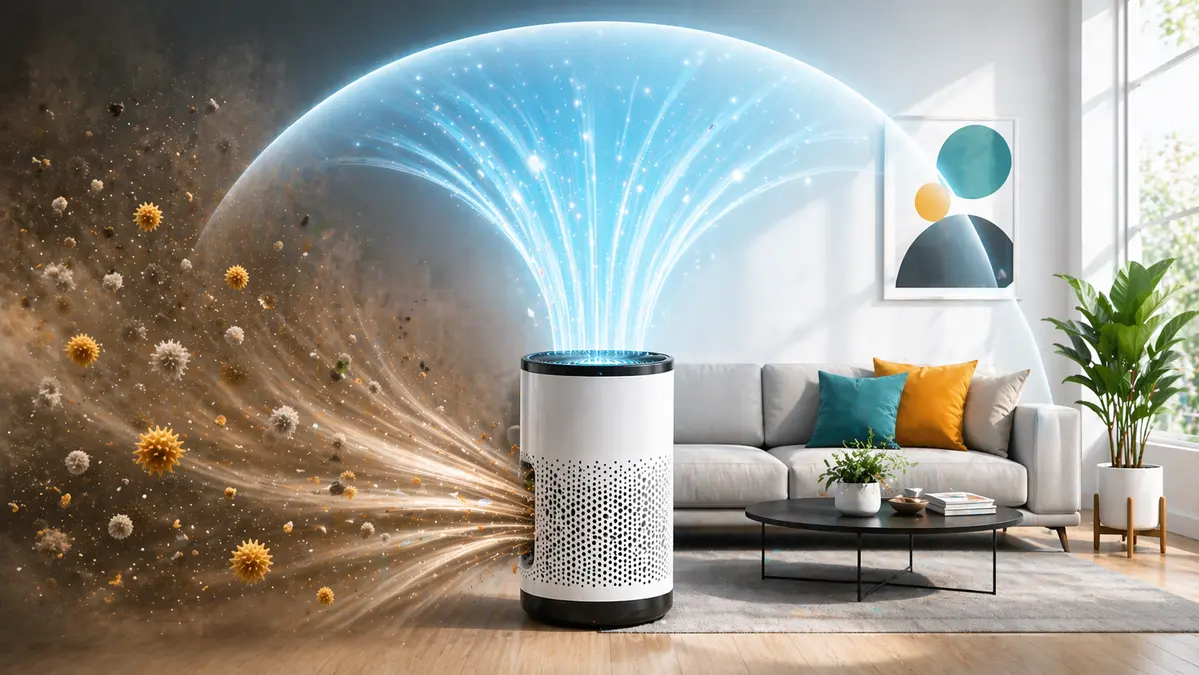
A portable purifier is a fan, one or more filters, and a cabinet that manages airflow. The fan pulls room air through the filter and returns cleaner air. The useful output is not simply “99.97%.” It is the quantity of cleaned air delivered each minute.
A HEPA filter captures particles through several physical mechanisms. Particles do not encounter a flat sieve with one hole size. They follow air paths through a dense fiber network and are collected by interception, impaction, and diffusion. A genuine HEPA filter is commonly rated to remove at least 99.97% of 0.3-micrometre particles in the test used for that filter.
That filter-efficiency statement is not a room-cleaning speed. A small purifier can have excellent media and still clean a large room slowly. A leaky cabinet or restrictive replacement filter can also reduce useful whole-machine performance. This is why clean air delivery rate, or CADR, is more useful for room sizing.
Activated carbon and other sorbents perform a different task. They adsorb selected gas molecules onto an internal surface. Results depend on the gas, carbon chemistry, media mass, humidity, contact time, and saturation. A black sheet is not evidence of high gas capacity.
The evidence: particle reduction is clearer than symptom relief
EPA’s current home-air-cleaner guide says portable cleaners and HVAC filters can filter particles, including PM2.5. It also says several HEPA studies have found small improvements in cardiovascular and respiratory health. Those benefits are not always noticeable to an individual, even when measurements change.
The allergy evidence is mixed rather than universally positive. A multicentre randomized, double-blind, placebo-controlled study of adults with house-dust-mite allergic rhinitis found that HEPA air purifiers reduced medication requirements and indoor PM2.5. That supports a possible clinical role as part of a broader plan.
Other allergens do not produce identical results. A placebo-controlled trial of 35 cat-allergic people found lower airborne cat allergen in the active-filter group, but no significant difference in nasal or chest symptoms, sleep disturbance, peak flow, spirometry, or rescue medication. Reducing an airborne marker does not guarantee that every person feels better.
EPA therefore uses careful language: portable HEPA cleaners may improve one or more allergy or asthma symptoms, but studies do not always show major improvements or improvements in every symptom. Anyone with persistent wheezing, breathing difficulty, or uncontrolled allergy or asthma symptoms should seek clinical care rather than use a purifier as treatment.
Do air purifiers work for dust?
They reduce airborne dust that reaches the intake. They do not vacuum shelves, carpets, mattresses, or floors. Larger dust and many allergen-bearing particles settle quickly, sometimes before room airflow carries them to the filter.
This explains why a filter can visibly collect dust while the coffee table still needs cleaning. The two observations are compatible. Filtration can lower the airborne concentration and slow some new deposition without eliminating household dust.
Use a purifier alongside damp dusting, a sealed HEPA vacuum, entry mats, and source control. Do not deliberately aim the purifier outlet across a dusty surface, litter box, or bedding because the airflow can resuspend material before eventually capturing some of it.
Do air purifiers work for allergies?
They can reduce exposure to airborne pollen, mold particles, and pet allergen. The benefit depends on how long the allergen remains airborne, how much is stored in surfaces, purifier airflow, and whether the source continues in the room.
For pollen, keep windows closed when outdoor counts are high and control particles entering on clothing and pets. For dust mites, bedding encasements, humidity control, and laundering target the reservoir more directly. For cat allergy, bedroom exclusion and surface cleaning matter alongside filtration.
Our updated cat-allergy purifier guide reviews the clinical uncertainty and explains why we no longer promise a fixed symptom-improvement timeline.
Do air purifiers work for smoke?
A high smoke CADR can substantially reduce fine smoke particles. EPA recommends choosing a purifier powerful enough for the intended room and running it as often as possible at the highest tolerable setting during wildfire smoke. For frequent heavy smoke, a smoke CADR approximately equal to room area is a conservative target for an eight-foot ceiling.
Smoke also contains gases. HEPA does not capture them, and a modest carbon layer cannot remove all of them. During wildfire smoke, close windows while outdoor air is worse, use recirculation where appropriate, create a cleaner-air room, and ventilate when outdoor conditions improve.
Secondhand tobacco smoke requires a firmer warning. EPA says ventilation, filtration, and air cleaning can reduce exposure but cannot eliminate it. Prohibiting smoking and vaping indoors and near doors, windows, and air intakes is the only way to eliminate indoor secondhand exposure.
See our wildfire-smoke evidence guide for current EPA sizing, cleaner-air room steps, and verified purifier data.
Do air purifiers work for cooking pollution?
Cooking can generate large amounts of particulate matter, especially during frying, grilling, high-temperature cooking, or accidental burning. A correctly sized purifier can reduce those airborne particles. It is a supplement to source control, not the first line.
EPA recommends using an outdoor-venting range hood whenever cooking and leaving it on for 10 to 20 minutes afterward. Back burners often improve capture. When outdoor air is clean and conditions are safe, windows or exhaust fans can add ventilation. A portable purifier helps when a good hood is unavailable or as extra particle control.
Do not expect a PM sensor to detect carbon monoxide or nitrogen dioxide. Keep fuel-burning appliances maintained and use working CO alarms. If an alarm sounds, follow emergency instructions and leave the area rather than trying to filter the air.
Do air purifiers work for mold?
A HEPA purifier can capture some airborne mold spores and fragments. It cannot stop mold growing on drywall, carpet, insulation, grout, or furniture. EPA states that mold results from a water or moisture problem and that filtration does not resolve the cause.
Fix the leak or humidity problem, assess the extent of contamination, and clean or remediate safely. A purifier may be useful as supplemental particle control during or after properly contained work. It should not be used to postpone repair or to hide a musty odor.
Do air purifiers reduce respiratory-virus risk?
Portable HEPA cleaners reduce airborne particles, including particles that may carry respiratory viruses. EPA advises choosing an appropriately sized unit with high smoke CADR, HEPA designation, or documented performance for particles below one micrometre. CDC includes portable HEPA cleaners in its cleaner-air recommendations and suggests aiming for five or more total air changes per hour from ventilation and filtration combined.
Filtration reduces concentration; it does not create a zero-risk room. Combine it with clean outdoor air when appropriate, staying home when sick, vaccination where recommended, and situation-specific public-health guidance.
What air purifiers do not remove
Carbon monoxide
Residential particle filters do not remove carbon monoxide. EPA’s gas-filter guidance says carbon monoxide is not readily captured by available residential gas-phase filtration products. Use approved alarms on every required level, maintain combustion appliances, never run engines or charcoal equipment indoors, and treat an alarm as an emergency.
Radon
EPA does not recommend air cleaners to reduce radon health risks. Test the building and use appropriate source-control mitigation, such as a professionally designed sub-slab depressurization system where needed.
Every VOC and odor
Gas filters are pollutant-specific and capacity-limited. Carbon can help with some cooking, pet, and smoke odors but is not a universal chemical-removal technology. Strong or recurring odor should trigger source investigation and safe ventilation, not just a larger scented filter.
How much CADR do you need?
For an eight-foot ceiling, a simple five-air-change target uses:
Required CADR = room square feet x 0.67
A 300-square-foot room therefore needs about 200 cfm for five air changes per hour at the purifier’s rated speed. This aligns closely with AHAM-style room ratings near 4.8 ACH. It is not necessary to demand CADR equal to room area for every ordinary use; that more conservative rule is helpful during frequent heavy wildfire smoke.
| Room | Approximate CADR for 5 ACH | Conservative heavy-smoke target |
|---|---|---|
| 120 sq. ft. | 80 cfm | 120 cfm |
| 200 sq. ft. | 134 cfm | 200 cfm |
| 300 sq. ft. | 200 cfm | 300 cfm |
| 400 sq. ft. | 268 cfm | 400 cfm |
High ceilings require more airflow. Open plans must be treated as the entire connected volume. CADR is normally measured at maximum speed, so size down if you plan to run quietly. Two purifiers in one room can approximately add their CADRs when placed well.
Why some owners see little benefit
- The pollutant is not airborne. Surface dust, mold growth, and contaminated textiles need source removal and cleaning.
- The unit is undersized. A large one-hour marketing area often means only one air change per hour.
- The tolerated speed is too low. Maximum CADR does not apply on Sleep mode.
- Airflow is blocked. Curtains, furniture, walls, and dirty prefilters restrict intake or outlet flow.
- Outdoor or indoor sources continue. Open windows during smoke, active smoking, candles, and frying can add pollution faster than a small purifier removes it.
- The wrong filter is installed. A poorly fitting replacement can leak or restrict airflow.
A dirty HEPA filter does not suddenly start passing every captured particle after an arbitrary date. As dust loads the media, resistance can reduce airflow and CADR. Replace according to the manual and indicator, plus observed loading, odor, damage, and airflow. Our filter replacement guide provides a condition-based method.
Are ozone generators and ionizers effective alternatives?
Do not use an ozone generator in an occupied home. EPA says that at concentrations within public-health standards, ozone has little potential to remove indoor contaminants. Concentrations high enough to have stronger effects can create a health hazard, and reactions may produce unwanted byproducts.
Ionizers and electrostatic systems vary. Some can remove particles, but they may also emit ozone or deposit charged material on surfaces. If considering an electronic feature, look for a verified whole-unit CADR, a model-specific ozone result or recognized low-ozone certification, and the ability to disable the feature. Mechanical filtration remains the simpler default.
Do air purifiers use much electricity?
Electricity use depends on wattage, speed, runtime, and local rate. Calculate monthly energy with:
Watts / 1,000 x hours per day x 30 = monthly kWh
A purifier drawing 50 watts continuously uses about 36 kWh per 30-day month. Multiply 36 by the rate on your bill. Lower speeds often use much less, but they also deliver less clean air. Compare energy at the fan setting that provides the airflow you need.
Four evidence-backed buying options
Levoit Vital 200S: balanced bedroom and pet pick
The Vital 200S has a certified 242 cfm smoke CADR, a removable washable prefilter, app control, a particle sensor, and no ionizer. HouseFresh’s purchased unit cleared PM1 in 23 minutes. It is our default choice for a medium bedroom or living room.
Winix 5510: strong airflow and separate pellet carbon
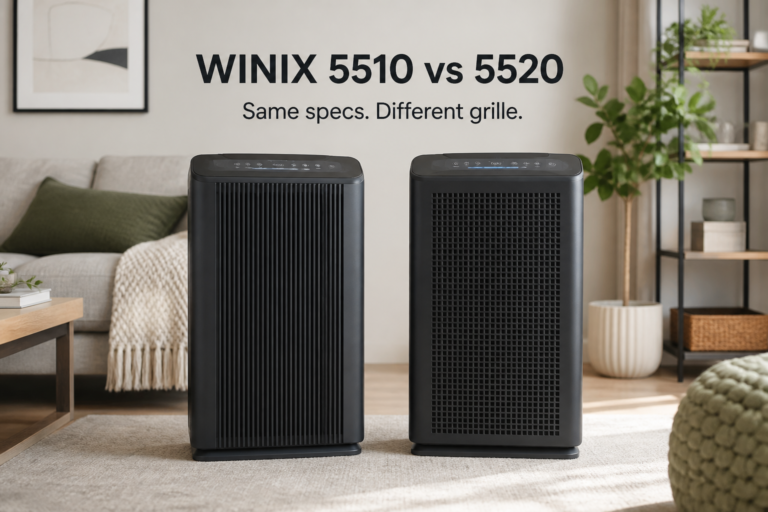
The 5510 has a 253 cfm certified smoke CADR and an estimated 249 cfm in HouseFresh’s test. Its Filter Q includes pellet carbon, but maximum speed measured a loud 67.2 dBA. Buy for a speed you will tolerate.
Coway AP-1512HH: simple proven particle purifier
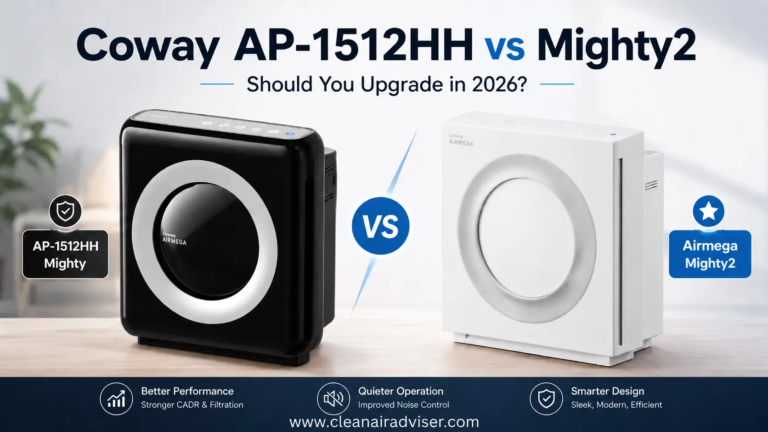
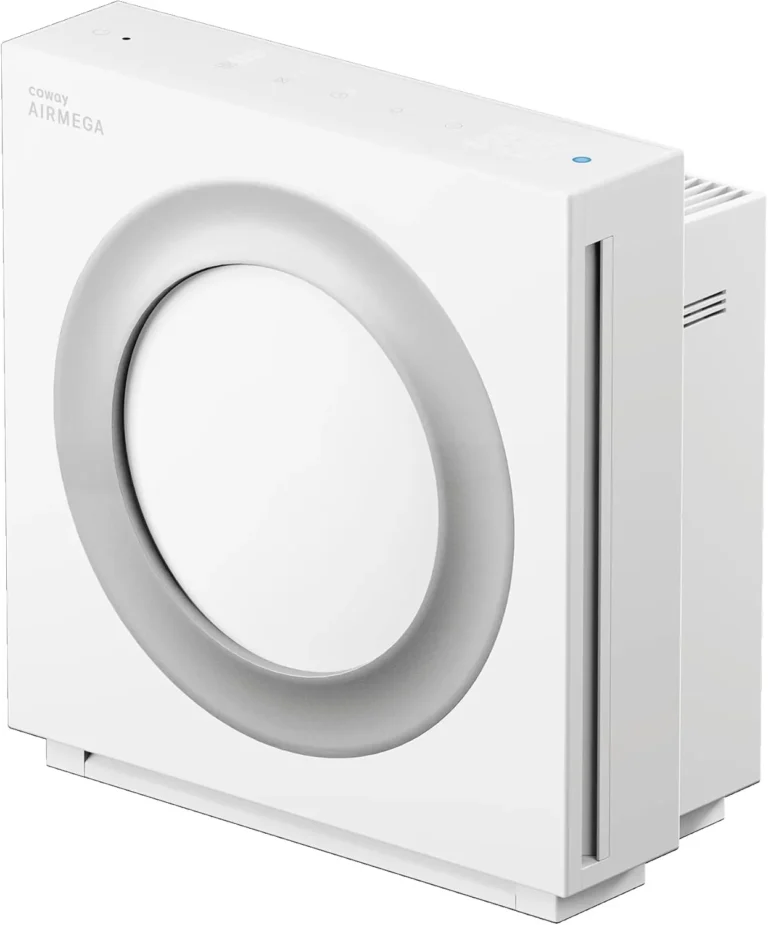
The Coway provides a 233 cfm smoke CADR, straightforward controls, and a long filter-supply history. Its thin carbon sheet is limited for odors, but particle performance remains useful.
AirFanta 3Pro: high particle airflow per dollar
HouseFresh estimated 353 cfm PM1 CADR from this modular four-filter unit. It suits users who prioritize airflow and accept assembly and exposed filters. Its carbon option reduces airflow and does not provide complete VOC control.
do air purifiers actually work: final decision
Use this do air purifiers actually work guide to match the option to your room, usage, and maintenance needs.
A sound do air purifiers actually work decision accounts for real-world fit, ongoing costs, and the limits of the product category.
When comparing choices, keep this do air purifiers actually work goal in view rather than relying on a single headline claim.
This do air purifiers actually work guide is designed to support a practical choice, not replace source control or the manufacturer instructions that apply to your model.
Quick answer: Air purifiers work well at reducing airborne particles when the purifier delivers enough clean air for the room and runs long enough. That includes fine smoke, cooking particles, pollen, some airborne allergens, and particles that can carry respiratory viruses. Health improvements are possible, but EPA describes them as generally small and not always noticeable.
Air purifiers are much less capable against gases unless they contain appropriate gas media. They cannot fix mold growth, remove settled dust, eliminate secondhand-smoke exposure, make carbon monoxide safe, or solve radon. Source control and ventilation with clean outdoor air remain the first steps.
The three checks that matter
- Right target: Is the problem an airborne particle, a gas, or a source that must be removed?
- Enough CADR: Does the purifier deliver enough clean air at a sound level you will actually use?
- Continuous operation: Are the intake, outlet, prefilter, and main filter maintained so airflow stays useful?
Frequently asked questions
Do air purifiers make a noticeable difference?
Often for particle concentrations, smoke clearance, and some odors with adequate carbon. Health or symptom changes may be small or absent even when instruments show cleaner air.
Should I leave an air purifier on all day?
Longer operation filters more air. Continuous use is reasonable when an airborne source persists, but select a safe, maintained unit and a speed that delivers enough CADR without making the room unusable.
Do I need a HEPA purifier?
HEPA is a good default for particles, but also verify whole-unit CADR. Excellent media in an undersized or leaky cabinet will not clean a large room quickly.
Should windows be open or closed?
It depends on outdoor air. Ventilate when outdoor air is clean and the indoor source needs removal. Close windows when wildfire smoke, high pollen, or outdoor pollution is worse, then filter the indoor air.
Can one purifier clean an entire house?
Usually not through closed doors and divided rooms. Portable purifiers are designed for one room or connected area. Use multiple units or compatible central filtration for whole-home coverage.
Bottom line
Air purifiers are effective particle-control tools, not universal indoor-air machines. A verified CADR, appropriate room size, useful fan speed, good placement, and maintained filters determine how well they work. The strongest outcomes are lower airborne PM2.5, smoke, and other fine particles.
Health improvements are possible but not guaranteed. Odor and gas control is more limited, while mold, carbon monoxide, radon, smoking, and settled dust require different solutions. Start by removing the source, ventilate with clean outdoor air, and use filtration as a well-sized supplement.
Sources
- US EPA: Guide to Air Cleaners in the Home
- US EPA: Air Cleaners and Air Filters in the Home
- US EPA: Air Cleaners, HVAC Filters, and Respiratory Viruses
- US CDC: Taking Steps for Cleaner Air for Respiratory Virus Prevention
- US EPA: Ozone Generators Sold as Air Cleaners
- US EPA: Secondhand Tobacco Smoke and Indoor Air Quality
- US EPA: Strategies for Improving Indoor Air Quality While Cooking
- US EPA: Will Air Cleaners Reduce Health Risks?
- Peer-reviewed multicentre trial: HEPA air purifiers and allergic rhinitis
- Peer-reviewed placebo-controlled trial: HEPA air cleaner and cat allergy
- HouseFresh: Levoit Vital 200S purchased-unit review
- HouseFresh: Winix 5510 purchased-unit review
- HouseFresh: AirFanta 3Pro purchased-unit review