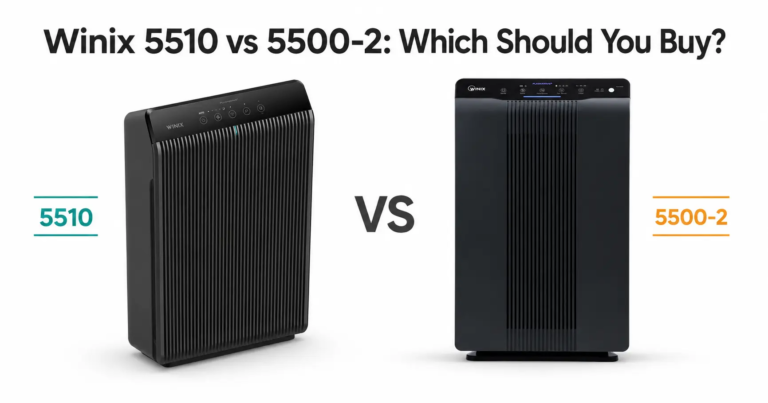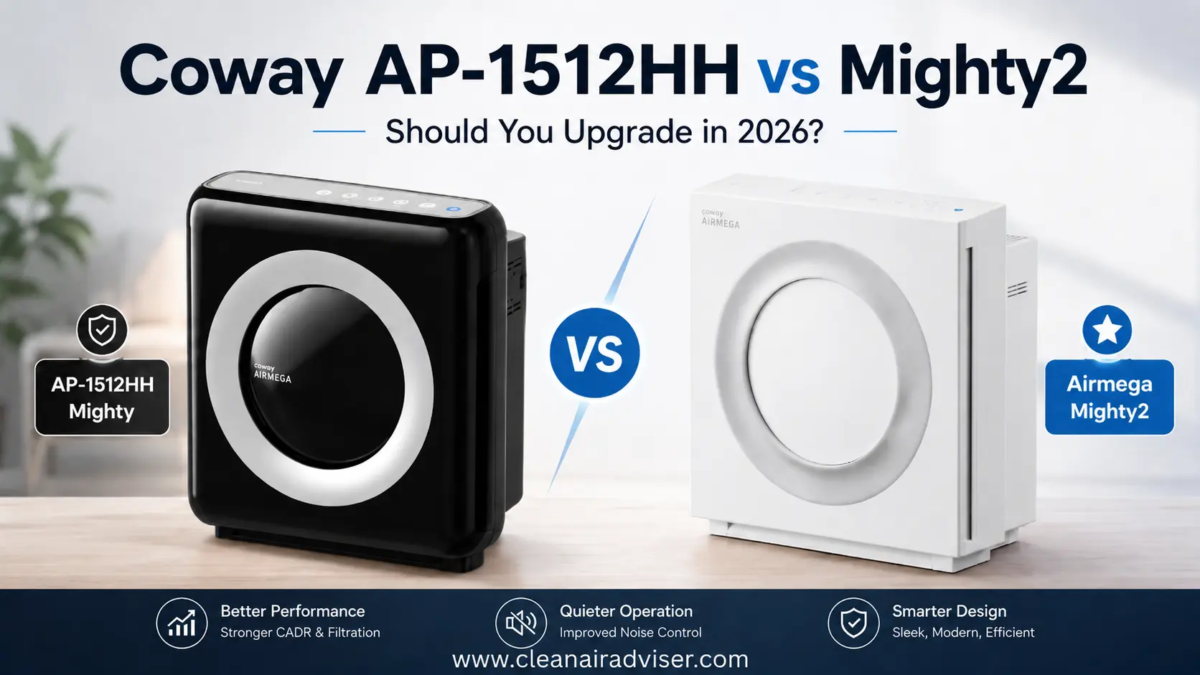
Coway AP-1512HH vs Mighty2: Which Should You Buy in 2026?
Disclosure: Clean Air Adviser may earn a commission when you buy through links on this page. This does not change what you pay. We have not personally owned or lab-tested either purifier. This comparison separates Coway specifications, independent measurements, and public owner reports.
Quick answer: This AP-1512HH vs Mighty2 guide highlights the evidence, practical fit, and buying limits that matter before you decide.
Coway Mighty2 vs AP-1512HH specifications
| Feature | AP-1512HH Mighty | Mighty2 AP-1512N |
|---|---|---|
| Smoke CADR | 233 CFM | 240 CFM |
| Dust CADR | 246 CFM | 242 CFM |
| Pollen CADR | 240 CFM | 249 CFM |
| Practical room target | 361 sq. ft. at 4.8 ACH | About 375 sq. ft. when Coway’s 1,800 sq. ft. one-ACH claim is converted to 4.8 ACH |
| Filter | Washable pre-filter, two deodorization sheets, HEPA filter | Slide-out washable pre-filter, bonded Max2 carbon and particle filter |
| Ionizer | Optional bipolar device | None |
| Sensor display | Basic color indicator | MegaScan laser sensor with PM1, PM2.5, and PM10 numbers |
| Manufacturer noise | 24 to 53 dBA | 19 to 50 dBA |
| Maximum rated power | 77 W | 56 W |
| Wi-Fi or app | No | No |
| Dimensions | 16.8 x 18.3 x 9.6 in. | 16.9 x 17.9 x 9.3 in. |
| Weight | 12.3 lb. | 15.2 lb. |
| Warranty | 3 years | 3 years |
The CADR differences look small on paper. Mighty2 gains seven CFM for smoke and nine for pollen, while the original Mighty leads dust by four CFM. Those certified or published figures alone would not justify a large premium. The more meaningful differences appear when noise, power, sensor quality, and filter design are considered.
Independent particle performance
HouseFresh bought both models and tested them in the same 728-cubic-foot room. The original AP-1512HH reduced PM1 to zero in 26 minutes at maximum speed with its ionizer enabled and 29 minutes with it disabled. The Mighty2 reached zero in 23 minutes at Turbo.
That makes the Mighty2 measurably faster in this setup. HouseFresh estimated its Turbo PM1 CADR at 260 CFM. At speed 2, the Mighty2 completed the test in 38 minutes while producing 42.6 dBA, with an estimated 151 CFM. This quiet-speed result is more useful than maximum speed for a bedroom, office, or TV room.
| HouseFresh test | AP-1512HH | Mighty2 |
|---|---|---|
| Fastest PM1-zero result | 26 min with ionizer, 29 min without | 23 min on Turbo |
| Useful quiet setting | Speed 2 at 44.4 dBA | Speed 2 at 42.6 dBA |
| Quiet-setting clean time | 51 min at speed 2 | 38 min at speed 2 |
| Maximum measured noise | 60.1 dBA | 56.9 dBA |
The Mighty2 therefore has a real performance advantage, particularly when the fan must remain below about 45 dBA. It is not a night-and-day change in a small room, but it is more than a cosmetic redesign.
Noise: Mighty2 wins, with one early caution
HouseFresh measured the AP-1512HH at 38.9 dBA on speed 1, 44.4 on speed 2, and 60.1 on speed 3. The Mighty2 measured 35.9 in Sleep, 38.1 on speed 1, 42.6 on speed 2, 49.3 on speed 3, and 56.9 on Turbo. Both are comfortable at low settings, but the Mighty2 delivers more usable airflow before becoming intrusive.
Recent owner reports introduce an important quality-control caveat. Several Mighty2 buyers have described an abnormal rattle at low speeds, and a HouseFresh video reportedly encountered a similar noise in an early unit before another was obtained for testing. These reports do not establish a failure rate, and many owners report normal operation. They are enough to justify checking a new unit promptly.
Normal airflow is a smooth whoosh. A rhythmic rattle, scraping sound, or mechanical buzz should not be accepted as normal on a new purifier. Record the sound, compare speeds, and use the seller’s return or exchange process while the window remains open.
Energy use: the newer motor is much better at full output
HouseFresh measured the original Mighty at 0.3 watts in standby, 3.7 on speed 1, 8.7 on speed 2, and 75.3 on speed 3. Mighty2 used 0.39 watts in standby, 2.53 in Sleep, 4.85 on speed 1, 10.28 on speed 2, 19.88 on speed 3, and 49.12 on Turbo.
At lower speeds, both cost little to run. At maximum, Mighty2 used about 26 watts less in HouseFresh’s tests while cleaning faster. At 15 cents per kWh and continuous maximum-speed operation, the simple annual estimates are about $107.94 for the old Mighty and $64.55 for Mighty2. Most homes will spend less because Auto mode and lower speeds reduce consumption.
Do not use an assumed “average 30 watts” to claim an exact five-year saving. Fan behavior, air quality, hours, and electricity rates vary. The defensible conclusion is narrower: Mighty2 is substantially more efficient at maximum measured output.
Filter design and annual cost
The AP-1512HH uses separate filter layers. Coway’s genuine set includes one HEPA filter and two deodorization sheets. Coway recommends roughly six months per deodorization sheet and one year for the HEPA filter. The direct price checked during our AP-1512HH filter-guide update was $59.99 on sale, with a $64.99 regular price.
Mighty2 uses a bonded Max2 cartridge with particle media and pelleted activated carbon. Coway lists a one-year life, and HouseFresh used a $69.99 genuine-filter price. The annual OEM difference is therefore around $5 to $10 at those reference prices, not the $40 to $55 claimed in the old comparison.
| Filter question | AP-1512HH | Mighty2 |
|---|---|---|
| Carbon form | Thin deodorization sheets | Pelleted activated carbon in Max2 |
| Replace carbon separately? | Yes | No |
| Official schedule | Carbon about 6 months; HEPA about 1 year | Whole Max2 up to 1 year |
| Recent genuine price reference | $59.99 sale / $64.99 list | $69.99 |
| Aftermarket selection | Mature | Still developing |
Mighty2’s pellet carbon is the better physical design for odors, but its bonded construction creates waste if the carbon exhausts before the particle media. The original lets you change the deodorization sheet independently, yet that sheet contains much less carbon. Buyers with serious VOC or tobacco-smoke problems should look beyond both models to a purifier that publishes a substantial carbon weight.
Ionizer removal and ozone
The AP-1512HH contains an optional bipolar device. ENERGY STAR’s certification record lists ozone emissions of 9 ppb. Owners can leave the ionizer off, and HouseFresh found only a three-minute test difference between enabled and disabled operation.
Mighty2 removes the ionizer entirely. This is simpler for buyers who do not want intentional ion generation and eliminates the need to remember a setting. The strong independent result shows that the new model does not need ionization to outperform the original in HouseFresh’s test.
This is a meaningful design improvement, but not a reason by itself to discard a working original Mighty. Turning the old unit’s ionizer off leaves its mechanical fan and filters doing the main particle-cleaning work.
MegaScan sensor vs the old color light
The AP-1512HH has a dust sensor and a colored pollution indicator. It can raise the fan in Auto mode, but it does not show a numerical concentration. Mighty2’s MegaScan laser sensor displays PM1, PM2.5, and PM10 estimates and reacts more quickly to particle changes.
This is the strongest everyday feature upgrade. During cooking or wildfire smoke, a number makes it easier to see whether conditions are improving and whether a higher fan speed is needed. It is still a consumer sensor, not a complete air-quality station. It does not measure carbon dioxide, carbon monoxide, radon, or most gases.
Neither model has Wi-Fi or an app. Buyers who expect remote controls, schedules from a phone, or historical graphs will need another model or a separate monitor. A smart plug may control basic power, but it cannot add sensor history or remote fan-speed selection.
Pre-filter maintenance
The old Mighty requires the front cover to be removed before accessing its washable pre-filter. Mighty2 moves the pre-filter to a slide-out side tray. This reduces the chance of knocking accumulated hair and dust back into the room and makes frequent vacuuming easier.
That small design change matters in pet homes. A maintenance step that takes less effort is more likely to happen on schedule. The pre-filter does not replace vacuuming, because most hair and heavy dust settle before reaching any purifier.
Price and value decision
On August 13, 2026, Coway listed the AP-1512HH at $239.99 and Mighty2 at $269.99. At only a $30 direct-price difference, Mighty2 is the clear new purchase. It offers better measured performance, quieter useful airflow, lower maximum power, better carbon, a better sensor, and easier pre-filter access.
Retail discounts can reverse the value decision. The original Mighty has a long history of deep sales. If it falls below about $170 while Mighty2 stays near $270, saving $100 becomes reasonable for a medium room. Between those extremes, consider how much the numerical sensor and quiet-speed performance matter to you.
Do not buy based on the 1,800-square-foot claim alone. Coway states that figure at one air change per hour. Dividing the same airflow across a very large space makes cleaning slow. For frequent particle removal in a normal eight-foot room, both are roughly 360 to 390-square-foot-class purifiers.
Should existing AP-1512HH owners upgrade?
Usually no. A working AP-1512HH still has competitive CADR, simple controls, available filters, and strong independent performance. The environmental and financial cost of replacing a healthy machine outweighs a modest cleaning-speed improvement for many owners.
Upgrade when one of these conditions is true:
- Your original Mighty is becoming mechanically noisy or unreliable.
- You regularly need maximum airflow and want lower noise and power use.
- You want numerical PM readings without buying a separate monitor.
- You do not want an ionizer physically present, even when disabled.
- The original cabinet or filter seals are damaged.
Keep the old model when it runs smoothly, spends most of its time on speed 1 or 2, and its basic color indicator is enough. A fresh genuine filter may restore airflow for much less than a new purifier.
Who should buy each model?
Buy the AP-1512HH if:
- It is at least $75 to $100 cheaper than Mighty2.
- You prefer separate carbon and particle-filter schedules.
- You value a mature genuine and aftermarket filter ecosystem.
- You do not need numerical particle readings.
- You are comfortable leaving the optional ionizer disabled.
Buy Mighty2 if:
- The price difference is modest.
- You want better performance below 45 dBA.
- You want lower maximum-speed electricity use.
- You prefer pellet carbon and easier pre-filter cleaning.
- You want PM1, PM2.5, and PM10 readings on the purifier.
- You want a design with no ionizer.
For deeper single-product analysis, read our updated AP-1512HH review and Coway Mighty2 review.
AP-1512HH vs Mighty2: final decision
Use this AP-1512HH vs Mighty2 guide to match the option to your room, usage, and maintenance needs.
A sound AP-1512HH vs Mighty2 decision accounts for real-world fit, ongoing costs, and the limits of the product category.
When comparing choices, keep this AP-1512HH vs Mighty2 goal in view rather than relying on a single headline claim.
This AP-1512HH vs Mighty2 guide is designed to support a practical choice, not replace source control or the manufacturer instructions that apply to your model.
The Coway Mighty2 AP-1512N is now the better new purchase than the older AP-1512HH when their prices are close. Independent testing shows that the Mighty2 cleans particles faster, delivers more airflow at comfortable noise levels, and uses less power at maximum speed. It also replaces the optional ionizer with a larger bonded filter, adds numerical PM1, PM2.5, and PM10 readings, and makes the washable pre-filter easier to remove.
That does not mean every AP-1512HH owner should upgrade. A working original Mighty remains capable, its filters are widely available, and the difference in everyday particle removal is not large enough to justify replacing a healthy purifier. The real decision depends on whether you already own one and how large the price gap is today.
Simple buying rule
- New buyer: Choose the Mighty2 when it costs no more than about $75 extra.
- Bargain buyer: Choose the AP-1512HH when it is at least $75 to $100 cheaper.
- Existing AP-1512HH owner: Keep it unless it is failing or you specifically need quieter high airflow, numerical particle readings, or no ionizer hardware.
- Noise-sensitive buyer: Buy from a retailer with an easy return policy and listen for abnormal rattling during the return window.
Frequently asked questions
Is Mighty2 more powerful than the AP-1512HH?
Its published smoke CADR is only seven CFM higher, but HouseFresh measured faster maximum and quiet-speed particle cleaning. The improvement is meaningful at comfortable noise levels.
Which model is quieter?
Mighty2. HouseFresh measured 56.9 dBA at Turbo versus 60.1 dBA at the old Mighty’s maximum, and Mighty2 completed its speed-2 test faster at a lower noise level.
Are the filters interchangeable?
No. The AP-1512HH uses the filter set shared with the Airmega 200M. Mighty2 uses the newer AP-1512N-FP Max2 filter. Match the purifier model before ordering.
Does Mighty2 have an ionizer?
No. It relies on mechanical particle and carbon filtration. The AP-1512HH has an optional bipolar device that can be switched off.
Does either model have Wi-Fi?
No. Both use physical controls. Mighty2 adds a numerical particle display but no app or remote history.
Is the Mighty2 rattle problem widespread?
Several recent owners have reported low-speed rattling, but no reliable dataset establishes a defect rate. Treat it as an early quality-control signal, inspect a new unit during the return window, and exchange a unit with abnormal mechanical noise.
Which is better for wildfire smoke?
Mighty2 has faster independent particle cleaning and pellet carbon, so it is the better of these two when prices are close. During heavy smoke, use a properly sized purifier at the highest tolerable speed, keep outdoor smoke out when advised, and follow local public-health guidance.
Final verdict
One final shopping check can prevent an expensive mistake. Compare the purifier price and the correct genuine filter price in the same session, then save both product codes. The old Mighty is AP-1512HH and its genuine set is shared with the Airmega 200M. Mighty2 is AP-1512N and uses AP-1512N-FP. Similar names do not make the filters interchangeable. Also confirm the seller’s return terms, especially for Mighty2 while the recent rattle reports remain unresolved. A lower purchase price is not a bargain if a marketplace seller makes a noisy unit difficult to exchange.
For a new buyer in 2026, Mighty2 wins when the price gap is modest. The independent evidence now supports the upgrade: 23-minute maximum cleaning, a 38-minute result at 42.6 dBA, lower maximum power use, pellet carbon, a faster numerical sensor, and easier pre-filter access.
The AP-1512HH remains the value choice during a deep sale and the sensible machine to keep if you already own a working one. It has competitive airflow, separate filters, and a much longer ownership record. Mighty2 is a better product, but not an automatic replacement for every original Mighty.
Sources
- Coway: AP-1512HH official specifications and direct price
- Coway: Mighty2 AP-1512N specifications, filter, sensor, direct price, and room claim
- ENERGY STAR: AP-1512HH certification, CADR, power, and ozone record
- HouseFresh: independently purchased AP-1512HH particle, noise, and power tests
- HouseFresh: independently purchased Mighty2 particle, noise, power, and filter tests
- HouseFresh: air-purifier testing methodology
- Coway: genuine AP-1512HH and 200M filter set
- Coway Store on Amazon: Mighty2 AP-1512N-FP Max2 filter specifications and current reference price
- Reddit r/AirPurifiers: recent owner reports of Mighty2 rattling and return experience
- Reddit r/AirPurifiers: additional Mighty2 noise and support reports