Winix 5520 Review (2026): Worth Buying Over the 5510?
Disclosure: CleanAirAdviser participates in the Amazon Associates Program. If you buy through our links, we may earn a commission at no extra cost to you. We do not own the Winix 5520 and did not physically test it. This review separates Winix specifications, HouseFresh’s purchased-unit test data, and owner reports so you can see where each conclusion comes from. Read how we review products.
This Winix 5520 review starts with the question most buyers actually need answered: why buy the 5520 when the Winix 5510 uses the same filter, has the same official CADR figures, and usually costs less?
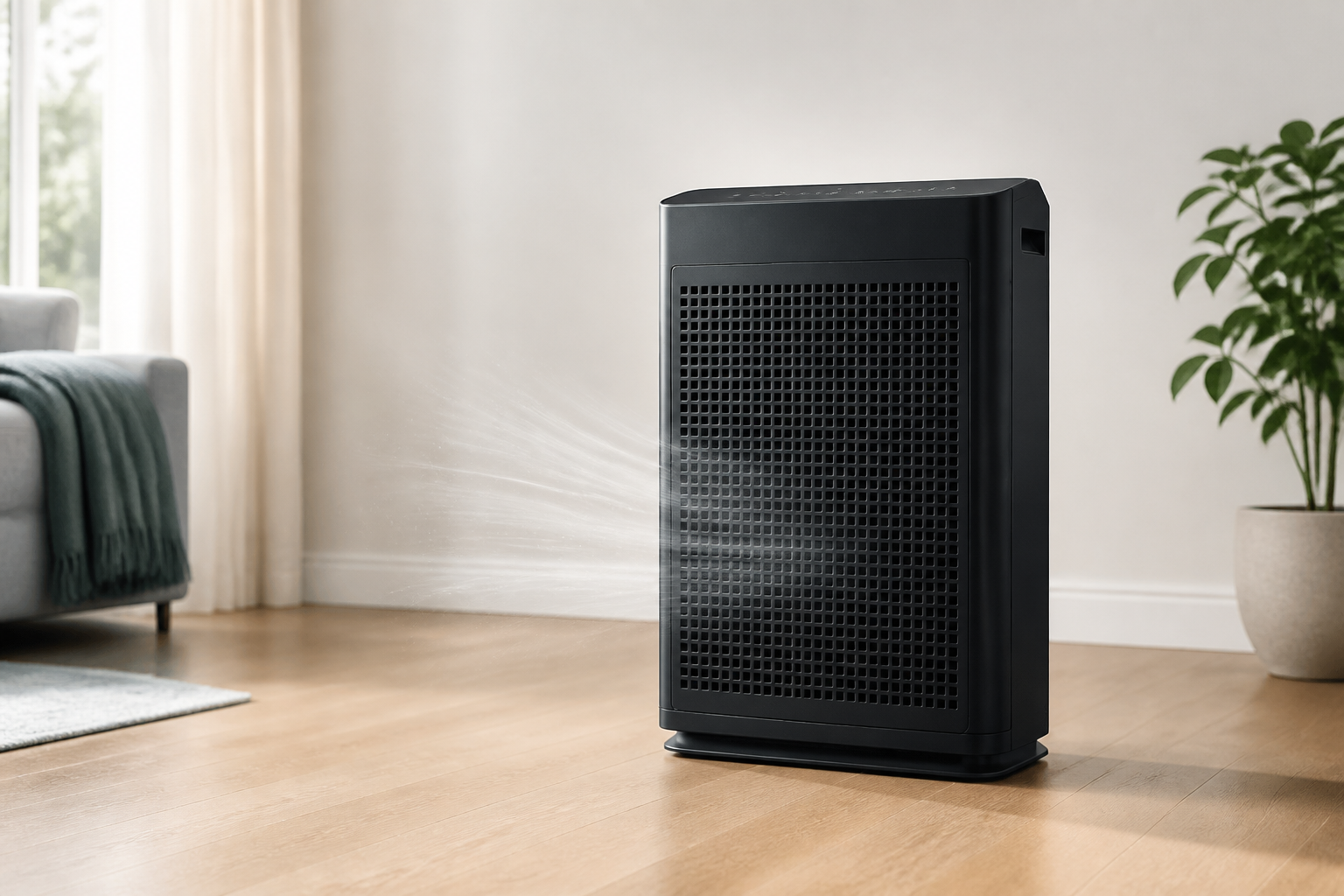
The answer is price and appearance, not extra cleaning power. The 5520 has a black front panel with a square-pattern grille, while the 5510 uses a white vertical grille. Winix gives both models the same 392-square-foot AHAM room rating, the same 252/247/253 CFM dust, pollen, and smoke CADR, the same Filter Q, the same WiFi features, and the same two-year warranty.
Independent results support that similarity. HouseFresh bought a 5520 and measured an estimated PM1 CADR of 249 CFM at top speed. It cleared their 728-cubic-foot smoke test room to PM1 zero in 24 minutes, matching the 5510’s top-speed result. The catch is sound. HouseFresh measured 64.9 dBA on the highest setting, and only speed 1 stayed below their 45 dBA quiet-use threshold.
Buy the Winix 5520 when it costs no more than the 5510, you prefer the black design, and you want fast particle removal plus app control.
Buy the Winix 5510 instead when it is cheaper or you care about stronger cleaning at a quiet fan speed.
Skip both if you need a true particle sensor for automatic smoke or dust response, or if high-speed noise will stop you from running the purifier hard when air quality is poor.
Affiliate link. Compare the final price with the Winix 5510 before ordering.
Winix 5520 review: quick facts
| Official room size | 392 sq ft at 4.8 air changes per hour |
| Official CADR | Dust 252, pollen 247, smoke 253 CFM |
| Independent top-speed result | PM1 zero in 24 minutes; estimated PM1 CADR 249 CFM in HouseFresh’s test |
| Quiet-use result | Speed 1: 40.4 dBA, 55-minute test, estimated PM1 CADR 106 CFM |
| Filters | Washable pre-filter, pellet AOC carbon, True HEPA, optional PlasmaWave |
| Replacement filter | Filter Q, SKU 1712-0123-00 |
| Filter schedule | Replace the True HEPA and carbon set about every 12 months; actual life depends on conditions |
| Sensor | Odor or gas sensor plus ambient-light sensor; not a PM2.5 particle sensor |
| Smart features | Winix Smart app, WiFi, Alexa, schedules through the app |
| Rated power | 65 W |
| Dimensions | 13.59 x 8.27 x 22.17 inches |
| Weight | 13.3 lb |
| Warranty | Two years |
Who should buy the Winix 5520?
The 5520 makes the most sense in a medium bedroom, office, den, or closed living room where you can run a higher fan speed during cooking, cleaning, pollen spikes, or smoke events. Its official 253 CFM smoke CADR is appropriate for a 392-square-foot room at 4.8 changes per hour. That is a meaningful cleaning rate, not the once-per-hour marketing calculation used for the much larger 1,882-square-foot claim.
It is also a reasonable fit for households that want a pellet carbon layer rather than a thin carbon-coated sheet. Pellet carbon gives the filter more useful adsorbent material for everyday cooking smells, pet odors, and some gases. Still, this is not a deep-bed carbon machine. It can reduce ordinary odors, but buyers dealing with heavy wildfire gases, renovation VOCs, or persistent tobacco smoke should not expect a few pounds of specialty carbon performance from a slim consumer purifier.
The model is less convincing for noise-sensitive sleepers. Speed 1 is reasonably quiet, but HouseFresh estimated only 106 CFM at that setting. If you size the purifier using the 253 CFM headline and then run it on speed 1 all night, you are not receiving the advertised maximum airflow. For quiet bedrooms, size around the fan speed you will tolerate, not the highest speed printed on the box.
What this Winix 5520 review found about cleaning performance
Winix publishes CADR values of 252 CFM for dust, 247 CFM for pollen, and 253 CFM for smoke. The smoke number is the most useful starting point for room sizing because fine smoke particles are difficult to remove. At 253 CFM, the unit can deliver close to five air changes per hour in its AHAM-rated room.
HouseFresh’s independent particle test landed close to the official result. After filling a 728-cubic-foot room with incense smoke, the team ran the purifier on its highest speed and tracked PM1, PM2.5, and PM10 with a PurpleAir sensor. The 5520 reached PM1 zero in 24 minutes, producing an estimated PM1 CADR of 249 CFM. That result is close enough to the official smoke CADR to support the core airflow claim.
The more revealing test happened at quieter settings. HouseFresh measured 40.4 dBA on speed 1 and estimated 106 CFM after a 55-minute clean. Speed 2 reached 45.8 dBA and cleared the room in 44 minutes. That can still work well in a smaller bedroom, but it shows why “quiet” and “full rated performance” cannot be treated as the same operating condition.
Simple sizing rule
- For roughly 350 to 400 sq ft, plan to use the top two speeds when air quality is poor.
- For quiet daily use, treat it more like a 150 to 200 sq ft purifier unless speed 2 sounds comfortable to you.
- For open layouts, use separate purifiers near the pollution sources instead of relying on the one-air-change 1,882 sq ft claim.
Winix 5520 review: noise is the biggest compromise
Winix calls the 5520 ultra-quiet and lists a very low slowest-speed figure. That description applies to low operation, not the setting that produces the full CADR. HouseFresh measured 40.4, 45.8, 50.9, and 64.9 dBA across the four main speeds from three feet away.
A 64.9 dBA purifier is easy to hear across a room. It may be acceptable for a short cleaning burst while you are cooking or away, but many people will not want that sound beside a television or bed. The 5520 is slightly quieter at full speed than HouseFresh’s 67.2 dBA result for the 5510, yet the 5510 moved more air at the sub-45 dBA test point. In practical terms, the black 5520 wins by a small margin at full-power sound, while the white 5510 wins the quieter-performance comparison.
Auto mode cannot solve every noise issue because its sensor is not measuring particles. It may ramp up for cooking odors or a spray product while failing to respond directly to dust or fine smoke that does not trigger the gas sensor strongly. If particle removal is the goal, select a manual speed based on room conditions rather than assuming the colored light has measured PM2.5.
Winix 5520 review: Filter Q cost and the fit mistake to avoid
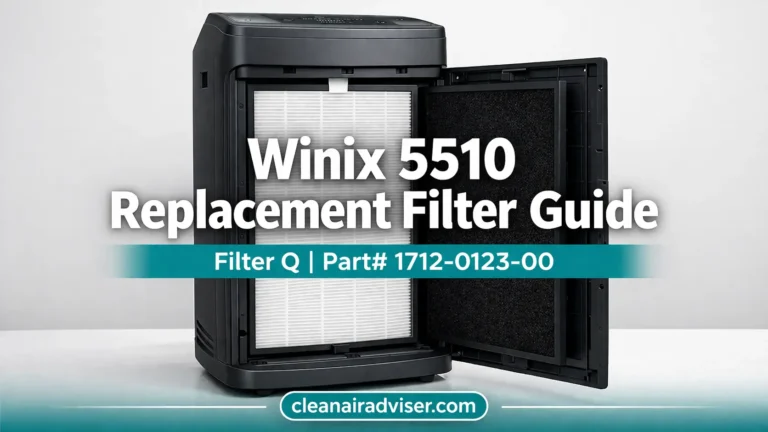
The correct replacement is Winix Filter Q, SKU 1712-0123-00. Winix lists it for the 5510, 5520, and 5530. The set contains one True HEPA filter and one pellet AOC carbon filter, with a recommended replacement interval of about 12 months. Winix notes that heavy smoke and poor air quality can shorten useful filter life.
Do not buy Filter H just because a marketplace listing says it fits. Filter H belongs to the older 5500-2 and AM80. Walmart owner reviews on one third-party Filter H listing specifically report that the filter was too large for the 5510 and 5520. The model number in the merchant title is not a fit guarantee. Match the Q designation and 1712-0123-00 SKU before ordering.
At the time of this evidence check, Winix showed Filter Q in stock with a promotional price below its $79.99 list price. Promotions change, so budget using the list price and treat discounts as upside. Our Winix Filter Q guide explains the replacement steps and the same fit rules for both the 5510 and 5520.
What the carbon filter can and cannot do
The AOC carbon filter uses pellets, which is preferable to a lightly coated mesh for recurring kitchen and pet odors. HouseFresh weighed the carbon in the closely related models at roughly 226 grams. That is useful for common household smells, but modest compared with purifiers built around several pounds of activated carbon.
Carbon does not destroy every gas permanently. It adsorbs compounds until available sites fill, and heat or humidity can affect performance. If an odor returns quickly, ventilation and source control matter more than increasing fan speed forever. Remove the source, ventilate when outdoor air is safe, and use the purifier as support. Never use an air purifier as protection from carbon monoxide. Install and maintain appropriate carbon-monoxide alarms.
PlasmaWave: optional, not required for strong particle removal
PlasmaWave is Winix’s bipolar ionization feature. Winix says it helps break down pollutants. Its current product page reports an eight-hour time-weighted-average ozone result of 0.22 ppbv in a 30-cubic-metre chamber. That is a very low reported result under that protocol. The 5520 is also listed as CARB certified, which means it falls within California’s applicable ozone-emission standard. CARB certification is a regulatory threshold, not a medical endorsement, while the 0.22 ppbv figure is the more model-specific evidence.
You can turn PlasmaWave off with the dedicated control. HouseFresh found almost no difference in the older 5500-2 particle test with the feature on versus off. Their 5520 result also demonstrates that airflow and filtration are doing the central work. If you prefer mechanical filtration only, disable PlasmaWave and continue using the HEPA and carbon stages.
App, sensor, and everyday controls
The Winix Smart app adds remote power, fan-speed control, schedules, filter-life monitoring, and air-quality history from the onboard sensor. Alexa support is listed by Winix. HouseFresh found the app clean and easy to use, but less feature-rich than some Levoit, Xiaomi, and Philips apps.
The front air-quality light changes color as the gas sensor detects odor-related compounds. An ambient-light sensor automatically reduces lights and fan speed in a dark room. This is convenient for bedrooms, but automatic sleep behavior can reduce airflow at the exact time you want continuous overnight cleaning. If allergies or smoke are the concern, choose a fixed manual speed that remains comfortable instead of relying on the light sensor.
Owner reports collected from Walmart are broadly positive about simple setup, the purifier reacting to cooking or spray odors, and easy filter access. Complaints include WiFi reconnection friction, high-speed sound, and disappointment when a smaller fan speed feels weaker than an older, larger Winix. Some Walmart reviews are incentivized, so we treat these as recurring usability signals, not controlled evidence.
Energy and annual running cost
The manual rates the 5520 at 65 W. HouseFresh measured 55.31 W at top speed without PlasmaWave and 55.6 W with it. Lower speeds used far less: 6.89 W on speed 1, 10.63 W on speed 2, and 16.77 W on speed 3. That means your real electricity cost depends more on the chosen fan speed than the 65 W label.
HouseFresh calculated $66.52 per year for continuous top-speed use using the average US electricity rate available in March 2026. Adding the $79.99 Filter Q list price produced a conservative $146.51 annual running-cost estimate. Most households will spend less on electricity because they will not run speed 4 all day, but smoke-heavy homes may replace the filter sooner than 12 months.
Winix 5520 review vs 5510: use price as the tiebreaker
| Decision point | Winix 5520 | Winix 5510 |
|---|---|---|
| Official CADR | 252 / 247 / 253 | 252 / 247 / 253 |
| Official room size | 392 sq ft | 392 sq ft |
| Filter | Filter Q | Filter Q |
| WiFi and app | Yes | Yes |
| Front design | Black square pattern | White vertical pattern |
| HouseFresh top-speed PM1 result | 24 minutes | 24 minutes |
| HouseFresh top-speed sound | 64.9 dBA | 67.2 dBA |
| HouseFresh sub-45 dBA performance | 106 CFM at 40.4 dBA | Stronger result in HouseFresh’s quiet test |
Neither is universally better. The 5520 is a little quieter at maximum, while the 5510 delivered better usable airflow under HouseFresh’s quiet threshold. Since both share the core specifications and replacement filter, buy the less expensive model unless one design fits your room much better.
Our Winix 5510 review covers that model in depth. For a direct side-by-side decision, see our Winix 5510 vs 5520 comparison.
Is it a true replacement for the Winix 5500-2?
The 5520 replaces the old formula in Winix’s current lineup, but it is not a direct copy. It adds WiFi and a slimmer body, loses the handheld remote, uses Filter Q instead of Filter H, and changes the washable-carbon arrangement. The 5500-2 remains quieter at full speed in HouseFresh’s measurements, while the 5520 offers current production and app support.
If you already own a working 5500-2, the 5520 is not an urgent upgrade. Keep the older unit and buy the correct Filter H while genuine supply remains available. New shoppers should favor the 5520 when the discontinued 5500-2 is sold by an uncertain marketplace seller or priced close to a new current model. See our updated Winix 5500-2 review and 5510 vs 5500-2 comparison for the detailed transition.
What we like and what should give you pause
What we like
- Official CADR is supported by HouseFresh’s independent top-speed result.
- Pellet carbon is more useful for everyday odors than a carbon-coated sheet.
- WiFi, app control, schedules, auto mode, and Alexa are included.
- Filter Q fits three current Winix models and was in stock during our check.
- The pre-filter is removable and easy to vacuum.
- PlasmaWave can be switched off.
What we do not like
- Top speed is loud at 64.9 dBA in HouseFresh’s test.
- Quiet speed sacrifices more airflow than the 5510.
- The auto sensor reacts to gases, not PM2.5 particles.
- Filter Q can add up to $79.99 per year at list price.
- The large-room marketing number uses only one air change per hour.
- It offers little functional reason to pay more than the 5510.
Five checks before you buy
- Compare the 5510 price. Treat these as performance twins and avoid paying extra only because one listing says “new generation.”
- Size for repeated air changes. Use 392 sq ft as the realistic high-cleaning room size, not 1,882 sq ft.
- Plan for sound. Decide whether you can tolerate speed 3 or 4 during bad-air periods.
- Budget for Filter Q. Confirm SKU 1712-0123-00 and ignore third-party listings that incorrectly claim Filter H compatibility.
- Know what Auto mode senses. For smoke particles, dust, and pollen, choose a steady manual speed instead of relying only on the gas sensor.
Winix 5520 review FAQ
Is the Winix 5520 a True HEPA air purifier?
Winix describes Filter Q as True HEPA and says it captures 99.99% of inanimate particles as small as 0.01 microns in laboratory testing. That is a manufacturer filtration claim. HouseFresh’s room test independently supports strong whole-unit particle removal but did not test filter efficiency at 0.01 microns.
Does the Winix 5520 produce ozone?
The optional PlasmaWave feature uses bipolar ionization. Winix’s current product page reports an eight-hour time-weighted-average ozone result of 0.22 ppbv in a 30-cubic-metre chamber, and the unit is CARB certified. That is a very low manufacturer-reported result under the stated test, but it is not a medical endorsement. You can turn PlasmaWave off and use the mechanical filters alone.
What filter fits the Winix 5520?
Use Winix Filter Q, SKU 1712-0123-00. The same genuine set fits the Winix 5510 and 5530. Do not substitute Filter H, even if a marketplace seller claims it fits.
Is the Winix 5520 good for a bedroom?
Yes, especially in a medium bedroom, but select the fan speed carefully. Speed 1 measured 40.4 dBA in HouseFresh’s test and was the only setting below 45 dBA. Its measured cleaning rate was lower than the headline CADR, so a smaller bedroom gives you more margin.
Is the Winix 5520 better than the 5510?
Not overall. It was slightly quieter at maximum in HouseFresh’s tests, but the 5510 cleaned more effectively under the quiet-test threshold. Official airflow, room rating, filter, app features, and warranty are the same. Buy whichever costs less unless you strongly prefer one design.
Final verdict
This Winix 5520 review finds it is a capable medium-room purifier, not a bad 5510. Its official CADR holds up well against HouseFresh’s smoke-based test, the pellet carbon filter is useful for ordinary household odors, and the current platform gives you app control without making the purifier dependent on the app.
The reason for caution is value. Full-speed cleaning comes with 64.9 dBA sound, quiet performance trails the 5510, and the gas sensor cannot directly measure the particles most people buy a HEPA purifier to remove. If the 5520 is cheaper than the 5510, it is an easy recommendation. If it costs more, the black grille is the main thing you are paying for.
Affiliate link. Confirm the model number, seller, return policy, and current 5510 price.
Sources and verification notes
- Winix America: Winix 5520 official product page. Current official price and availability, CADR, AHAM room size, filtration, features, dimensions, warranty, and certifications.
- Winix America: Winix 5510 and 5520 user manual. Power, placement, controls, Filter Q, maintenance, ozone-compliance wording, and warranty terms.
- Winix America: Filter Q 1712-0123-00 official page. Model compatibility, replacement interval, filtration claims, price, and stock status.
- HouseFresh: Winix 5520 independent review. Purchased-unit PM1 tests, sound measurements, power measurements, quiet-speed comparison, app observations, and annual-cost model.
- HouseFresh: Air-purifier testing methodology. Test-room volume, particle instrumentation, repeatable procedure, and CADR estimation.
- Walmart: Winix 5520 merchant listing and owner reviews. Current merchant availability and recurring setup, auto-mode, sound, WiFi, and maintenance comments. Incentivized reviews were treated as usability reports, not laboratory evidence.
- California Air Resources Board: CARB-certified air-cleaner list and program explanation. Regulatory context for ozone-emission certification.
Evidence checked August 13, 2026. Prices and stock can change. Performance measurements belong to HouseFresh; CleanAirAdviser did not repeat those tests.