Best Air Purifier for Wildfire Smoke: 2026 Evidence Guide
Disclosure: Clean Air Adviser may earn a commission when you buy through links on this page. This does not change what you pay. We have not physically tested these purifiers. Recommendations are based on current manufacturer specifications, ENERGY STAR or AHAM data, EPA wildfire guidance, and clearly identified independent measurements.
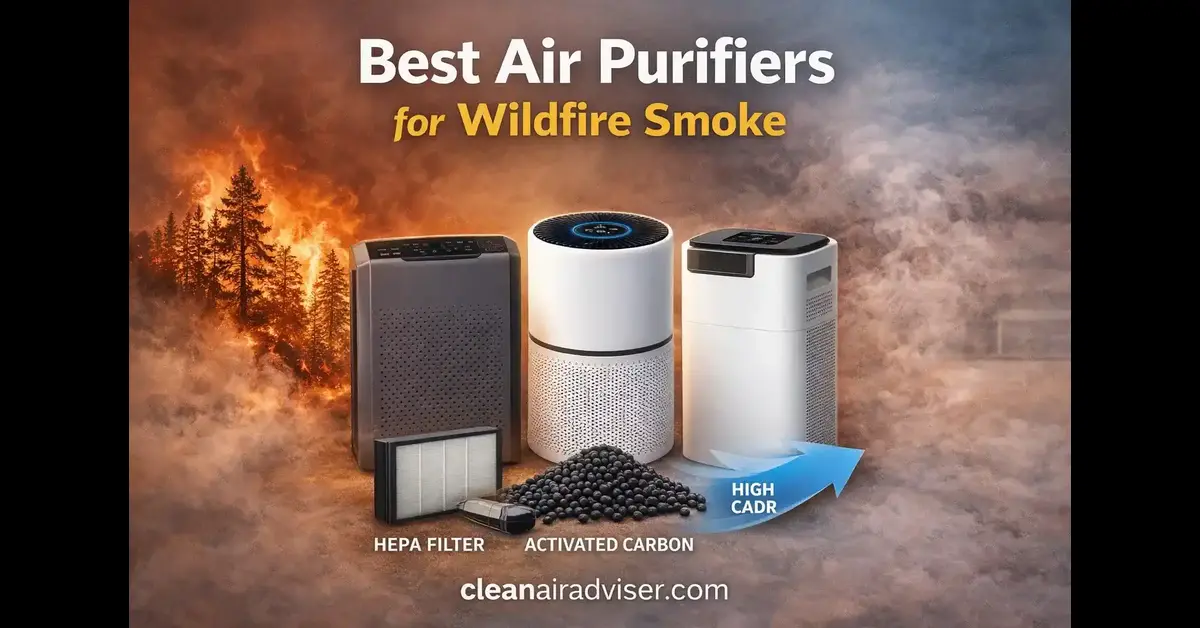
Quick answer: This air purifier for wildfire smoke guide covers room sizing, filtration, carbon limits, and the practical steps that protect indoor air during smoke events.
Best wildfire-smoke air purifiers: the short list
| Pick | Verified or measured particle airflow | Wildfire room target | Main tradeoff |
|---|---|---|---|
| Best conventional: Levoit Vital 200S | 242 cfm official smoke CADR; 23-minute HouseFresh PM1 test | About 240 sq. ft. for frequent heavy smoke | Carbon quantity is useful but not enough for severe gas contamination |
| Best airflow value: AirFanta 3Pro | 353 cfm estimated PM1 CADR in HouseFresh’s top-speed test | About 350 sq. ft. using the measured result | Modular assembly and exposed filters are less conventional |
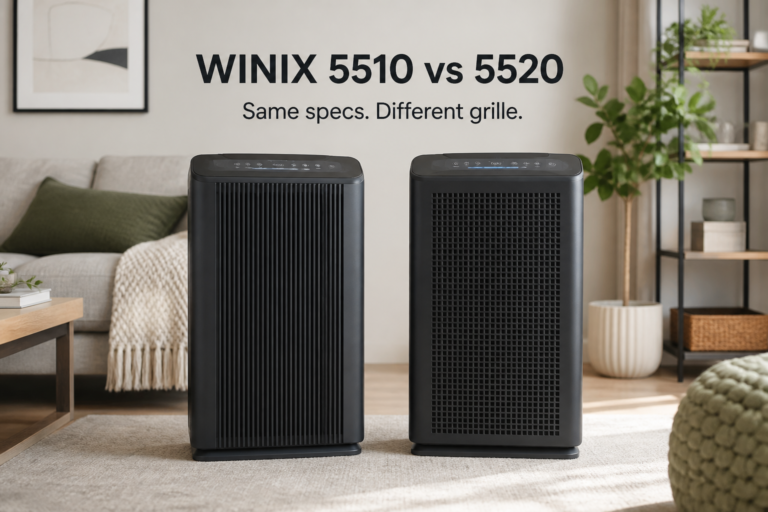
| Best Winix option: Winix 5510 | 253 cfm official smoke CADR; 249 cfm estimated by HouseFresh | About 250 sq. ft. for frequent heavy smoke | Very loud at maximum; Auto mode is gas-sensor based |
| Best smart cylindrical pick: Levoit Core 400S | 260 cfm official smoke CADR; 213 cfm estimated for the US unit by HouseFresh | About 260 sq. ft. from certification, with regional-model caution | Less accessible prefilter; US and European performance differs |
| Proven simple option: Coway AP-1512HH | 233 cfm official smoke CADR | About 230 sq. ft. for frequent heavy smoke | Thin carbon sheet is limited for smoke odor and gases |
| Emergency DIY: four-filter Corsi-Rosenthal box | 401 ± 31 cfm wildfire-smoke CADR in EPA chamber research | About 400 sq. ft. if built like the tested design | Large, no gas media, and build quality changes performance |
The room targets above use the conservative smoke-CADR-equals-square-feet approach for frequent heavy smoke. EPA’s general minimum is less demanding: smoke CADR at least two-thirds of the room area. Higher ceilings, leaky rooms, frequent door opening, and continuing outdoor smoke all increase the airflow needed.
How we chose these models
Wildfire guides often rank purifiers by HEPA labels, star ratings, or affiliate payout. None is enough. We first looked for certified smoke CADR or credible independent particle-removal data. Smoke CADR combines media efficiency and airflow, so it tells you how much particle-free air the whole machine produces per minute.
We then considered noise at useful speeds, filter availability, prefilter access, ionization, and carbon. Smoke contains both particles and gases. A HEPA filter handles particles but not gases. Activated carbon can adsorb some gases, but most portable purifiers contain modest carbon quantities. We do not call any consumer model a complete solution for every wildfire gas.
Finally, we checked current manuals and manufacturer pages, plus purchased-unit measurements where available. We did not convert a brand’s “cleans 1,800 square feet in one hour” claim into an effective wildfire room size. One air change per hour is too slow for a cleaner-air room with smoke continuing to enter.
1. Levoit Vital 200S: best conventional pick
The Vital 200S is the easiest recommendation for a typical bedroom or closed living room. Its certified smoke CADR is 242 cfm, which puts it near a 240-square-foot room under the conservative wildfire rule. Levoit lists a 388-square-foot AHAM room size at 4.8 air changes per hour, but choosing the smaller target gives more capacity for infiltration.
HouseFresh bought and tested a Vital 200S. At maximum, it brought PM1 to zero in its 728-cubic-foot chamber in 23 minutes. That result supports the official performance range. Its maximum sound was 57.7 dBA in HouseFresh’s current comparison, substantially lower than the 67.2 dBA measured from the Winix 5510.
The front washable prefilter is useful during smoke season because it can be removed without handling the main filter. The unit has app control and a particle sensor, and the standard Vital 200S does not add an ionizer. The filter includes carbon pellets, but do not confuse a modest portable-filter carbon layer with a deep gas-removal canister.
Best for: a roughly 150 to 240 square-foot cleaner-air bedroom, people who want app monitoring, and households avoiding ionization.
Skip it when: the room is much larger, smoke is severe for weeks at a time, or you specifically need pounds of carbon for gases.
Read our evidence-based Levoit Vital 200S review and Vital 200S filter guide before ordering a spare.
2. AirFanta 3Pro: best high-airflow value
The AirFanta 3Pro uses four side filters and a PC-fan array, similar in principle to a compact commercialized Corsi-Rosenthal box. HouseFresh measured PM1 clearance in 17 minutes at 12.6 volts and estimated a 353 cfm PM1 CADR. With its HEPA-plus-carbon filters installed, the same chamber test took 20 minutes. Independent tests cited by HouseFresh measured 413 cfm at 12 volts and 436 cfm at 13 volts, showing why voltage and test method must accompany the number.
For planning, we would use HouseFresh’s more conservative 353 cfm result and size it for about 350 square feet during frequent heavy smoke. At top speed HouseFresh measured 56.3 dBA, and at 6.54 volts it measured 43.3 dBA while still clearing the test room in 28 minutes. That is an unusually strong airflow-to-noise result at this price class.
The drawbacks are practical. You assemble the base, four filters, and fan top. The exposed-filter appearance is not for every home, and the brand lacks the long retail history of Coway, Levoit, or Winix. Carbon-equipped filters reduce particle airflow and still do not turn the unit into a full gas scrubber.
Best for: maximum particle airflow per dollar, a larger cleaner-air room, and users comfortable with a modular design.
Skip it when: you need a child-resistant enclosed cabinet, traditional appliance styling, or local same-day filter availability.
3. Winix 5510: strong filtration, loud maximum speed
The Winix 5510 has official CADR values of 253 cfm smoke, 252 dust, and 247 pollen. ENERGY STAR associates it with a 392-square-foot room under the standard test. For frequent heavy smoke, we would keep it near 250 square feet.
HouseFresh’s purchased unit reached PM1 zero in 24 minutes and produced an estimated 249 cfm at maximum, closely supporting the certified result. The Filter Q set contains a separate True HEPA filter and pellet AOC carbon filter. HouseFresh reports that Winix confirmed 226 grams of carbon. That is more credible odor media than a thin carbon-coated sheet, but it is still measured in grams rather than pounds.
The big compromise is sound. HouseFresh recorded 67.2 dBA at the highest speed. At speed 2 it stayed at 40.8 dBA but delivered an estimated 125 cfm. A 5510 sized for 250 square feet on paper no longer has the same smoke capacity when a sleeper turns it down.
Another correction to the older version of this guide: the 5510 uses a gas sensor, not a laser PM2.5 sensor. Auto mode can respond to some odors or gases but does not directly measure the wildfire particles you are trying to remove. During a smoke event, choose a steady manual speed based on the room and noise tolerance.
PlasmaWave is optional. Winix’s current page reports an eight-hour time-weighted-average ozone result of 0.22 ppbv in a 30-cubic-metre chamber. That is very low under the stated test, but users who prefer mechanical filtration can switch it off.
See our updated Winix 5510 review and Filter Q replacement guide.
4. Levoit Core 400S: smart monitoring and a smoke-filter option
The Core 400S has a certified 260 cfm smoke CADR and an official 403-square-foot AHAM room size. For a smoke-focused cleaner-air room, use roughly 260 square feet as the conservative target. The VeSync app, PM sensor, schedules, and compact cylindrical footprint make it easier to monitor than the Winix.
HouseFresh found an important regional difference. Its US unit cleared the chamber in 24 minutes for an estimated 213 cfm PM1 CADR, while the European unit took 30 minutes and produced about 198 cfm. Certification and voltage-region details therefore matter when reading a global review.
Levoit sells several Core 400S filters. The Smoke Remover version is the relevant one for fire season. HouseFresh weighed 400 grams of pellet carbon in that option, more than the standard Core filter and more than many compact retail filters. The extra carbon also restricts airflow, so expect some particle-CADR tradeoff. No portable carbon layer should be presented as complete protection from wildfire gases.
The standard Core 400S has no ionizer. Do not confuse it with the separate PlasmaPro 400S variant. If you already own the standard model, buying the correct smoke filter and a spare before fire season can be more sensible than replacing the entire purifier.
Our Core 400S review and Core 400S filter guide explain the regional testing and filter choices.
5. Coway AP-1512HH: proven particle cleaning, limited carbon
The Coway AP-1512HH remains a dependable particle purifier. Its smoke CADR is 233 cfm, so it fits roughly 230 square feet under the conservative wildfire rule. It has been on the market for years, filters are easy to find, and its physical controls work without an account or app.
The limitation is odor and gas media. The Coway uses a thin carbon sheet rather than a substantial pellet bed. It can reduce some routine odors, but it should not be bought primarily for prolonged wildfire-gas removal. If you already own one, keep using it for PM2.5. Particle protection is the central goal, and the Coway delivers useful smoke CADR.
The optional ionizer can be disabled. Leave it off if you want mechanical filtration alone. Run the machine manually at a speed that holds indoor PM2.5 down rather than relying only on Eco behavior during a continuing outdoor event.
Read our Coway AP-1512HH review and replacement-filter guide.
Emergency alternative: a safer Corsi-Rosenthal box
When commercial purifiers are unavailable or unaffordable, EPA recognizes a well-built DIY air cleaner as a cost-effective way to reduce smoke particles. Its chamber research found that design matters:
| EPA-tested design | Wildfire-smoke CADR |
|---|---|
| One 1-inch MERV 13 filter on a box fan | 111 ± 1 cfm |
| One 1-inch MERV 13 filter plus cardboard shroud | 156 ± 4 cfm |
| One 4-inch MERV 13 filter plus shroud | 248 ± 15 cfm |
| Two 1-inch MERV 13 filters plus shroud | 263 ± 22 cfm |
| Four-filter Corsi-Rosenthal box plus shroud | 401 ± 31 cfm |
Use a newer certified box fan, from 2012 or later, with modern safety features. Follow EPA’s build instructions, keep the fan unobstructed, add a shroud, and never leave an unsafe or damaged setup running. A MERV 13 DIY cleaner removes particles but has no meaningful gas stage. EPA considers DIY an alternative when a known-performance commercial cleaner is unavailable or unaffordable, not a permanent replacement in every situation.
Use the correct wildfire-smoke sizing rule
EPA’s 2026 public-health guide says portable air cleaners should ideally provide filtered airflow at least four to five times the room volume per hour. The simpler shopping rules assume an eight-foot ceiling:
- Minimum: smoke CADR at least two-thirds of room area.
- Frequent heavy smoke: smoke CADR approximately equal to room area.
- High ceiling or leaky room: buy more CADR or use a smaller cleaner-air room.
Example: a 12 by 15 foot bedroom is 180 square feet. EPA’s minimum is 120 cfm. The more protective heavy-smoke target is about 180 cfm. A purifier with 240 to 260 cfm provides added margin for open doors, filter loading, and lower tolerated fan speeds.
Two units in one room can add useful CADR. Two purifiers delivering 150 cfm each provide roughly 300 cfm combined, assuming good placement and unobstructed airflow. This is often quieter and more resilient than one machine screaming at maximum.
HEPA, carbon, MERV, and sensors: what matters
HEPA captures particles, including PM2.5
Wildfire smoke particles are the primary target for a portable purifier. A correctly sealed high-efficiency or HEPA filter plus enough airflow can substantially lower indoor PM2.5. Do not pay extra for an H13 label without whole-machine airflow data. A restrictive high-grade filter in a weak fan can deliver less clean air than a well-engineered purifier with a higher verified CADR.
Carbon capacity is limited
HEPA does not remove gases. Activated carbon can adsorb some odors and volatile compounds, but effectiveness depends on carbon type, mass, contact time, humidity, and the specific chemical. A few hundred grams can help with odor, yet it is not equivalent to a purifier containing several pounds of gas media. Ventilate when outdoor air improves and remove indoor sources.
MERV 13 is for HVAC and DIY designs
EPA recommends MERV 13 or higher for compatible central systems and DIY cleaners. Ask an HVAC professional whether the system can handle the added resistance. Set the central fan to On during smoke if advised for your system, and use recirculation rather than an outdoor-air intake when safe.
A PM sensor helps, but manual speed is safer during an event
A real PM2.5 sensor can show trends and help you see whether the room is improving. It cannot detect every wildfire gas. A gas sensor cannot directly measure smoke particles. EPA advises running the cleaner continuously on the highest setting you can tolerate in a cleaner-air room. Manual operation prevents a sensor or sleep mode from lowering airflow at the wrong moment.
How to create a cleaner-air room
- Pick one room. Choose a bedroom or other space large enough for the household, ideally with an attached bathroom.
- Close it off. Shut windows and doors without blocking an emergency exit.
- Manage cooling safely. Set compatible air conditioning to recirculate and close fresh-air intakes. EPA warns that single-hose portable air conditioners can pull smoke inside.
- Filter continuously. Run the correctly sized purifier at the highest tolerable speed.
- Stop indoor particle sources. Avoid frying, broiling, candles, incense, smoking, vaping, aerosols, and non-HEPA vacuuming.
- Keep it clean. Damp-mop or wipe settled dust instead of stirring it into the air.
- Monitor conditions. Use AirNow’s Fire and Smoke Map and local instructions. Air out the room when outdoor air safely improves.
Do not seal a room so aggressively that it creates a heat danger. Smoke and extreme heat can occur together. EPA emphasizes staying cool, and local evacuation or safety directions take priority over keeping a purifier running.
Filter care during and after wildfire smoke
Keep at least one correct replacement filter on hand before fire season. During heavy smoke, inspect reusable prefilters frequently and clean them according to the manual. Do not wash a non-washable HEPA filter. A dark filter is evidence of loading, but color alone does not measure remaining airflow or capacity.
Replace the main filter when it is heavily soiled, develops persistent smoke odor, is damaged or wet, or produces clearly reduced airflow after prefilter cleaning. EPA says filters may need replacement more often during heavy smoke. It does not support a universal claim that every HEPA filter becomes saturated in two to six weeks.
Our filter replacement timing guide explains why runtime, pollution load, pressure, airflow, and manufacturer indicators are more useful than one invented calendar rule.
Air purifier for wildfire smoke: final decision
Use this air purifier for wildfire smoke guide to choose enough particle airflow for the room where people spend time.
A sound air purifier for wildfire smoke plan combines filtration with source control and official public-health advice.
For an ongoing event, an air purifier for wildfire smoke should run at a tolerable manual speed instead of relying on a sensor alone.
Keep this air purifier for wildfire smoke decision tied to actual room volume, outdoor conditions, and filter availability.
Quick answer: For wildfire smoke, choose a purifier by its smoke CADR, not its largest advertised room number. EPA’s minimum is a tobacco-smoke CADR at least two-thirds of the room’s square footage. For people who face frequent heavy smoke, EPA also cites AHAM’s more protective recommendation: choose a smoke CADR approximately equal to the room area.
Our best conventional pick is the Levoit Vital 200S because it combines a verified 242 cfm smoke CADR, strong independent particle removal, a washable prefilter, no ionizer, and lower maximum noise than the new Winix models. The AirFanta 3Pro is the high-airflow value pick if its modular design works for you. The Winix 5510 has pellet carbon and excellent top-speed performance, but it is loud and its Auto mode uses a gas sensor rather than a particle sensor.
If smoke is already outside
- Follow evacuation orders and local emergency information.
- Choose one closed room where the household can stay comfortably.
- Close windows and doors; set compatible HVAC or air conditioning to recirculate.
- Run the purifier continuously at the highest speed you can tolerate.
- Avoid frying, candles, incense, smoking, aerosol sprays, and ordinary vacuuming in the room.
- Check AirNow and keep spare filters available.
An air purifier reduces indoor particles. It does not make an unsafe building safe, replace evacuation, or treat smoke exposure. Seek medical help for severe breathing difficulty, chest pain, or other urgent symptoms.
Frequently asked questions
Do air purifiers work for wildfire smoke?
Yes, a correctly sized portable air cleaner can substantially lower indoor PM2.5. It works best in a closed cleaner-air room with continuing filtration. It cannot remove all gases, stop smoke infiltration, or replace evacuation and medical guidance.
What smoke CADR do I need?
EPA says at least two-thirds of the room area in square feet for an eight-foot ceiling. For frequent heavy smoke, choosing CADR approximately equal to room area gives more protection. Size up for high ceilings, infiltration, and quieter operation.
Should I run the purifier on Auto?
During an active smoke event, use a steady manual setting and run continuously. A sensor may not detect every pollutant, and an automatic sleep feature can reduce airflow when the room gets dark.
Does carbon remove wildfire VOCs?
Activated carbon can reduce some gases and odors, but portable filters vary greatly in carbon mass. A thin sheet has limited capacity. Even pellet filters containing a few hundred grams do not guarantee removal of every wildfire gas.
Is a Corsi-Rosenthal box effective?
Yes for particles when properly built. EPA measured 401 ± 31 cfm wildfire-smoke CADR from a four-filter MERV 13 design with a shroud. It has no gas-removal stage and should use a newer certified box fan.
Should I open windows when the room smells smoky?
Not while outdoor air is worse. Keep the cleaner-air room closed and recirculate compatible cooling. When outdoor air improves, EPA advises airing out the room and using exhaust fans to freshen it.
Bottom line
The best wildfire-smoke purifier is the one that delivers enough verified smoke CADR at a sound level you will actually run. For a conventional machine, the Levoit Vital 200S offers the best balance. AirFanta’s 3Pro delivers more particle airflow per dollar, while the Winix 5510 provides a separate pellet-carbon stage but gets loud. The Core 400S is a good smart option, and a Coway already in the home remains useful for particles.
Choose a smaller cleaner-air room, match smoke CADR to the room area when heavy smoke is common, close outdoor-air pathways, and run continuously. Those steps matter more than a very large one-hour coverage claim or an H13 badge.
Sources
- US EPA: Wildfire Smoke, A Guide for Public Health Officials (2026)
- US EPA: Create a Clean Room to Protect Indoor Air Quality During a Wildfire
- US EPA: Research on DIY Air Cleaners to Reduce Wildfire Smoke Indoors
- US EPA: Preparing for Smoke and Heat
- HouseFresh: Levoit Vital 200S purchased-unit review
- HouseFresh: AirFanta 3Pro purchased-unit review
- HouseFresh: Winix 5510 purchased-unit review
- HouseFresh: Levoit Core 400S US and European testing
- Winix America: Winix 5510 official specifications
- Levoit: Vital 200S official product page