Best Air Purifier for Bedroom (2026): Quiet Picks With Real Airflow
Disclosure: Clean Air Adviser may earn a commission from qualifying purchases made through Amazon links, at no extra cost to you. Product selection and conclusions are based on the evidence described above.
Quick answer: This best air purifier for bedroom guide compares quiet airflow, room sizing, sleep needs, and practical buying tradeoffs.
Best bedroom air purifiers at a glance
| Model | Room fit at about 5 ACH | Quiet-setting evidence | Why it fits a bedroom | Main drawback |
|---|---|---|---|---|
| Levoit Vital 200S | About 360 sq ft from 242 cfm smoke CADR | 41.9 dBA at speed 2; PM1 zero in 46 minutes in HouseFresh’s test | Good controls, washable pre-filter, no ionizer | Large for a tiny bedroom |
| CleanAirKits Luggable XL-7 | About 390 sq ft from HouseFresh’s estimated 260 cfm | 38.8 dBA on its only speed; PM1 zero in 23 minutes | Exceptional airflow-to-noise ratio | No carbon, sensor, app, or speed control |
| Levoit Core 300S | About 210 sq ft from 141 cfm smoke CADR | Top-speed PM1 test took 45 minutes; use a lower speed only in a suitably small room | Compact, display-off control, app scheduling | Too small for many large primary bedrooms |
| Coway Airmega Mighty2 | About 360 sq ft from 240 cfm smoke CADR | 42.6 dBA on speed 2; PM1 zero in 38 minutes | Strong mid-speed performance and simple controls | Some early buyers report rattling units |
Room estimates assume an 8-foot ceiling and roughly five air changes per hour. Independent test times describe each product in HouseFresh’s room; they do not predict the exact time required in your bedroom.
1. Levoit Vital 200S: best overall
The Vital 200S is large enough to run below maximum speed in a normal bedroom without giving up all useful airflow. Levoit lists a smoke CADR of 242 cfm. That supports about 360 square feet at five air changes per hour with an 8-foot ceiling, before allowing for furniture, open doors, and imperfect mixing.
HouseFresh bought and tested the unit. At top speed, it cleared the room’s PM1 pollution in 23 minutes and measured 57.7 dBA. More relevant for sleep, speed 2 measured 41.9 dBA and reached PM1 zero in 46 minutes. The exact sound in your room will differ with distance, flooring, walls, and background noise, but this provides a useful combination of airflow and measured sound on a livable setting.
The display can be turned off, the app can schedule settings, and a light sensor can change display behavior. The removable pre-filter can be washed and fully dried, which is helpful if a pet enters the bedroom. There is no ionizer to manage.
The Vital 200S is not the quietest machine here, and its footprint is unnecessary in a 100-square-foot guest room. For a typical primary bedroom, however, it offers the best mix of airflow, controls, maintenance, and price.
Best for: medium bedrooms, allergy-focused use, and pet households that need easy pre-filter cleaning.
Read our Levoit Vital 200S review and Vital 200S filter guide for full test and ownership details.
2. CleanAirKits Luggable XL-7: best clean air per decibel
The Luggable XL-7 takes a different approach from a plastic retail purifier. Seven computer fans pull air through two widely available 20-by-25-inch MERV 13 filters. HouseFresh measured 38.8 dBA on its only speed, a PM1 clearance time of 23 minutes, and an estimated PM1 clean-air delivery of 260 cfm. It also drew about 10.5 watts.
Those numbers make it the standout choice for a light sleeper who still needs high particle airflow. A conventional purifier can advertise a quieter minimum setting, but that does not mean it delivers comparable clean air at that setting.
The compromises are practical. The Luggable XL-7 is wide, has one speed, and lacks an app, sensor, night light control, and activated carbon. MERV 13 filters can remove airborne particles effectively when enough air passes through them, but this model will not address gas or odor concerns. Its wood-panel construction also feels more like a specialist air-cleaning tool than a polished bedroom appliance.
CleanAirKits sells kits and prebuilt options directly. Because the recommended configuration is not an ordinary Amazon product, use the maker’s exact filter guidance rather than buying a similarly named listing from an unknown seller.
Best for: noise-sensitive users, large bedrooms, and shoppers who prioritize particle airflow over smart features and odor control.
View the Luggable options at CleanAirKits
3. Levoit Core 300S: best for a small bedroom
The Core 300S makes sense when floor space is limited and the bedroom is genuinely small. Levoit lists a 141 cfm smoke CADR, which corresponds to about 210 square feet at five air changes per hour with an 8-foot ceiling. It should not be treated as a whole-floor purifier because a large one-air-change marketing number appears on a product page.
HouseFresh’s independent test required 45 minutes to reach PM1 zero at the highest setting. That is slower than the larger purifiers here, as expected. A lower nighttime speed will clean more slowly again, so keep this model to a small, closed bedroom or buy a larger purifier and run it lower.
The strengths are size and control. The display can be turned off, VeSync adds schedules, and the cylindrical cabinet is easy to place near a wall while maintaining the manual’s clearance. The bonded filter’s mesh pre-filter should be vacuumed or brushed according to the instructions, not washed.
Do not choose it only because the box advertises a very low Sleep-mode decibel figure. Choose it because the room is small enough that its full CADR provides useful headroom.
Best for: small guest rooms, dorm-style bedrooms, and users who want a compact smart purifier.
Our Core 300 replacement-filter guide explains the compatible filter variants and reset process.
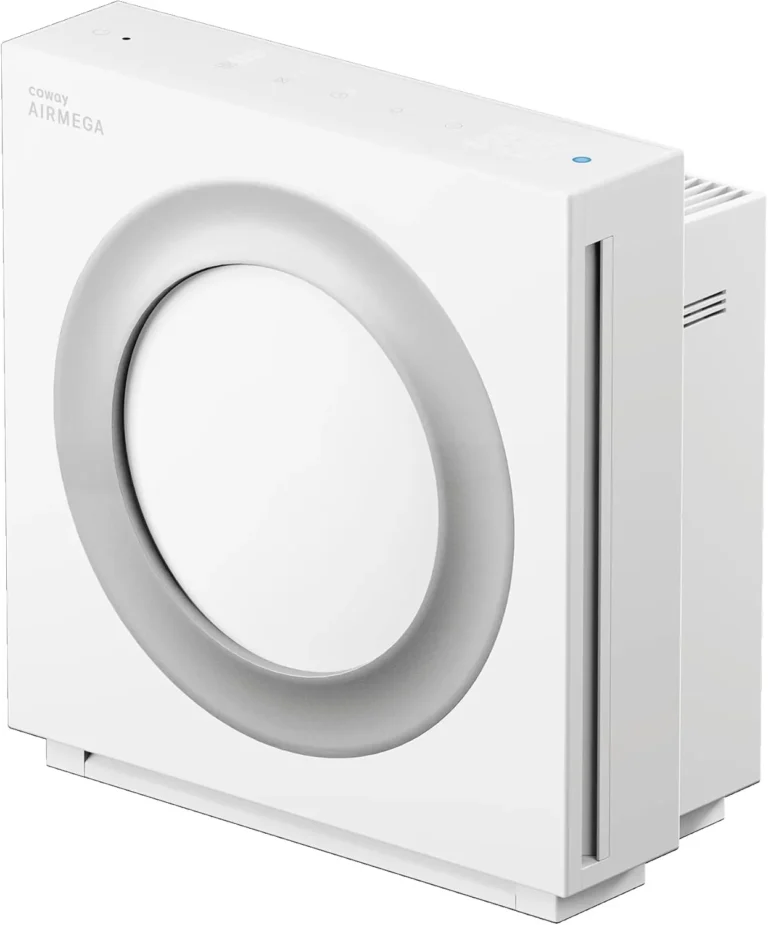
4. Coway Airmega Mighty2: best simple higher-airflow alternative
The newer Mighty2 has a certified smoke CADR of 240 cfm, almost the same as the Vital 200S. HouseFresh’s purchased unit reached PM1 zero in 23 minutes on Turbo. On speed 2 it measured 42.6 dBA and reached PM1 zero in 38 minutes, a stronger quiet-setting result than several conventional mid-size purifiers.
It also has a washable pre-filter and straightforward physical controls. Coway lists a large 1,800-square-foot room claim at one air change per hour, but a bedroom strategy should use about five changes per hour. That makes it more appropriate for roughly 360 square feet with an 8-foot ceiling.
There is one ownership concern to weigh. Some early owners have reported rattling or buzzing that appears separate from ordinary airflow. A rattle can be much more disruptive than steady fan noise. Buy from a seller with a practical return policy, run the machine through every speed when it arrives, and contact Coway if the unit develops mechanical noise.
Best for: medium or larger bedrooms where mid-speed airflow matters more than app features.
Our Coway Mighty2 review covers current lab measurements, the rattle reports, and buying precautions. The Mighty2 filter guide explains the correct Max2 replacement.
Can an air purifier improve sleep?
The strongest answer is “possibly for some people, under some conditions,” not a guarantee.
A double-blind crossover pilot study involved 30 healthy adults who used an active high-efficiency filter and a placebo filter for two weeks each. The active condition was associated with 12 more minutes of total sleep and 19 more minutes in bed on average. Several sleep and mood outcomes did not change, and time awake after sleep onset was higher in the active condition. Two authors were affiliated with Dyson, which readers should consider when interpreting a small pilot study.
Another randomized study in people with house-dust-mite allergic rhinitis found lower bedroom particle levels and improved medication scores, but subjective symptoms and quality-of-life scores did not differ from placebo. Research on bedroom ventilation has also found better sleep measures under higher ventilation conditions, but that is a different intervention from recirculating air filtration.
The reasonable conclusion is that cleaner bedroom air may help in a particular polluted or allergy-affected setting, but a purifier is not a proven sleep treatment for everyone. If insomnia, loud snoring, breathing pauses, or daytime sleepiness persists, seek appropriate medical advice rather than upgrading air cleaners repeatedly.
An air purifier does not remove bedroom CO₂
People exhale carbon dioxide through the night. A standard purifier recirculates indoor air through particle and sometimes carbon media; it does not provide fresh outdoor air and does not meaningfully control normal occupancy-generated CO₂.
Ventilation studies have linked lower bedroom CO₂ under increased outdoor-air supply with better measured sleep in small field experiments. That does not mean one CO₂ threshold diagnoses poor sleep, and outdoor air should not be brought in during wildfire smoke or severe outdoor pollution without appropriate filtration. It does mean a purifier and ventilation solve different problems.
If a room feels stuffy, inspect whether doors, windows, and the home’s mechanical ventilation can provide safe fresh air. Never block required vents. If combustion appliances are present, use working carbon-monoxide alarms; a purifier is not a CO alarm and does not make a combustion problem safe.
How to size a purifier for a bedroom
Start with smoke CADR, room area, and ceiling height. For approximately five air changes per hour:
Required CADR in cfm = room area × ceiling height × 5 ÷ 60
Examples with an 8-foot ceiling:
- 120 square feet needs about 80 cfm.
- 180 square feet needs about 120 cfm.
- 250 square feet needs about 167 cfm.
- 350 square feet needs about 233 cfm.
Buy some headroom if you plan to use a quieter speed. Manufacturers rarely publish CADR for every fan setting, so independent quiet-speed particle tests are unusually useful. A larger purifier on medium can deliver more clean air with less objectionable sound than a small purifier forced to maximum.
Bedroom setup that works in practice
- Do not aim the outlet at your face. Direct airflow can feel dry or drafty even though the purifier is not removing meaningful moisture.
- Keep the intake open. Leave the clearance required by the manual and avoid curtains, bedding, and furniture.
- Use a stable floor position. Do not place a large purifier on a nightstand unless the manufacturer permits it and the surface safely supports it.
- Turn display lights off. Test the setting before bedtime. Some models restore defaults after a power interruption.
- Start higher before bed. Run a stronger speed while the room is unoccupied, then switch to a quieter setting that still provides useful airflow overnight.
- Keep the door closed when practical. An open door connects the purifier to a larger air volume.
- Run it continuously. More operating time means more air passes through the filter.
Bedroom pollutants need different controls
- Airborne pollen and pet allergen: filtration can reduce what remains airborne, while cleaning and bedroom pet exclusion address settled and newly introduced allergen.
- Dust mites: mites live mainly in bedding and soft materials. Humidity control, washing, encasements, and cleaning matter; a purifier only captures material that becomes airborne.
- Mold: a purifier may capture airborne spores, but moisture correction and safe remediation are the solution.
- Odors and VOCs: particle filters do not remove gases. Meaningful activated carbon can help with some compounds, but source removal and ventilation with clean air come first.
- Carbon dioxide: use ventilation, not a recirculating particle purifier.
For allergy-specific product comparisons, see our best air purifier for allergies guide. Pet households can use the pet purifier guide. Our how air purifiers work guide separates particle evidence from gas and health claims.
Best air purifier for bedroom: final decision
Use this best air purifier for bedroom guide to choose enough clean-air delivery at a sound level you can comfortably sleep with.
A practical best air purifier for bedroom choice matches air changes to the actual room and uses a tolerable manual speed.
Keep this best air purifier for bedroom decision focused on nighttime noise, filtration cost, and the pollution source.
The best bedroom air purifier is not simply the model with the lowest advertised decibel number. That number usually comes from the weakest Sleep setting, where clean-air delivery may also be very low. A better bedroom purifier delivers enough filtered air at a sound level you can tolerate, turns its display lights off, and fits the actual room.
For most bedrooms, the Levoit Vital 200S is the best conventional choice. It combines a verified 242 cfm smoke CADR, strong independent performance at a quieter fan setting, full display control, and no ionizer. If fan noise is the deciding factor, the CleanAirKits Luggable XL-7 moves far more air per decibel, although it has no carbon filter, sensor, app, or Sleep mode. Small bedrooms can use the Levoit Core 300S, while the Coway Airmega Mighty2 offers more airflow and simple operation.
We have not personally tested these purifiers. Our recommendations use current manufacturer specifications, purchased-unit measurements from HouseFresh, and public-health guidance. We do not promise that a purifier will cure insomnia, treat a medical condition, or improve anyone’s sleep by a specific number of minutes.
Quick picks
- Best overall conventional purifier: Levoit Vital 200S
- Best clean air per decibel: CleanAirKits Luggable XL-7
- Best for a small bedroom: Levoit Core 300S
- Best simple, higher-airflow alternative: Coway Airmega Mighty2
One important limit: ordinary particle air purifiers do not remove the carbon dioxide you exhale overnight. If a closed bedroom becomes stuffy or CO₂ rises, ventilation with suitable outdoor air is the relevant control.
Frequently asked questions
What decibel level is best for sleeping?
There is no universal preference. Steady 40 dBA fan sound may be comfortable for one person and disruptive for another. Compare measured sound at the fan setting that provides useful clean air, not only the brand’s minimum Sleep figure. Listen for tonal hum, pulsing, or rattle as well as the number.
Should I place the purifier next to the bed?
It should be in the bedroom with unobstructed airflow, but it does not need to be inches from your head. Place it on a stable surface, follow the manual’s clearances, and direct the outlet away from the sleeper.
Can a purifier make the bedroom too dry?
A normal filter purifier does not remove water vapor like a dehumidifier. Moving air can make skin or eyes feel drier, especially if the outlet blows directly at you. Measure humidity if dryness is a concern and correct the airflow direction first.
Should I leave Auto mode on overnight?
Auto mode is convenient, but a sensor may lower the fan before the room has received your target air changes, or change speed and wake a light sleeper. A steady manual speed is more predictable. Test both and choose the setting that provides consistent airflow without disturbing sleep.
Will a purifier help with snoring or sleep apnea?
It is not a treatment for obstructive sleep apnea and cannot be expected to stop snoring. Seek medical evaluation for loud habitual snoring, witnessed breathing pauses, choking during sleep, or excessive daytime sleepiness.
How often should a bedroom filter be replaced?
Follow the exact manual and filter indicator, then account for actual loading, airflow, odor, and damage. Clean only the pre-filter parts the manufacturer says are cleanable. Our filter replacement guide explains why one calendar interval does not fit every bedroom.
Bottom line
The Vital 200S is the best conventional bedroom purifier for most people because it combines adequate CADR, useful quiet-speed performance, display control, and simple maintenance. Choose the Luggable XL-7 when clean air per decibel matters most, the Core 300S for a genuinely small room, or the Mighty2 for stronger quiet-setting airflow with simple controls.
Size the machine from CADR, listen to it on the speed you will actually use, and keep expectations realistic. A purifier can reduce airborne particles. It does not remove exhaled CO₂, replace ventilation, or guarantee better sleep.
Sources
- US EPA: Guide to Air Cleaners in the Home
- US EPA: Air Cleaners and Air Filters in the Home
- US EPA: Indoor CO₂ and ventilation
- Journal of Sleep Research: Air purification and sleep pilot trial
- Yonsei Medical Journal: Air purifiers and allergic rhinitis randomized trial
- Indoor Air: Bedroom ventilation, sleep, and next-day performance
- Science of the Total Environment: Bedroom ventilation field study
- HouseFresh: Levoit Vital 200S independent test
- Levoit: Vital 200S product specifications
- HouseFresh: CleanAirKits Luggable XL-7 independent test
- CleanAirKits: Luggable product information
- HouseFresh: Levoit Core 300S independent test
- Levoit: Core 300S product specifications
- HouseFresh: Coway Airmega Mighty2 independent test
- Coway: Airmega Mighty2 product specifications