Best Air Purifier for Cat Allergies: Evidence-Based Picks (2026)
Disclosure: Clean Air Adviser may earn a commission when you buy through links on this page. This does not change what you pay. We have not physically tested these purifiers. This guide uses current manufacturer data, purchased-unit measurements, peer-reviewed research, and allergy-organization guidance. It is not medical or veterinary advice.
Quick answer: This air purifier for cat allergies guide compares evidence-backed picks, room sizing, and the practical limits of filtration for airborne Fel d 1.
How to use an air purifier for cat allergies
- Place the air purifier for cat allergies in the allergic person’s closed bedroom first, with clear intake and outlet space.
- Run the air purifier for cat allergies continuously at the highest practical speed, then clean only the parts the manufacturer identifies as cleanable.
- Use the air purifier for cat allergies alongside bedroom cat exclusion and cleaning, because it cannot remove settled allergen from textiles.
Related guide
If asthma is part of the concern, see our air purifier guide for cats with asthma for practical limits, particle-control steps, and buying rules.
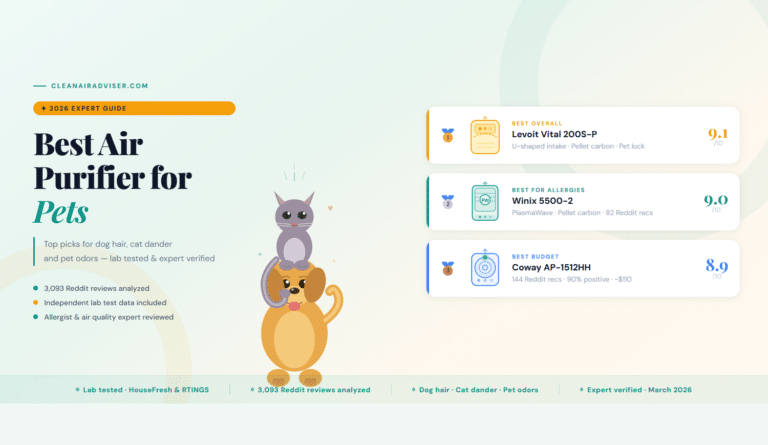
Quick answer: A correctly sized HEPA purifier can lower airborne cat allergen, but it cannot remove allergen already settled in bedding, carpet, furniture, or clothing. The best conventional choice for most cat households is the Levoit Vital 200S: verified 242 cfm smoke CADR, a removable washable prefilter for hair, strong independent particle removal, app control, and no ionizer.
The evidence deserves an honest explanation. A 2022 bedroom study measured a median 76.6% reduction in airborne Fel d 1 during filtration. However, a double-blind clinical trial found that a HEPA cleaner reduced airborne allergen without producing a significant improvement in symptoms, lung function, sleep disturbance, or medication use compared with placebo. A purifier can reduce exposure. It is not a guaranteed allergy treatment.
If your household also deals with pollen, dust mites, or mold sensitivity, use our broader air purifier for allergies guide to match filtration and source control to each trigger.
Our practical recommendation
- Put the first purifier in the allergic person’s bedroom and keep the cat out of that room.
- Choose enough verified CADR for about five air changes per hour.
- Run continuously at the highest sound level you can live with.
- Combine filtration with weekly HEPA vacuuming, damp dusting, and washable bedding.
- See an allergist when symptoms persist or asthma is involved. See a veterinarian for a cat with coughing or breathing problems.
Best air purifiers for cat allergies: quick comparison
| Pick | Particle airflow | Useful room target | Why it stands out |
|---|---|---|---|
| Best overall: Levoit Vital 200S | 242 cfm smoke CADR | About 360 sq. ft. at roughly 5 ACH | Washable hair prefilter, particle sensor, app, no ionizer |
| Best for pellet carbon: Winix 5510 | 253 cfm smoke CADR; 249 cfm estimated by HouseFresh | About 380 sq. ft. at roughly 5 ACH | Separate pellet-carbon filter and washable prefilter |
| Best simple value: Coway AP-1512HH | 233 cfm smoke CADR | About 350 sq. ft. at roughly 5 ACH | Long track record, easy controls, widely available filters |
| Best compact smart pick: Levoit Core 400S | 260 cfm certified smoke CADR; lower in HouseFresh’s US test | About 390 sq. ft. from certification | Small footprint, PM sensor, app and schedules |
| Best airflow value: AirFanta 3Pro | 353 cfm estimated PM1 CADR by HouseFresh | About 530 sq. ft. at roughly 5 ACH | High airflow for larger rooms and strong quiet-speed value |
Room targets assume an eight-foot ceiling and approximately five air changes per hour. They are not manufacturer “cleans once per hour” coverage claims. Use a smaller room target if you cannot tolerate maximum speed, the room has high ceilings, or doors stay open.
Do air purifiers help with cat allergies?
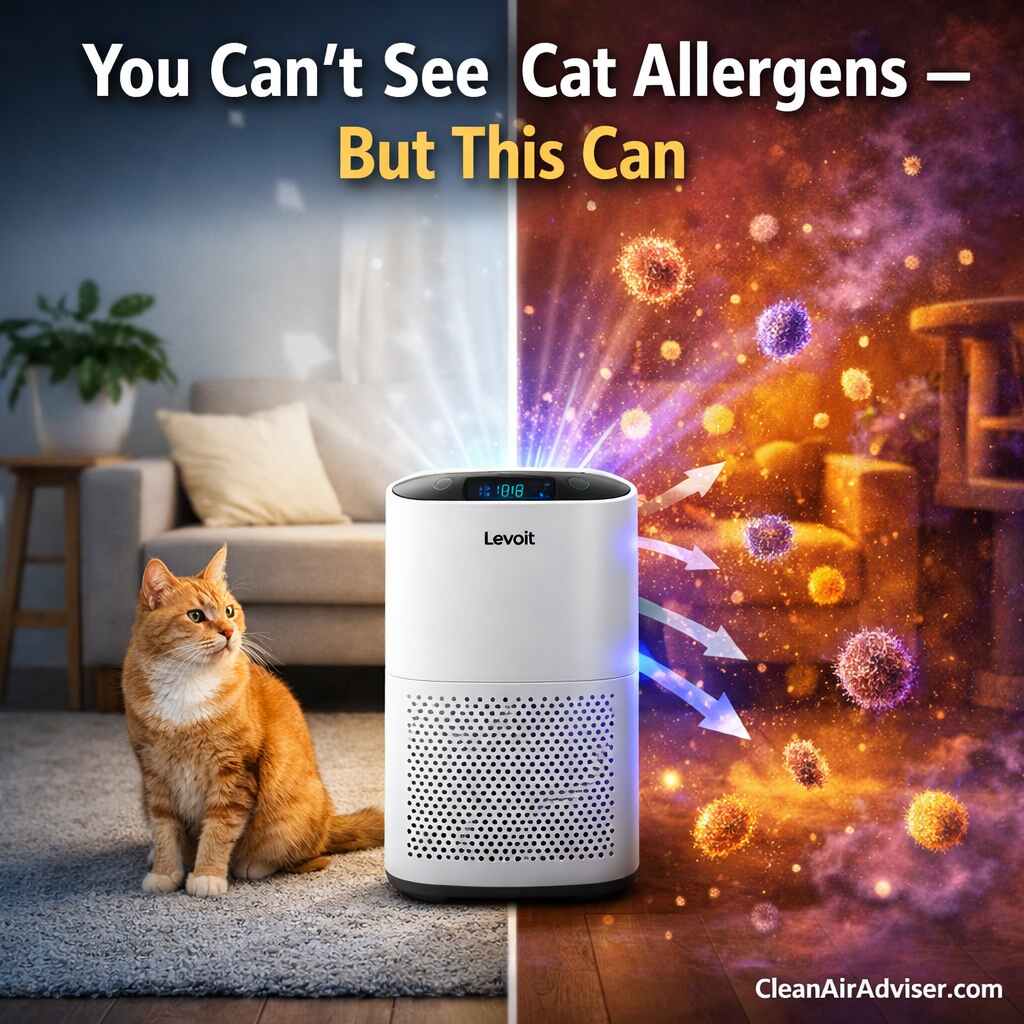
They can reduce airborne exposure, but symptom benefit varies. Cat allergens travel on particles across a wide size range. When those particles are floating, a high-efficiency filter can capture them. Once they settle into porous surfaces, an air purifier cannot reach them until activity sends them airborne again.
A 2022 study in 22 bedrooms compared conditions with and without filtration. The researchers reported a median 76.6% reduction in airborne Fel d 1 across 21 relevant rooms, along with reductions in particulate matter. This shows that filtration can change what is in the air.
The strongest caution comes from a 1998 double-blind, placebo-controlled trial involving 35 cat-allergic people living with cats. Active HEPA filtration, bedroom cat exclusion, and mattress and pillow covers reduced airborne cat allergen versus placebo. The investigators did not detect significant differences in nasal or chest symptoms, sleep disturbance, peak flow, spirometry, or rescue medication use.
A smaller exposure study in five cat homes found lower inhaled Fel d 1 during air-cleaner use, particularly when the cat was in the room. Its authors still concluded that cat removal remained the best advice for people who develop symptoms on exposure.
The fair conclusion is neither “purifiers cure cat allergies” nor “purifiers do nothing.” They can lower one part of exposure. Clinical response depends on sensitivity, total allergen reservoirs, cat access, medication, ventilation, cleaning, and other triggers. Discuss persistent symptoms, wheezing, or asthma with a qualified clinician.
What is Fel d 1?
Fel d 1 is the major cat allergen. Cats produce it in salivary and skin-related glands. Grooming spreads it onto fur and skin, and allergen-bearing particles enter the air and settle throughout the home. The problem is the protein, not the hair itself. A hairless cat can still produce cat allergen.
Fel d 1 is readily transported on clothing and can be found in places without resident cats. In a cat home, soft surfaces become long-term reservoirs. Walking on carpet, sitting on a sofa, making the bed, or vacuuming with a leaky machine can resuspend particles. That is why air filtration works best as one part of a broader exposure-reduction plan.
How to choose a purifier for cat allergen
Use CADR, not a HEPA badge alone
HEPA describes filter performance under a test. CADR describes how much clean air the whole purifier produces. For an eight-foot ceiling, the room area supported at five air changes per hour is roughly CADR multiplied by 1.5. A 240 cfm purifier therefore fits about 360 square feet at maximum.
More filtration cycles can reduce airborne particles faster, but the highest speed is often loud. HouseFresh measured the Winix 5510 at 67.2 dBA on maximum and only 125 cfm at a quieter speed below 45 dBA. Buy for the fan speed you will use, not the speed you intend to avoid.
Prefer an accessible prefilter
Cat hair is much larger than Fel d 1 and is not the allergy target, but it can cover the first filter surface. A removable prefilter makes hair and lint easier to vacuum. Follow the model’s manual rather than a universal weekly schedule. Homes with several shedding cats may need inspection much more often than a low-dust bedroom.
Carbon is for some odor, not allergen
Activated carbon does not capture Fel d 1 better than the particle filter. It can adsorb some odor molecules, with results depending on carbon mass, chemistry, humidity, and contact time. A pellet filter containing a few hundred grams can help routine smells but is not a solution for strong ammonia or an unclean litter box.
Source control comes first: scoop litter promptly, wash the box safely, use appropriate ventilation, and ask a veterinarian about changes in urination or unusually strong odor. Never mix cleaning products in a litter area.
Avoid overclaiming ozone safety
Mechanical filtration does not need ionization. Some purifiers include a defeatable ionizer. California certification indicates compliance with an ozone-emission limit, not zero output or medical approval. If you prefer filtration alone, choose a model without an ionizer or leave the feature off.
1. Levoit Vital 200S: best overall
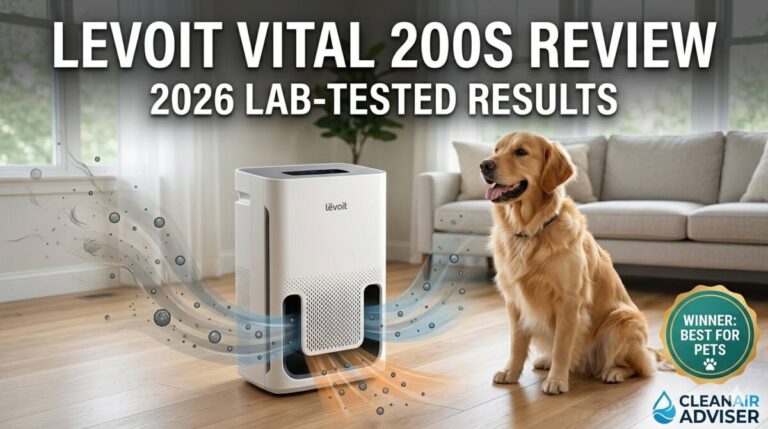
The Vital 200S combines the features that matter in a cat home without relying on a pet-specific marketing label. Its certified smoke CADR is 242 cfm, giving roughly five air changes per hour in about 360 square feet with an eight-foot ceiling. Levoit’s AHAM room listing is 388 square feet at 4.8 ACH.
HouseFresh bought the Vital 200S and measured PM1 clearance in 23 minutes in its 728-cubic-foot test room. The large front prefilter can be removed for cleaning, and the U-shaped inlet provides useful intake area near the floor. A control lock helps prevent a curious cat from changing settings. VeSync adds schedules and remote control.
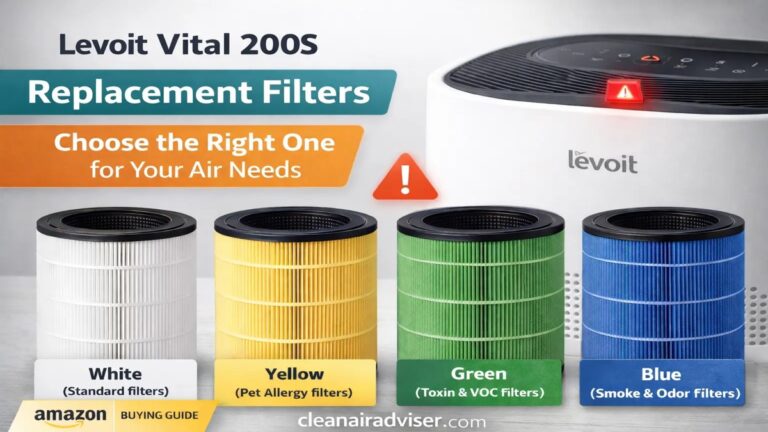
The standard Vital 200S has no ionizer. It uses a particle sensor for Auto mode, but continuous manual speed remains useful when allergen production is ongoing. The filter includes pellet carbon for ordinary odor support. Do not pay more for a “pet” replacement unless the listing identifies a real media difference and correct Vital 200S fit.
Choose it for: bedrooms and medium living rooms, washable hair capture, and app control without ionization.
Tradeoffs: the main filter is proprietary, the app needs an account for remote features, and maximum airflow still creates audible fan noise.
See our Levoit Vital 200S review and Vital 200S filter guide.
2. Winix 5510: best when odor media matters
The Winix 5510 has certified CADR figures of 253 cfm smoke, 252 dust, and 247 pollen. HouseFresh’s purchased unit reached PM1 zero in 24 minutes and produced an estimated 249 cfm on maximum. The results support its use in a medium room.
Filter Q separates the washable prefilter, pellet AOC carbon, and True HEPA stages. HouseFresh reports that Winix confirmed 226 grams of carbon. That gives the 5510 more credible odor-media depth than a thin carbon-coated sheet, though it cannot guarantee ammonia or VOC removal.
There are two reasons it is not our top pick. Maximum speed measured 67.2 dBA, which many people will not run beside a bed. Also, its Auto mode is based on a gas sensor rather than a PM2.5 sensor. The display can respond to some odor events without directly measuring airborne cat-allergen particles.
PlasmaWave is optional. Winix reports a model-specific eight-hour ozone result of 0.22 ppbv in a 30-cubic-metre chamber. Users who want mechanical filtration only can switch it off.
Our Winix 5510 review and Filter Q guide cover noise and ownership costs.
3. Coway AP-1512HH: simple, proven value
The Coway AP-1512HH has a 233 cfm smoke CADR, which supports roughly 350 square feet at five air changes per hour. It has straightforward physical controls, an accessible washable prefilter, widely available replacement filters, and years of market history.
Its main weakness for a cat household is the thin carbon sheet. It can assist with light odor, but it has much less gas-media depth than a pellet bed. Buy the Coway for particle filtration and reliability, not as an ammonia-removal machine.
The ionizer can be disabled. Eco mode may stop the fan after the particle sensor sees clean air, so a steady manual speed is more predictable when allergen is continuously being released and resuspended.
Read our Coway AP-1512HH review and Coway filter guide.
4. Levoit Core 400S: compact smart alternative
The Core 400S has a certified 260 cfm smoke CADR and a compact round footprint. It includes a PM sensor, display, VeSync control, schedules, and no ionizer on the standard model. The official number supports about 390 square feet at five air changes per hour.
HouseFresh found regional performance differences. Its US model produced an estimated 213 cfm PM1 CADR, while its European model measured 198 cfm. Buyers outside the United States should not assume identical airflow from the same name.
The cylindrical prefilter is less convenient to access than the Vital 200S’s removable front screen. In a home with heavy shedding, that maintenance difference is meaningful. Choose the Core 400S when compact placement and smart monitoring matter more than easy prefilter cleaning.
Our Core 400S review and Core 400S filter guide explain the variants.
5. AirFanta 3Pro: high airflow for a larger room
The AirFanta 3Pro is a compact four-filter, PC-fan design. HouseFresh measured an estimated 353 cfm PM1 CADR at top speed, enough for about 530 square feet at five air changes per hour. At 6.54 volts it measured 43.3 dBA and still cleared the chamber in 28 minutes, giving it strong quiet-speed performance.
It is less appliance-like than the other picks. The filters form the sides, the fan array sits on top, and the unit requires simple assembly. That exposed layout may be a poor match for cats that chew, scratch, spray, or climb on equipment. Place it where the animal cannot damage the filters or wiring.
Where to put the purifier
AAFA recommends considering a HEPA air cleaner especially where people sleep and running it at least four hours per day. Continuous operation generally provides more filtration than intermittent use, as long as noise and cost allow it.
- Bedroom first. Keep the cat out and close the door. Place the purifier where intake and outlet remain clear, following the manual’s wall-clearance instructions.
- Main shared room second. If budget allows, a second purifier where the cat spends time reduces the need to move one unit and leave a room unfiltered.
- Not directly beside the litter box. Dust and moisture can overload a filter, and strong airflow may spread litter dust. Use source control and place the purifier several feet away with a clear airflow path.
Do not point a strong outlet directly at the bed, cat bed, litter, or dusty textiles. The goal is whole-room circulation without deliberately resuspending reservoirs.
What else reduces cat-allergen exposure?
AAFA’s medically reviewed guidance treats filtration as one part of a multi-step plan. Useful measures include:
- Keep the cat out of the allergic person’s bedroom.
- Vacuum carpet and fabric furniture weekly with a HEPA-filter vacuum.
- Replace wall-to-wall carpet with hard flooring when practical, or use washable rugs.
- Wash removable textiles and pet bedding regularly according to their care labels.
- Damp-dust hard surfaces so allergen is captured rather than sent back into the air.
- Use suitable high-efficiency HVAC filtration if the system can handle it.
- Work with an allergist on diagnosis and treatment rather than relying on appliance marketing.
AAFA also discusses allergen-reducing cat food as an available option. Evidence and suitability should be discussed with a veterinarian, especially when a cat has medical or dietary needs. It should not replace environmental control or human allergy care.
A note about feline asthma
Coughing, wheezing, rapid breathing, or open-mouth breathing in a cat requires veterinary attention. Cornell explains that feline asthma involves lower-airway inflammation and is generally treated with prescribed corticosteroids, sometimes with bronchodilators. Drugs appropriate for one condition may be harmful for another.
Cornell notes that indoor-air purification and allergen avoidance are sometimes recommended because they help human asthma patients, but they have not been rigorously tested or proven to work in feline asthma patients. A purifier is therefore not a treatment plan for a cat.
Reducing smoke, dusty litter, aerosol cleaners, candle smoke, and other suspected irritants is sensible, but coordinate changes with the veterinarian. Do not delay treatment while shopping for a purifier.
Maintenance in a cat household
Inspect the prefilter regularly and clean it when hair or dust buildup appears, using the manufacturer instructions. Some prefilters can be rinsed; others should only be vacuumed. Let every washable part dry fully before reinstalling it.
Do not use a universal four-to-eight-month HEPA schedule. Filter life depends on airflow, runtime, dust, smoke, litter particles, the number of animals, and prefilter care. Follow the model’s indicator and manual, then replace sooner if airflow falls, the media is damaged or wet, or persistent odor remains after source control.
Our air-purifier filter timing guide gives a condition-based inspection method.
Air purifier for cat allergies: buying decision
An air purifier for cat allergies should be sized from CADR for the room, then paired with bedroom exclusion, cleaning, and medical advice when symptoms persist.
The best air purifier for cat allergies is one you can run consistently with clear airflow and the right filter maintenance.
Frequently asked questions
Will a HEPA purifier cure cat allergies?
No. It can lower airborne Fel d 1, but it does not remove settled reservoirs and clinical symptom improvement is not guaranteed. Use it as one part of an allergist-guided exposure and treatment plan.
How many air changes per hour should I target?
About five is a practical target for continuous particle removal. Multiply CADR by 1.5 to estimate square feet at five ACH with an eight-foot ceiling. Size down when running at quieter speeds.
Does carbon remove cat dander?
No. The HEPA or particle filter handles allergen-bearing particles. Carbon targets some gases and odors. Carbon amount does not replace CADR.
Should the purifier go next to the litter box?
Not directly beside it. Keep several feet of separation and do not aim airflow across litter. Prompt scooping, appropriate litter, cleaning, and ventilation address the source more effectively.
Is the Winix 5510 better than the Vital 200S?
The Winix has a separate 226-gram pellet-carbon filter and slightly higher official smoke CADR. The Vital is much quieter at maximum in HouseFresh’s testing, has a particle sensor, an easier front prefilter, and no ionizer. We prefer the Vital for most bedrooms.
How quickly will symptoms improve?
No reliable universal timeline exists. Airborne particles can fall within hours, but symptom response varies and the strongest placebo-controlled cat-allergy trial found no significant clinical difference over three months. Seek medical guidance rather than waiting for a promised day-three result.
Bottom line
The Levoit Vital 200S is our best overall cat-allergy purifier because it combines verified particle airflow, manageable noise, washable hair capture, and no ionizer. The Winix 5510 is useful when pellet carbon matters, the Coway AP-1512HH is the proven simple choice, the Core 400S fits compact smart setups, and the AirFanta 3Pro offers more airflow for a large room.
More importantly, set the right expectation: filtration reduces airborne allergen exposure. It does not guarantee symptom relief and cannot clean allergen out of textiles. Bedroom cat exclusion, HEPA vacuuming, damp cleaning, washable surfaces, and appropriate medical care remain central.
Sources
- American Journal of Respiratory and Critical Care Medicine via PubMed: placebo-controlled HEPA trial in cat-allergic subjects
- Clinical and Translational Allergy via PubMed: home filtration effects on pet allergens and particulate matter
- Clinical and Experimental Allergy via PubMed: filtration and personal exposure to cat allergen
- Asthma and Allergy Foundation of America: dog and cat allergy guidance
- Cornell Feline Health Center: feline asthma overview
- HouseFresh: Levoit Vital 200S purchased-unit review
- HouseFresh: Winix 5510 purchased-unit review
- HouseFresh: Levoit Core 400S US and European testing
- HouseFresh: AirFanta 3Pro purchased-unit review
- Winix America: Winix 5510 official specifications