Best Air Purifier for Pets: Hair, Dander and Odor Picks (2026)
Disclosure: CleanAirAdviser may earn a commission if you buy through an Amazon link on this page, at no extra cost to you. The links do not determine the rankings.
Best air purifier for pets: practical setup
The best air purifier for pets should be matched to the room, left with clear airflow, and used alongside regular cleaning rather than as a substitute for it.
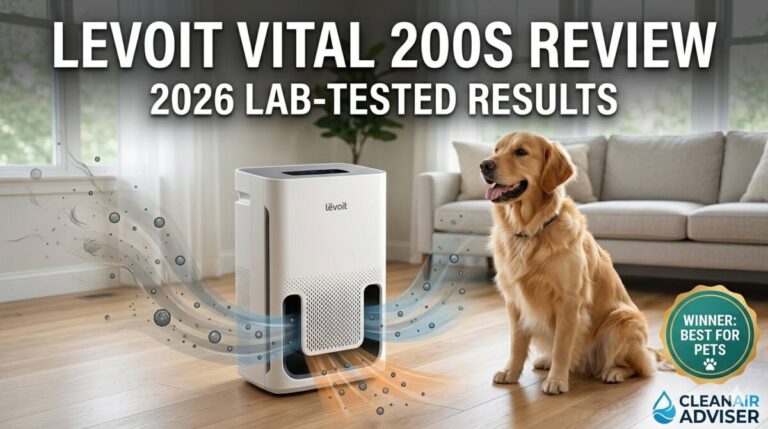
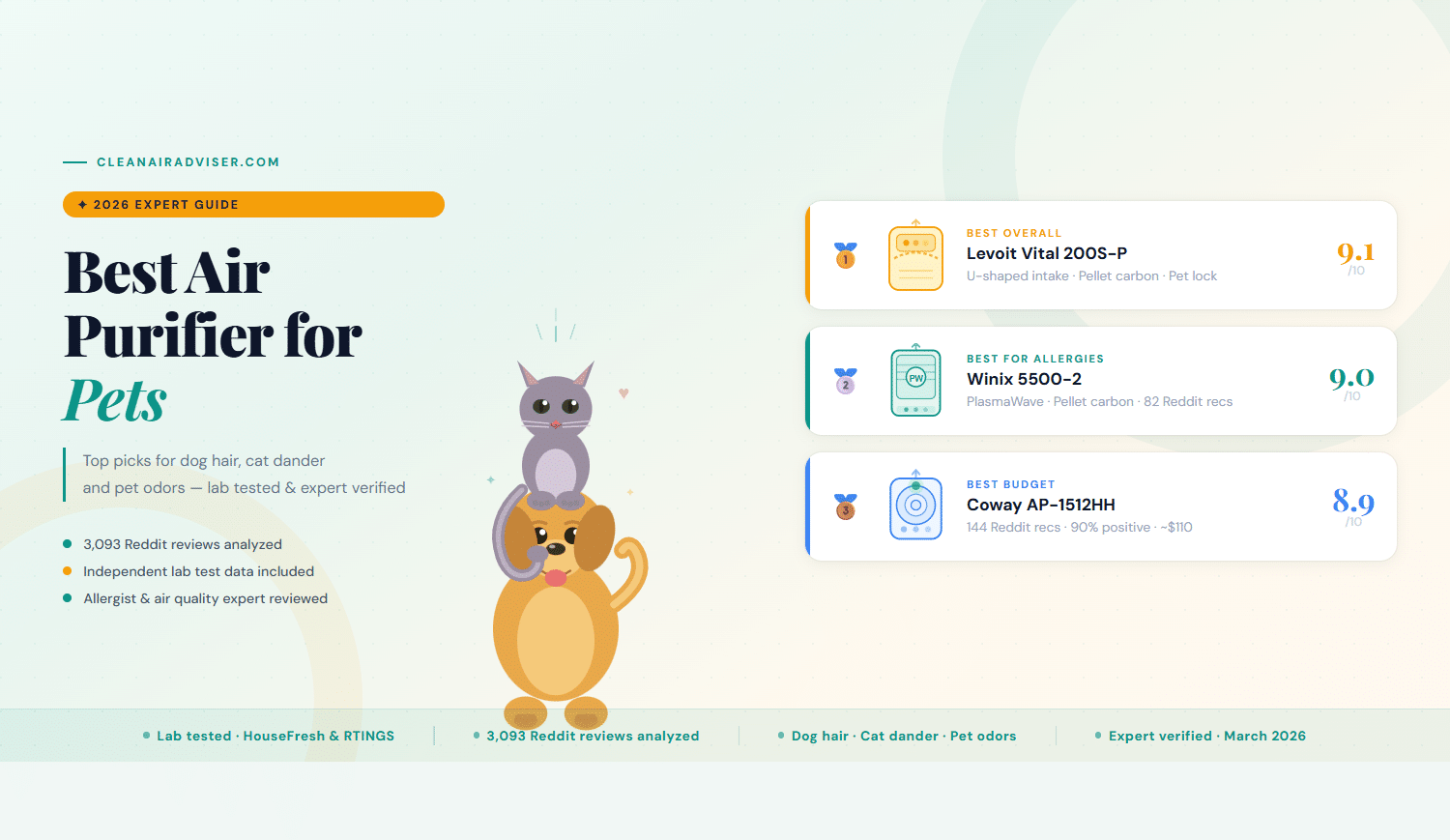
Quick answer: The Levoit Vital 200S is the best air purifier for pets in a typical bedroom or closed living room. It combines 242 cfm certified smoke CADR, a removable washable prefilter for hair and lint, strong independent particle removal, a particle sensor, app control, a panel lock, and no ionizer. Choose the AirFanta 3Pro for more particle airflow, the Winix 5510 when routine pet odors matter, the Shark NeverChange HP302 when washable outer screens and a long-life-filter design appeal, or the Coway AP-1512HH for proven simplicity.
The important distinction is what you want removed. Hair usually settles on floors and furniture, allergen proteins travel on airborne and settled particles, and odor compounds are gases. No single filter handles all three equally well. A purifier can lower airborne particles and provide some odor support, but it does not replace vacuuming, washing pet bedding, litter-box care, grooming, ventilation, or allergy treatment.
We have not physically tested these purifiers. Recommendations use current manufacturer information, public certification data, purchased-unit testing, peer-reviewed cat-allergen research, and allergy-organization guidance. Product claims and independent results are identified separately.
Best air purifiers for pets: quick comparison
| Pick | Particle airflow | Practical room target | Pet-home advantage | Main tradeoff |
|---|---|---|---|---|
| Best overall: Levoit Vital 200S | 242 cfm certified smoke CADR | About 360 sq. ft. at 5 ACH | Removable washable prefilter, particle sensor, lock, no ionizer | Particle and carbon media are replaced together |
| Best high airflow: AirFanta 3Pro | 353 cfm estimated PM1 CADR with particle filters | About 529 sq. ft. at 5 ACH | High airflow per dollar and strong quiet-speed result | Exposed modular filters, light assembly, no app or lock |
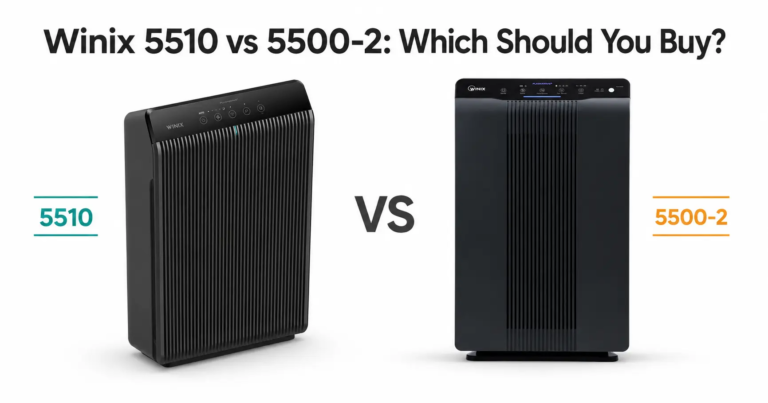
| Best for particles plus routine odors: Winix 5510 | 249 cfm estimated PM1 CADR | About 372 sq. ft. at 5 ACH | Separate washable prefilter and 226-gram pellet-carbon stage | Very loud at maximum; Auto mode uses odor sensor |
| Best long-filter design: Shark HP302 | 204 cfm certified smoke CADR | About 300 sq. ft. at 4.8 ACH | Washable Debris Defense screens and numerical particle display | Five-year claim has conditions; no app; fragrance cartridge |
| Best simple proven pick: Coway AP-1512HH | 233.6 cfm certified smoke CADR | About 350 sq. ft. at 5 ACH | Washable prefilter, particle sensor, mature filter market | Thin carbon sheet and optional ionizer |
Room-size shortcut: with an eight-foot ceiling, divide smoke CADR by about 0.67 for a five-air-change room target. A 240 cfm machine therefore serves roughly 360 square feet at maximum speed. Size smaller if doors remain open, ceilings are high, or you plan to run a quiet setting.
What a pet air purifier can and cannot do
Pet hair
Most whole hairs are too heavy to remain airborne for long. Some float briefly and reach a prefilter, but much of the shedding lands on carpet, upholstery, bedding, and corners. A purifier is not a vacuum cleaner. Its useful role is catching some airborne hair and lint before those materials load the main filter.
A removable prefilter is valuable because it can be cleaned without replacing the expensive particle filter. “Washable” does not mean every layer can be washed. Follow the manual, allow a wet screen to dry completely, and never put water on HEPA or other particle media unless the manufacturer explicitly permits it.
Pet dander and allergen
People often use “dander” to mean the allergy itself. The actual triggers are proteins from skin, saliva, and urine carried on particles. Cat allergen Fel d 1 is especially persistent and spreads on clothing and household dust. A high-efficiency purifier can capture airborne carrier particles. It cannot reach material already settled into a sofa, mattress, rug, wall dust, or clothing.
The evidence supports exposure reduction but not a symptom promise. A 2022 bedroom study measured a median 76.6 percent reduction in airborne Fel d 1 during filtration. A double-blind placebo-controlled trial found lower airborne allergen without significant differences in symptoms, lung function, sleep disturbance, or medication use. Filtration is one layer of control, not a cure.
Pet odors
HEPA and other particle filters do not remove most odor gases. Activated carbon or another sorbent is needed, and the amount of media matters. Thin coated sheets provide limited support. Pellets generally offer more usable material, while specialist gas purifiers contain pounds of sorbent.
Even a good carbon stage should not be used to cover a dirty litter box, urine-soaked material, damp pet bedding, or a ventilation problem. Remove the odor source first. A fragrance cartridge changes perceived smell but does not prove the gases were removed.
How to choose a pet purifier
Start with CADR, not a pet label
Clean Air Delivery Rate combines airflow and particle removal into a complete-machine number. AHAM’s suggested room size is based on 4.8 air changes per hour. There is no universal rule that every pet home needs 300 cfm or 1.5 times the room area. Required CADR depends on room volume and the air-change target.
Use CADR = room area × ceiling height × target ACH ÷ 60. For a 300-square-foot room with an eight-foot ceiling at five ACH, the answer is 200 cfm.
Published CADR is normally measured at maximum speed. If the purifier becomes too loud, real airflow falls when you reduce the fan. Independent results at several speeds are more useful than a sleep-mode noise number alone.
Prefer accessible prefilter maintenance
A flat removable screen is usually easier to vacuum or rinse than a cylindrical fabric surface inside a bonded filter. The Vital 200S and Winix 5510 make the first layer easy to access. Shark adds two washable outer screens. AirFanta exposes its filter faces and needs careful vacuuming. The Coway requires removing the front panel, but the screen itself is washable.
Choose the sensor for the problem
A particle sensor can react when dust or dander is stirred up. An odor sensor may react to some gases but can ignore allergen particles that have no odor. The Winix 5510 uses an odor sensor, so manual speed is more predictable for dander. No sensor tells you that every allergen or gas is gone.
Avoid intentional ozone generation
EPA calls ozone a lung irritant and advises avoiding air cleaners that intentionally produce it. Mechanical particle filters and carbon do not generate ozone, but an added ionizer, plasma system, electrostatic stage, or some UV designs may have separate emissions. If a recommended machine has an optional electronic mode, you can leave it off. Our rankings do not depend on claims that PlasmaWave or another ionizer neutralizes pet-allergen proteins.
1. Levoit Vital 200S: best overall
The Vital 200S offers the most complete set of practical pet-home features without relying on a “pet” label. Its certified smoke CADR is 242 cfm, and Levoit’s AHAM room listing is 388 square feet at 4.8 ACH. We use about 360 square feet as the simple five-ACH target.
HouseFresh bought the Vital 200S and measured PM1 reaching zero in its 728-cubic-foot room in 23 minutes at maximum. Sound reached 57.7 dBA at that speed. At a quieter setting around its sub-45-dBA target, the same test took 46 minutes. That difference is a useful reminder to buy enough capacity for the speed you will actually run.
The large front prefilter lifts out for cleaning, and the U-shaped inlet provides useful intake near floor level. This does not make hair disappear or guarantee longer main-filter life, but it makes frequent maintenance less frustrating. A panel lock prevents paws or children from changing settings. The standard model has a particle sensor, VeSync schedules, and no ionizer.
The combined filter includes carbon pellets for ordinary smells. It is not a deep carbon bed for severe litter, urine, skunk, or chemical odors. Because the particle and carbon layers are bonded, the entire assembly is replaced together when one part reaches the end of useful life.
Best for: most cat or dog households in a medium room, especially when easy hair maintenance, smart control, and a particle sensor matter.
See our Levoit Vital 200S review and replacement-filter guide for current filter wording and variants.
2. AirFanta 3Pro: best high-airflow value
The AirFanta 3Pro is a compact filter box with four side filters and a top array of PC-style fans. It needs light assembly, exposes the filter surfaces, and has no sensor, Auto mode, app, or lock. Those limitations make it a poor fit where a pet may scratch or dislodge the filters. In a stable placement, its airflow is excellent.
HouseFresh measured PM1 reaching zero in 17 minutes with the particle-filter set and estimated 353 cfm CADR, enough for roughly 529 square feet at five ACH. The carbon-plus-particle filters took 20 minutes, showing the airflow cost of denser media. Maximum sound was 56.3 dBA. At 6.54 volts, it measured 43.3 dBA and still cleared the chamber in 28 minutes.
This is the better choice when several animals share a larger room and high particle throughput matters more than a washable screen, display, or app. Use a gentle vacuum method recommended for the filter surface and keep the unit out of reach of claws, chewing, spills, and unstable furniture.
Best for: high particle airflow per dollar in a larger room with a safe, stable placement.
3. Winix 5510: best for dander plus routine odors
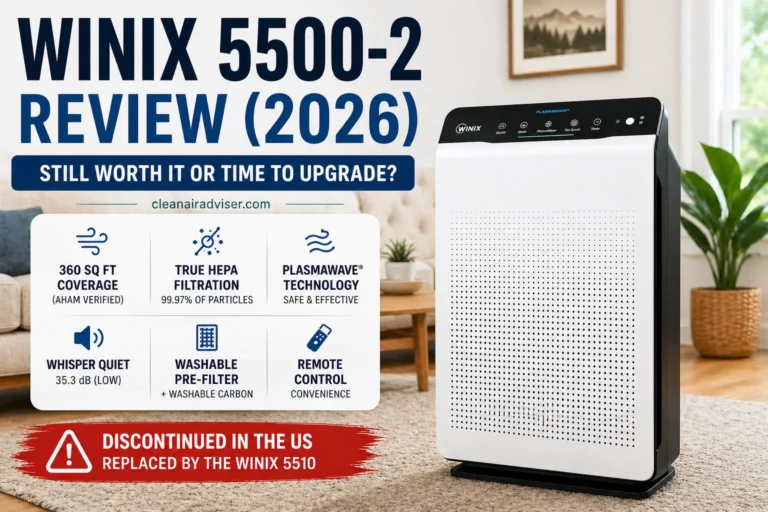
The Winix 5510 combines a washable prefilter, True HEPA filter, and a separate 226-gram pellet-carbon stage. The separate carbon cassette is more serviceable than carbon bonded to a main filter and provides more physical media than a thin coated sheet. It remains a modest amount for gases, so expectations should stay at ordinary cooking and pet-odor support.
HouseFresh measured PM1 reaching zero in 24 minutes and estimated 249 cfm CADR at top speed. It supports about 372 square feet at five ACH. Maximum sound reached 67.2 dBA, much louder than the Vital 200S or AirFanta. At speed two, Winix measured 40.8 dBA and the test took 47 minutes.
The app adds remote control. Auto mode uses an odor sensor, not a particle sensor, so it may not increase speed when allergen particles rise. Use a manual fan speed for dander. PlasmaWave can be disabled, and no reliable evidence supports presenting it as a clinically meaningful Fel d 1 treatment.
Best for: a household that wants strong particle cleaning, app control, an easy prefilter, and a separate pellet-carbon stage for normal odors.
Read the full Winix 5510 review and Filter Q replacement guide.
4. Shark NeverChange HP302: best long-filter design
The Shark HP302 uses two washable Debris Defense screens before its main HEPA multi-filter. Those outer screens are convenient in a shedding household because they can be cleaned without handling the main media. The on-device display reports particle estimates, and the machine has Auto mode but no app.
ENERGY STAR lists 204 cfm smoke CADR, 216 cfm dust, 235 cfm pollen, and a 316-square-foot room size. RTINGS measured a similar 208 cfm for PM1 at maximum and 138 cfm at a setting no louder than 45 dBA. Measured noise ranged from 33.8 to 60.1 dBA. Those numbers make this a medium-room purifier, not a rapid whole-house cleaner.
Shark’s “up to five years” main-filter claim has defined test conditions: a 300-square-foot area, 12 hours per day at maximum, and an endpoint that permits a 50 percent CADR decline. Pet hair, dust, smoke, maintenance, and runtime can change real life. The screens still need cleaning, and the optional Odor Neutralizer cartridge is a fragrance consumable rather than proof of odor-gas removal.
Best for: buyers who accept a roughly 200 cfm purifier and value washable outer screens and potentially fewer main-filter purchases.
Our Shark HP302 review audits the coverage and five-year claims. The HP302 filter guide explains every maintenance part.
5. Coway AP-1512HH: best simple proven pick
The Coway AP-1512HH remains a dependable mechanical purifier when its optional ionizer is switched off. Certified results list about 233.6 cfm smoke CADR, 247.7 cfm dust, and 232.2 cfm pollen. The room listing is roughly 362 square feet at 4.8 ACH.
HouseFresh’s unit reached PM1 zero in 26 minutes with the ionizer active and 29 minutes with it disabled. Its washable prefilter is easy to access behind the front panel, the particle sensor can run Auto mode, and replacements are widely available.
The carbon sheet is thin, so the Coway is a better dander and general-particle choice than a litter-box odor specialist. Maximum sound was 60.1 dBA in HouseFresh testing, and power use rises sharply on its top setting. It has no app or control lock.
Best for: buyers who want a proven, simple particle purifier and a mature replacement-filter market.
See the AP-1512HH review and filter guide.
Cat, dog, and litter-box strategies
For cat allergen
Put the first purifier in the allergic person’s bedroom, run it continuously at a tolerable speed, and keep the cat out of that room if possible. Clean bedding and hard surfaces, vacuum with a HEPA-filtered machine, and reduce fabric reservoirs. Filtration can lower airborne Fel d 1 but cannot remove what is embedded throughout the home.
Our cat-allergy air-purifier guide covers the clinical evidence and room setup. The broader allergy purifier guide separates pet, pollen, dust-mite, and mold control.
For dog hair
Use the purifier for airborne dander and fine material, not visible fur on floors. Vacuum and clean pet bedding. Inspect the prefilter frequently during a shed, but do not turn one household’s weekly routine into a universal schedule. A Great Pyrenees, a short-haired dog, and a pet-free pollen season load filters very differently.
Our dog dander and allergy guide covers dog-specific source control.
For litter-box smell
Scoop and clean the box, use appropriate litter depth, remove contaminated material, and ventilate when outdoor air is clean. Place a carbon-equipped purifier where it can circulate the room without blowing directly across loose litter. The Winix has the most useful separate carbon stage among our conventional picks, but it cannot make neglected waste hygienic or remove every ammonia-related gas.
Pet-safe placement and operation
- Use a stable floor position with clear intake and exhaust space.
- Keep power cords away from chewing and scratching.
- Do not let a pet sit on or block the outlet.
- Avoid intentional ozone generators. Leave optional ionizers off if you want mechanical filtration only.
- Skip fragrance cartridges if an animal or person reacts to scented products.
- Unplug the purifier before opening it for maintenance.
- Let washable screens dry completely before reinstalling them.
- Talk with a veterinarian about coughing, wheezing, breathing difficulty, or other pet symptoms. A purifier is not veterinary treatment.
Common mistakes in pet homes
- Buying by “pet” branding: verify CADR, room size, prefilter access, and carbon construction.
- Expecting fur to disappear: whole hairs mainly need a vacuum or other surface cleaning.
- Trusting a one-ACH room claim: calculate the area at roughly five ACH.
- Using Sleep mode all day: low noise usually means lower clean-air delivery.
- Assuming Auto mode detects dander: sensor type and control behavior vary.
- Replacing every filter on one calendar: inspect and follow the exact manual and filter condition.
- Calling fragrance odor removal: scent can mask perception without proving adsorption.
- Promising allergy relief: airborne reduction does not guarantee symptom improvement.
Frequently asked questions
Do air purifiers really help with pets?
They can lower airborne particles, including some allergen carriers and fine debris. Carbon-equipped models can help with some ordinary odors. They do not clean fur from surfaces, remove every settled allergen, or replace source control.
Which purifier is best for pet hair?
The Vital 200S has the easiest removable front prefilter among our conventional picks, while Shark’s washable outer screens are also convenient. Airflow and placement still matter, and visible hair on surfaces requires cleaning.
Which purifier is best for cat litter odor?
The Winix 5510 has the most useful separate pellet-carbon stage among our normal retail picks. No portable purifier substitutes for scooping, cleaning, source removal, and ventilation. Serious recurring gas or chemical exposure needs a different assessment.
How often should I clean the prefilter?
Inspect it regularly and clean it according to the manual when visible loading appears or airflow is affected. Heavy shedding may require more frequent care. Do not assume every home needs weekly or biweekly cleaning.
How often should the main filter be replaced?
Use the manufacturer’s instructions, indicator, visible condition, airflow, odor breakthrough, and measured performance. Runtime, pollution, filter size, and prefilter care change service life. There is no universal three-to-six-month pet rule.
Can an air purifier cure a pet allergy?
No. It can reduce one part of airborne exposure. Clinical results are mixed, and allergen remains on surfaces and clothing. Discuss persistent symptoms or asthma with a qualified clinician.
Final verdict
Choose the Levoit Vital 200S for the best balance of particle airflow, easy hair maintenance, sensor behavior, app control, and no ionizer. Choose the AirFanta 3Pro for higher airflow in a pet-safe placement, the Winix 5510 for a separate carbon stage, the Shark HP302 for washable outer screens and a long-filter design, or the Coway AP-1512HH for simple proven filtration.
The winning setup is not the machine with the cutest paw icon. It is enough CADR for the room, a speed you will actually run, accessible prefilter care, realistic odor expectations, and regular cleaning of the places where hair and allergen settle.
Sources
- U.S. EPA: Guide to Air Cleaners in the Home. CADR sizing, source control, health limits, gases, filters, and ozone.
- AHAM Verifide: Air Changes per Hour FAQ. 4.8-ACH suggested room-size basis.
- Asthma and Allergy Foundation of America: Pet Allergy. Allergen sources and exposure-reduction guidance.
- American Journal of Respiratory and Critical Care Medicine: placebo-controlled cat-allergy air-cleaner trial.
- Clinical and Experimental Allergy: air filtration and airborne Fel d 1 reduction study.
- HouseFresh: Levoit Vital 200S purchased-unit review. Particle, sound, power, and filter testing.
- Levoit: Vital 200S-P official product page. Current specifications, features, and filter wording.
- HouseFresh: AirFanta 3Pro purchased-unit review. Particle and carbon-filter results, estimated CADR, and sound.
- HouseFresh: Winix 5510 purchased-unit review. Particle testing at top and quiet speeds, sound, and filter construction.
- Winix: 5510 official product page. Manufacturer filter, room-size, feature, and warranty information.
- ENERGY STAR: Shark HP302 certified product record. CADR, room size, power, and filter type.
- RTINGS: Shark HP302 purchased-unit review. PM1 CADR, quiet performance, noise, and room recommendation.
- HouseFresh: Coway AP-1512HH purchased-unit review. Certification, ionizer-on and ionizer-off particle testing, sound, and power.
- U.S. EPA: What is a HEPA filter?. Mechanical filter definition and particle-size explanation.