Shark HP302 Filter Replacement Guide (2026): The Honest 5-Year Math
Disclosure: CleanAirAdviser.com is a participant in the Amazon Associates Program. If you purchase through our links, we may earn a small commission at no extra cost to you. This helps us continue researching and reviewing air purifiers. Our opinions are our own. Read how we review.
If you’re looking for a straight answer on shark hp302 filter replacement, here it is: despite the “NeverChange” name, the HP302 has three separate maintenance tasks, not zero. Two of them are recurring costs Shark’s marketing tends to gloss over. And the headline “5-year filter” claim comes with fine print most owners never read.
This guide is the honest math: every part number, every realistic replacement window by household type, every cost line item, and the GB/T18801-2015 testing condition behind the 5-year promise — straight from Shark’s own product page. Skim the schedule below if you’re in a hurry, or keep reading for the full breakdown.
Table of Contents
Shark HP302 Filter Replacement Schedule (Quick Reference)
Here’s the complete shark hp302 filter replacement schedule at a glance — three components, three different timelines:
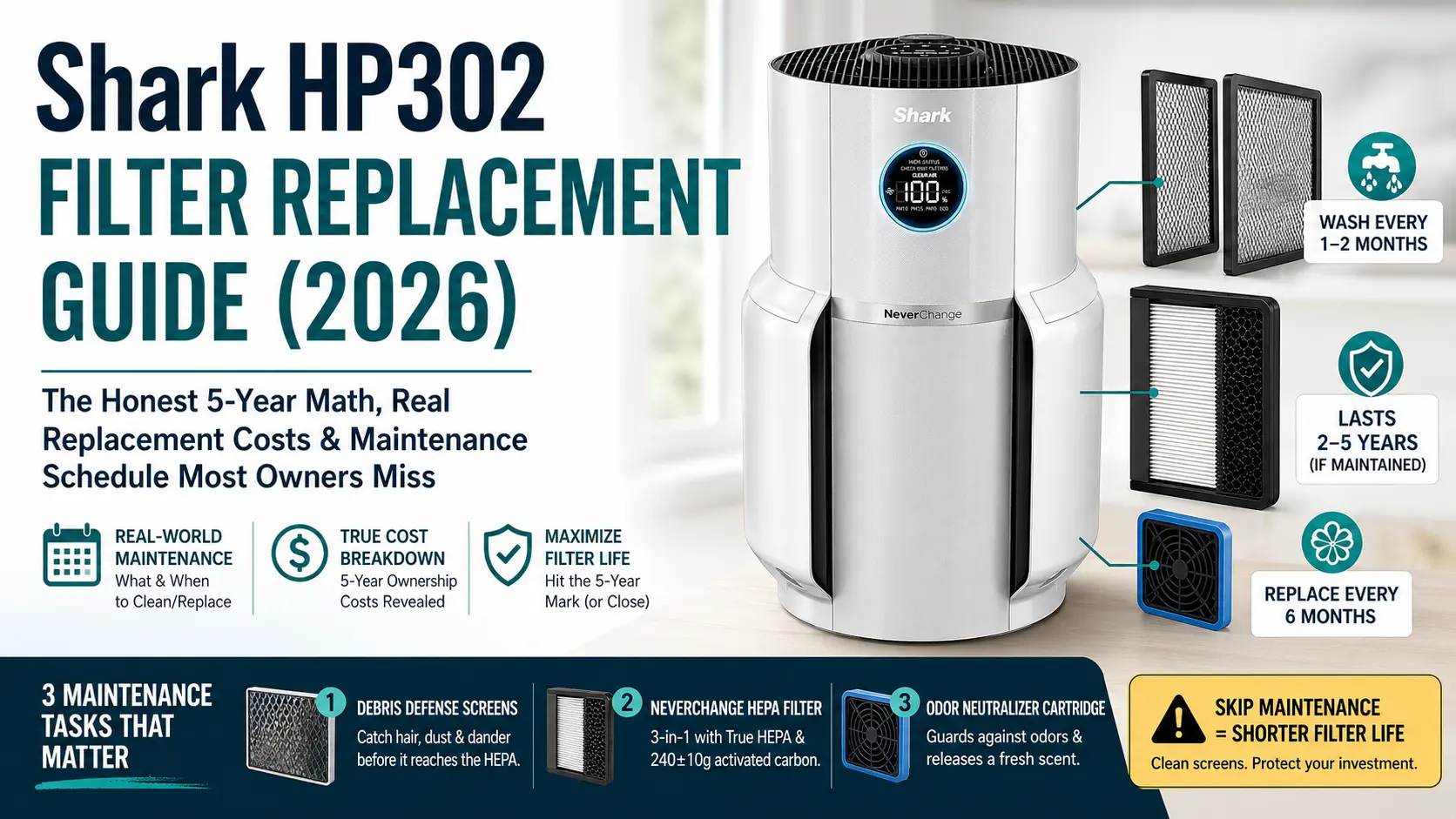
- Debris Defense screens: Vacuum or rinse every 1–2 months (more often with pets). Never replace.
- Odor Neutralizer cartridge (Part 1541FC3000): Replace every 6 months.
- NeverChange HEPA filter (Part HE3FKPET): Replace every 2 to 5 years, depending on room size, runtime, and air load.
| Component | What to Do | How Often | Cost |
|---|---|---|---|
| Debris Defense screens | Wash or vacuum (never replace) | Every 1–2 months | $0 |
| Odor Neutralizer cartridge (Part 1541FC3000) | Replace cartridge | Every 6 months | ~$20–26 OEM 2-pack, ~$3/cartridge third-party |
| NeverChange HEPA filter (Part HE3FKPET) | Replace filter | 2–5 years (varies by use) | ~$80 OEM, ~$25–35 third-party |
The Three Maintenance Tasks Every HP302 Owner Misses
Most HP302 buyers walk away from the box assuming “NeverChange” means zero ongoing maintenance. That’s not what the marketing actually says — but it’s the impression the branding creates. The reality is three components, two of which need active replacement on a fixed schedule:
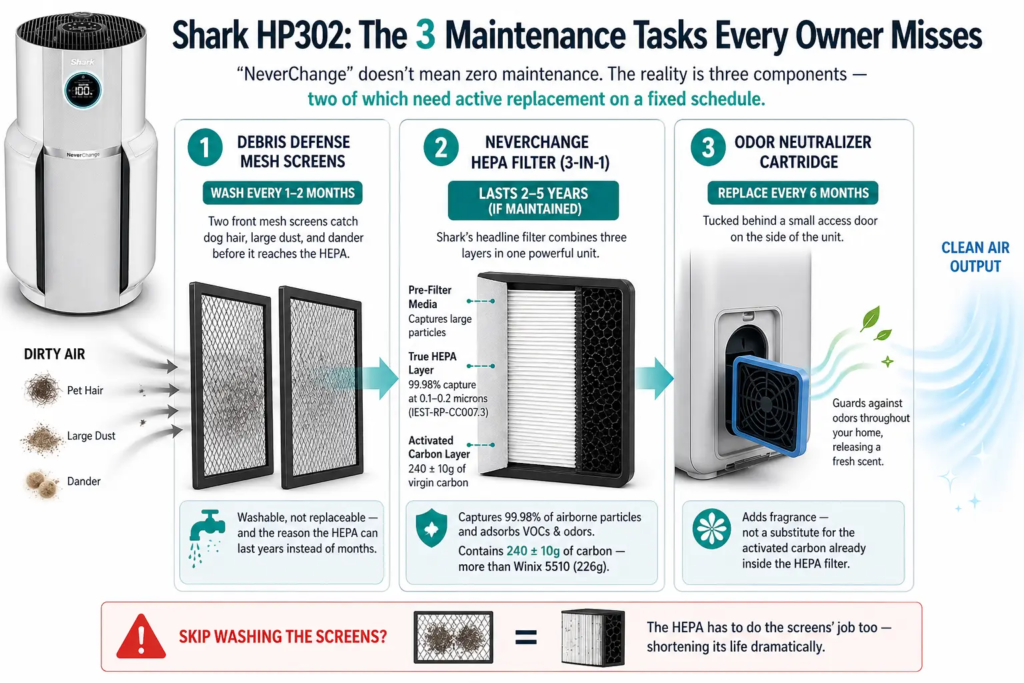
- Two Debris Defense washable mesh screens on the front of the unit. These catch dog hair, large dust, and dander before any of it reaches the HEPA. They’re washable, not replaceable — and that’s the entire reason the HEPA can credibly last years instead of months. Skip washing them and the HEPA does the screens’ job too, dramatically shortening its life.
- One Odor Neutralizer cartridge tucked behind a small access door. Shark’s official description: it “guards against odors throughout your home, releasing a fresh scent.” We’ll dig into what that actually means below — including why it’s not a substitute for the activated carbon already inside the HEPA filter.
- The NeverChange HEPA filter itself — Shark’s headline component. A 3-in-1 design containing pre-filter media, True HEPA layer (99.98% capture at 0.1–0.2 microns per IEST-RP-CC007.3), and 240 ± 10g of virgin activated carbon for VOC and odor adsorption. Yes, the HP302 has more carbon mass than the Winix 5510 (226g) — it’s just bonded into the same unit as the HEPA, which has cost implications we cover below.
Task 1 — Cleaning the Debris Defense Screens (Every 1–2 Months)
The two outer mesh screens are the unsung heroes of the HP302’s design — and the maintenance task that most directly affects how long your HEPA actually lasts. Per Shark’s own owner’s manual, neglecting the screens means dog hair, lint, and large dust go straight to the HEPA media, killing it well before the 5-year mark.
How to clean them
- Power off and unplug the unit.
- Slide the two Debris Defense screens off the front (no tools needed).
- Choose your method based on how dirty they are: vacuum with a soft brush attachment for routine cleaning, wipe with a damp microfibre cloth for moderate buildup, or rinse under running tap water if visible debris is heavy.
- Air-dry completely before reinstalling. Shark recommends a full 12 hours of air-drying time before putting them back. Damp screens trap moisture against the HEPA media — a recipe for mildew.
- Slide them back into place. The unit recognises them automatically; no reset required.
How often to clean
Shark’s official guidance is every 1 to 2 months in normal homes. In real-world pet households, monthly is the right rhythm — and every 2 weeks is appropriate for heavy shedders or active wildfire smoke seasons. Quick visual check: pull a screen out, hold it up to a light. If you can’t see clearly through the mesh, it’s overdue. This single task is what determines whether your HEPA hits the 5-year mark or dies at 8 months.
Task 2 — Replacing the Odor Neutralizer Cartridge (Every 6 Months)
This is the maintenance task most owners forget about — partly because the cartridge is small and tucked behind a door, partly because it’s not what does the heavy lifting on actual odor removal.
What it actually is — the honest answer
The Odor Neutralizer cartridge is a fragrance-releasing scent pod. Shark’s official scent is “Ocean Breeze.” Per Shark’s own marketing language, it “guards against odors” by “releasing a fresh scent into your air for 2x better odor reduction vs. filtration alone” (based on ASTM E544 vs. HP300 with filter and carbon only, after 30 minutes). That last bit is the key tell: “vs. filtration alone” — meaning the cartridge is layered on top of the activated carbon already inside the HEPA filter, providing supplementary scent rather than primary odor adsorption.
This matters because of a common misunderstanding. The HP302’s actual VOC and odor adsorption work is done by the 240 ± 10g of virgin activated carbon bonded into the NeverChange HEPA filter — substantial carbon mass, more than what’s in the Winix 5510 (226g). The cartridge layers fresh fragrance on top of that for 2x reduction scoring in Shark’s internal testing. If you remove the cartridge entirely, the HP302 still removes VOCs and odors via the bonded carbon — you just lose the “Ocean Breeze” scent.
Some owners actively dislike the scent. One Best Buy reviewer described it as “cloying laundry detergent.” Reddit’s r/AirPurifiers community has a vocal subset who consider fragrance-emitting products fundamentally at odds with what an air purifier should do. If you’re scent-sensitive, asthmatic, or sharing a home with someone who is, the practical solution is simple: leave the cartridge slot empty, or set the intensity dial to zero. You lose the fresh-scent feature; you lose nothing on actual filtration.
How to replace the cartridge
- Locate the Odor Neutralizer access door on the side of the HP302 — small, with a discreet latch.
- Open the door, note your current intensity dial setting, and remove the spent cartridge.
- Insert the new cartridge (Part Number 1541FC3000) and align the arrows.
- Rotate the intensity dial to your preferred level (off, low, medium, or high). Lower settings extend cartridge life.
- Close the access door. No reset or app pairing needed.
OEM vs third-party cartridges
Shark’s official 2-pack of cartridges is $25.99 on Shark’s accessory page (Best Buy frequently lists the same 2-pack at $19.99) — call it ~$20–26/year if you replace every 6 months. The same 1541FC3000 part fits Shark’s vacuum line as well, which is why third-party multi-packs are widely available on Amazon and Walmart. Pricing comparison:
| Option | Pack Size | Price | Cost per cartridge | Years of supply |
|---|---|---|---|---|
| OEM Shark (Ocean Breeze) | 2-pack | $19.99 (Best Buy)–$25.99 (Shark) | $10–13 | 1 year |
| Third-party | 4-pack | ~$10–15 | $2.50–3.75 | 2 years |
| Third-party | 8-pack | ~$14–20 | $1.75–2.50 | 4 years |
Over a 5-year ownership window, switching to a third-party 8-pack saves roughly $35–45 versus OEM. Trade-off: scent options vary by seller (cologne, lavender, “fresh”), and quality control is less consistent than Shark’s own. Stick with OEM if you want predictable scent; go third-party if you want the lowest running cost.
Task 3 — When to Replace the NeverChange HEPA Filter
Now we get to the headline claim — and the fine print that explains why owner experiences vary so wildly.
The honest 5-year math (with Shark’s own fine print)
Shark’s “up to 5 years” claim is real — but the testing conditions are buried in the asterisk. Here’s the exact disclosure pulled from Shark’s own product listing on Amazon and the SharkNinja site:
“Tested to GB/T18801-2015 P.CCM, based on 50% CADR declined, 300 SQFT, and 12 hrs daily operation on MAX fan speed.”
Read that carefully. The 5-year claim assumes you’re running the HP302 in a 300 sq ft room — about 21% of its advertised 1,400 sq ft coverage — for 12 hours per day on MAX fan speed. Two implications matter:
- If your room is bigger than 300 sq ft, the math compresses. A Reddit user did the calculation: “Manufacturer says 5 years for a 300 sq ft room. I have about 1,200 sq ft living space, so 1,200 ÷ 300 = 4. That’s 5 years ÷ 4 = 1.25 years for a filter swap.” This is straight room-volume math.
- If you run the unit 24/7 instead of 12 hours/day, the math compresses again. Doubling runtime roughly halves filter life.
What independent testing actually shows
RTINGS’ independent lab testing puts the HP302’s real performance in clearer context. They measured the unit’s PM1 CADR at 208 CFM (Shark doesn’t publish an AHAM CADR figure on the product page) and recommended a real-world room size of about 391 sq ft at maximum fan speed. That’s substantially smaller than the 1,400 sq ft marketing headline — and it lines up with how Shark calculates that 1,400 number: the footnote ties it to AHAM AC-1 at one air change per hour. Most allergy sufferers and pet owners benefit from 4–5 air changes per hour for meaningful symptom relief, which brings effective coverage closer to RTINGS’ 391 sq ft figure. RTINGS also measured noise from 33.8 dBA at minimum fan speed up to 60.1 dBA at maximum — quiet enough on low for bedrooms, loud enough on high to be conversational-disruptive.
Practical translation: the HP302 is a strong performer for medium rooms (about 300–400 sq ft at the air-change rate that actually relieves allergies), not the whole-home solution the 1,400 sq ft headline suggests. That’s not a knock on the HP302 — it’s just the honest sizing match.
Net result: the 5-year claim is achievable — but only in specific conditions. Here’s what that translates to for real households (estimates based on Shark’s testing conditions, owner-reported data on Reddit, and the room-volume math above):
| Household type | Realistic HEPA lifespan | Why |
|---|---|---|
| Small bedroom, no pets, light use | 4–5 years | Matches Shark’s test conditions closely |
| Average household, mixed-room use | 2–3 years | Larger effective room, longer runtime |
| Heavy pets or 24/7 runtime | 12–18 months | Continuous dander load + extended runtime |
| Heavy wildfire smoke zone | Less than 1 year | PM2.5 saturates HEPA media fast |
Reorient the filter every 3 months — Shark’s own forgotten advice
Shark’s own support documentation includes a maintenance step that almost no owner does: rotate the HEPA filter 180° every 3 months to “equalise the distribution of captured particles.” This redistributes the dust-cake, prevents one side of the HEPA from saturating faster than the other, and meaningfully extends effective life. It takes 30 seconds and is one of the highest-leverage maintenance tasks the manual mentions but Shark doesn’t promote.
How to know it’s time to replace
- The filter replacement light on the display. Most reliable signal — the unit’s algorithm has determined the HEPA is approaching end of useful life.
- Performance drop. If auto mode is constantly running on high speed when it used to coast on low, the HEPA is loaded and air resistance has increased.
- Visible darkening. Pop the front screens off and inspect the HEPA face. New, it’s pale white. End-of-life, it’s grey-to-dark across the whole face.
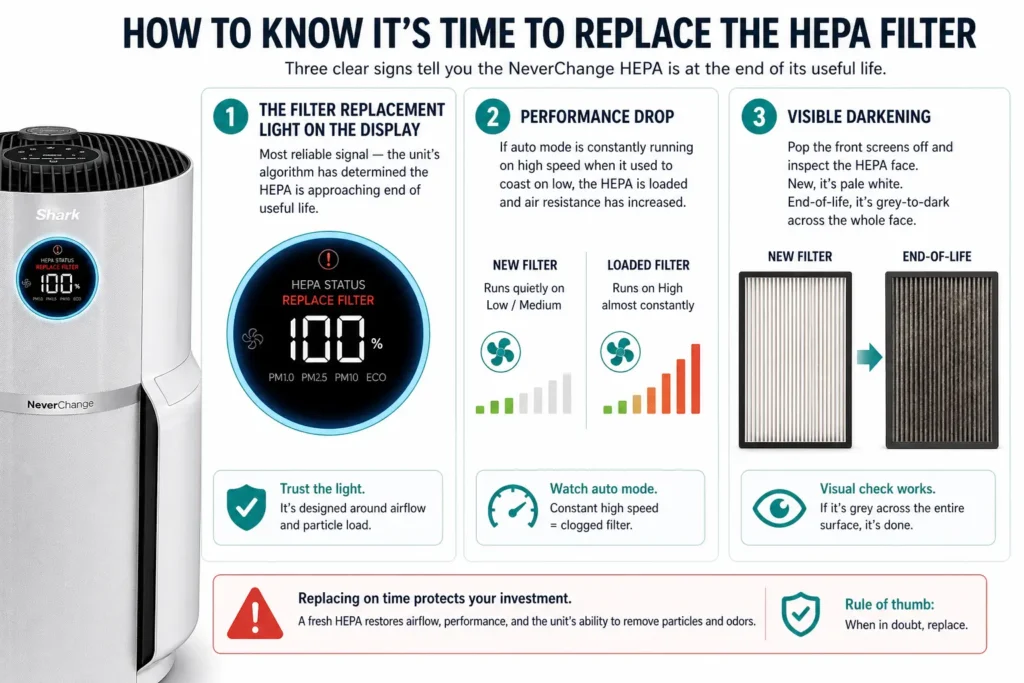
One important caveat about the CleanSense IQ display: it tracks ambient particulate air quality (PM1.0, PM2.5, PM10) — not the physical condition of the HEPA media itself, and not odours. Per Shark’s own support documentation, the clean-air percentage shown on the display corresponds to particulate concentration and explicitly does NOT include odour readings. If your room air is clean but your filter is loaded, the air quality readout can stay green even when the filter actually needs replacement. The filter replacement light is a separate indicator and is the one to watch for HEPA replacement timing.
OEM vs third-party HEPA replacement
The OEM NeverChange HEPA filter for the HP302 (Part Number HE3FKPET) is $79.99 on Shark’s official accessory page — note this is the actual NeverChange-specific part, distinct from the older HE2FKBAS which is the standard 6-12 month filter for HP200-series purifiers. Third-party 2-packs from sellers like BUXEBUX, iSingo, and Nispira run $35–55 for two filters on Amazon and Walmart. Both contain pre-filter, True HEPA, and activated carbon layers per the original spec. Quality varies between sellers; check reviews for the specific product before buying.
⚠️ Buyer Beware: Some Amazon and Walmart listings cross-list the older HE2FKBAS filter as “compatible with HP302.” It physically fits — but it’s the standard 6-12 month replacement filter for HP200-series Clean Sense purifiers, not the NeverChange long-life filter. Buying it means you’ve effectively converted your NeverChange purifier into a standard purifier with annual filter replacements. Always verify the listing specifically references HE3FKPET for the actual NeverChange replacement.
For broader filter replacement schedules across major brands, see our guide: How Often to Replace Your Air Purifier Filter.
The “$150 in Savings” Claim — Does the Math Actually Work?
Shark’s HP302 marketing prominently claims you’ll save up to $150 (or in some marketing variants, up to $300) on filter replacement costs over 5 years versus a competitor. The fine print: “Vs. cost of replacing filters on a competitor unit over 5-year period in 300 square foot space.”
Let’s check the math honestly with the cartridge cost factored in:
| Item | 5-year cost (OEM) | 5-year cost (third-party) |
|---|---|---|
| Odor Neutralizer cartridges (10 cartridges = 5 OEM 2-packs over 5 years) | ~$130 | ~$20 |
| NeverChange HEPA replacement (1× at year 3, average household) | ~$80 | ~$30 |
| 5-year total filter cost (HP302) | ~$210 | ~$50 |
Here’s the uncomfortable arithmetic: at OEM pricing, the 5-year cost of Odor Neutralizer cartridges alone (~$130) actually exceeds Shark’s headline “$150 savings” claim — before you’ve even replaced the HEPA. Add a single mid-life HEPA replacement and you’re at ~$210 in OEM running costs over 5 years. The “save $150” math only works if you somehow never use the cartridges Shark explicitly tells you to replace every 6 months. Switch to third-party cartridges and a third-party HEPA, however, and you genuinely come in around ~$50 over 5 years — that’s the real long-term cost story Shark could tell but doesn’t.
Here’s where the HP302 still wins honestly: even at $210 OEM-throughout, the cost compares favorably against typical separate-filter purifiers. A Coway AP-1512HH runs roughly $250 in 5-year filter costs. A Levoit Core 400S with bonded 3-in-1 filters runs $400+. The HP302’s long-term cost case is real — Shark just oversells it by ignoring the cartridges in their marketing.
Filter Light Reset and Common Troubleshooting
How to reset the filter light after replacement
- Install the new HEPA filter and reseat the front screens.
- Power the unit on.
- Press and hold the Filter Reset button (often the fan-speed button or a small dedicated icon — check the label on your unit, as Shark has used slightly different placements across production batches) for approximately 3 seconds until the indicator light turns off.
- Release. The unit confirms reset by displaying the air quality readout normally.
CleanSense IQ display stuck at 100% or 0%
A consistent Reddit troubleshooting thread reports the air quality sensor sometimes gets stuck — most commonly reading “100% / blue / good” regardless of actual room air, but occasionally the opposite (stuck at 0%/red, sometimes from brand-new units straight out of the box). The community fix: take a Q-tip dipped in isopropyl alcohol and gently clean the small sensor port (typically on the side of the unit, behind a small grille). Some owners report success “waking up” the sensor by lighting a match nearby or running the unit on max for 10 minutes to force a reading. If both fail and the issue is present out of the box, the sensor module itself may need warranty service — Shark has been honouring these claims under the 2-year warranty.
Practical workaround in the meantime: run the HP302 in manual fan-speed mode rather than AUTO. Filtration works exactly the same; you just lose the auto-adjustment feature, which several Reddit owners find unreliable on this model anyway.
Stuck filter cover or hard-to-open base
A less common but consistent Reddit complaint: the filter access cover gets physically stuck, making cleaning or HEPA replacement difficult. If gentle pressure and the manual’s release procedure don’t work, contact Shark support — owners have reported the company sending replacement units under the 2-year warranty for this specific issue rather than asking buyers to force the cover.
Cartridge scent too strong or causing headaches
Turn the intensity dial all the way down, or remove the cartridge entirely. The HP302’s filtration works perfectly without it — the bonded carbon in the HEPA filter still handles VOCs and odours. This is the same fix that addresses Best Buy reviewer complaints about the “Ocean Breeze” scent being overwhelming.
Warranty and What Voids It
Shark covers the HP302 with a 2-year limited warranty from date of purchase. Using third-party HEPA filters or Odor Neutralizer cartridges does not technically void coverage in the US — but if you experience a unit problem during the warranty period, Shark may ask you to install OEM filters before troubleshooting. Practical advice: keep one OEM filter in storage during the warranty period, then switch to third-party once you’re past year 2.
One quirk worth noting: Shark’s warranty is shorter than the headline filter life. The 5-year filter promise outlasts the 2-year unit warranty by 3 years — so for most owners, the unit will outlive its warranty before the first HEPA replacement is even needed.
What Reddit and Verified Owners Say
The HP302’s reputation on r/AirPurifiers is genuinely mixed, and the honest summary serves buyers better than a sanitised one. Three threads dominate the discussion:
- The “5-year math” debate. The most upvoted thread we found (+167 votes) came from an owner who opened the unit after about a year of use and described the internal filter as “really… filthy and soiled.” Their estimate based on real-world inspection: 2–4 years in a medium room, 1–3 years in a larger room — which directly supports the room-size math above. Cat owners and clean-air-zone households push back with their own multi-year ownership data, often citing 3+ years of acceptable performance. Both sides can be right — it’s room size, runtime, and air load math.
- The cartridge complaint. A consistent thread of owners actively dislike the Odor Neutralizer scent. Some characterise it as “cloying” or “cheap perfume.” The community-recommended fix is exactly what Shark allows for: turn the dial off or remove the cartridge.
- Sensor and AUTO-mode scepticism. Multiple Reddit threads complain that the air quality sensor gets stuck — sometimes at 100% (always blue/perfect), sometimes at 0%, sometimes “right out of the box” on brand-new units. One owner reported their sensor stuck at 0% across two separate units. The community frequently recommends running the HP302 in manual mode rather than trusting the auto display. See the troubleshooting section above for the Q-tip cleaning fix.
- Mechanical reliability complaints. Less common but consistent: stuck filter doors that won’t reopen for cleaning, difficulty accessing the base, and noise complaints above fan speed 2. Shark has reportedly honoured warranty replacements for the filter-cover issue.
Independent testing from Modern Castle confirms the underlying filtration performance is strong: PM2.5 reduced from 114.2 to 0.1 ppm, PM10 from 201.5 to 0.2 ppm, AQI from 181 to 1, with zero ozone produced. Yearly maintenance costs estimated at ~$20. Tom’s Guide reviewed a smaller NeverChange model and described it as effectively “RarelyChange” rather than literally “NeverChange” — a fair editorial shorthand for what owners actually experience. The unit absolutely works. The arguments are about how long it works at full efficiency before HEPA replacement is needed — and that depends entirely on what you’re putting through it.
For our full unit-level breakdown including build quality, noise, and direct competitor comparisons, see: Shark NeverChange HP302 Review. For dog-household scenarios specifically (where the Debris Defense screens shine): Best Air Purifier for Pets. For broader HEPA filtration guidance: Best HEPA Air Purifier Buying Guide 2026.
FAQ: Shark HP302 Filter Replacement
Does the Shark HP302 filter ever need to be replaced?
Yes. Despite the “NeverChange” branding, the HP302 has three components that need maintenance: Debris Defense screens (washed every 1–2 months, never replaced), the Odor Neutralizer cartridge (replaced every 6 months), and the NeverChange HEPA filter (replaced every 2–5 years depending on room size, runtime, and air load). Shark’s “5-year” claim assumes a 300 sq ft room and 12 hours/day of operation; larger rooms and 24/7 use compress that timeline.
How often should I replace the Shark odor neutralizer cartridge?
Every 6 months per Shark’s official guidance, regardless of how heavy your odour load is. The cartridge releases fragrance over time, so saturation isn’t the issue — the scent simply runs out. You can extend cartridge life slightly by setting the intensity dial to a lower setting, or skip the cartridge entirely if you’re scent-sensitive (the HP302’s filtration works fine without it).
What is the part number for the Shark HP302 odor neutralizer?
The Shark HP302 Odor Neutralizer cartridge uses part number 1541FC3000. The same part is compatible with multiple Shark air purifier models (HP301, HP302, HP152, HP132, HP232) and several Shark vacuum models (AZ3000, AZ3002, HZ3000, HZ3002, ZD550, IZ862H, IZ562H), which is why third-party multi-packs are widely available on Amazon and Walmart.
What is the part number for the Shark HP302 NeverChange HEPA filter?
The NeverChange HEPA replacement filter for the HP301 and HP302 uses part number HE3FKPET. This is distinct from the older HE2FKBAS part used in HP200-series Clean Sense purifiers (which has a 6-12 month replacement schedule rather than the NeverChange’s “up to 5 years”). The HE3FKPET is a 3-in-1 design containing a pre-filter layer, True HEPA layer, and 240 ± 10g of virgin activated carbon.
Can I use third-party filters in the Shark HP302?
Yes. Both the HEPA filter (Part HE3FKPET) and the Odor Neutralizer cartridge (Part 1541FC3000) have widely available third-party alternatives on Amazon and Walmart. Third-party HEPA filters typically cost $35–55 for a 2-pack versus $79.99 for the OEM single from Shark. Third-party cartridges run $1.75–$3.75 per cartridge versus $13–$10 for OEM (Shark’s official $25.99 2-pack, Best Buy’s $19.99 2-pack). Quality varies between sellers; check reviews before buying. Using third-party filters does not technically void Shark’s 2-year limited warranty in the US, though Shark may ask you to install OEM filters during warranty troubleshooting.
How long does the NeverChange filter really last?
It depends on room size and runtime. Shark’s 5-year claim is based on testing at 300 sq ft with 12 hours/day operation on MAX fan. Light-use small bedrooms can genuinely reach 4–5 years. Average mixed-use households typically need replacement at 2–3 years. Heavy-pet households running 24/7 see effective HEPA life drop to 12–18 months. Heavy wildfire smoke zones can saturate the filter in under a year. The filter replacement indicator on the display is the most reliable signal — when it activates, the HEPA is approaching end of useful life regardless of calendar age.
How do I reset the filter light on a Shark HP302?
After installing a new HEPA filter, power the unit on and press and hold the Filter Reset button (often the fan-speed button or a small dedicated icon — check your unit’s label, as placement varies slightly across production batches) for approximately 3 seconds until the indicator light turns off. The unit confirms reset by returning to the normal air quality display.
Sources
- SharkNinja official product pages — HP302 specifications, NeverChange HEPA filter (HE3FKPET) including 240 ± 10g virgin carbon spec, Odor Neutralizer (1541FC3000) compatibility list, GB/T18801-2015 testing disclosure, accessory pricing
- Best Buy product pages and Q&A — HE2FKPRO/HE3FKPET compatibility clarification, owner reviews, retailer pricing
- Amazon and Walmart listings (verified) — current pricing, part numbers, third-party alternatives, owner reviews
- RTINGS independent lab testing — measured PM1 CADR (208 CFM), recommended room size at max speed (~391 sq ft), noise measurements (33.8–60.1 dBA)
- Modern Castle independent testing — PM2.5/PM10/AQI reduction, ozone emission verification, ~$20/year maintenance cost estimate
- Tom’s Guide — line-level NeverChange testing observations and the “RarelyChange” editorial framing
- Reddit r/AirPurifiers — long-term ownership feedback (including the +167-vote “filthy after a year” thread), room-size math debate, sensor stuck at 100%/0% troubleshooting
- EPA — Guide to Air Cleaners in the Home — HEPA standard definition
Have an HP302 ownership story or filter-life experience to share? Drop a comment below — we update these guides as new owner data comes in.