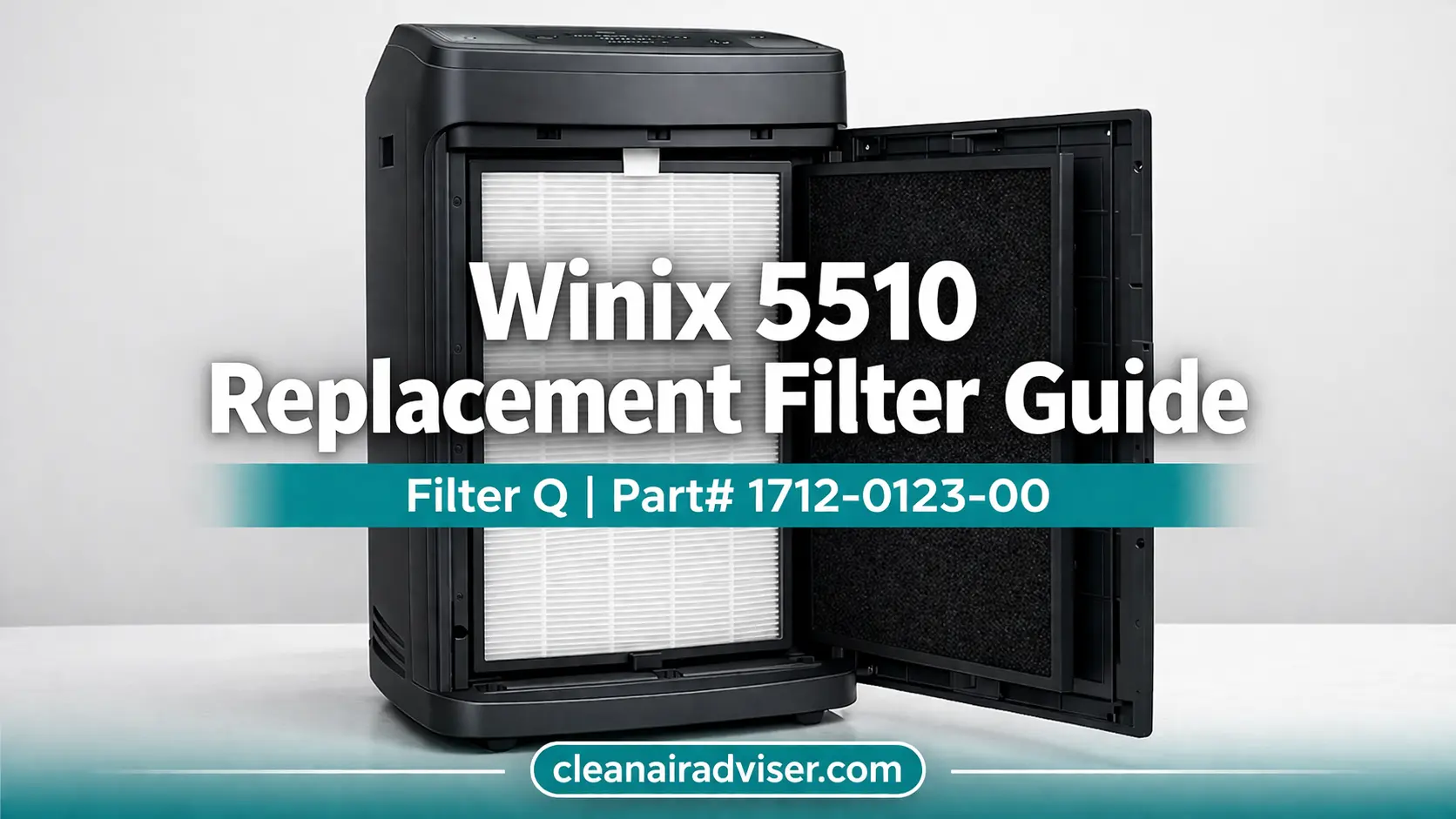
Winix 5510 Replacement Filter: Filter Q (1712-0123-00)
Disclosure: Clean Air Adviser may earn a commission when you buy through links on this page. This does not change what you pay. We have not tested Filter Q media in a laboratory. Compatibility and maintenance instructions below come from Winix’s current product page and 5510/5520 manual, with independent observations clearly identified.
Quick answer: This winix 5510 replacement filter guide highlights the evidence, practical fit, and buying limits that matter before you decide.
Filter Q compatibility
| Purifier | Correct replacement | Will Filter Q fit? |
|---|---|---|
| Winix 5510 | Filter Q, 1712-0123-00 | Yes |
| Winix 5520 | Filter Q, 1712-0123-00 | Yes |
| Winix 5530 | Filter Q, 1712-0123-00 | Yes, included on Winix’s current Filter Q page |
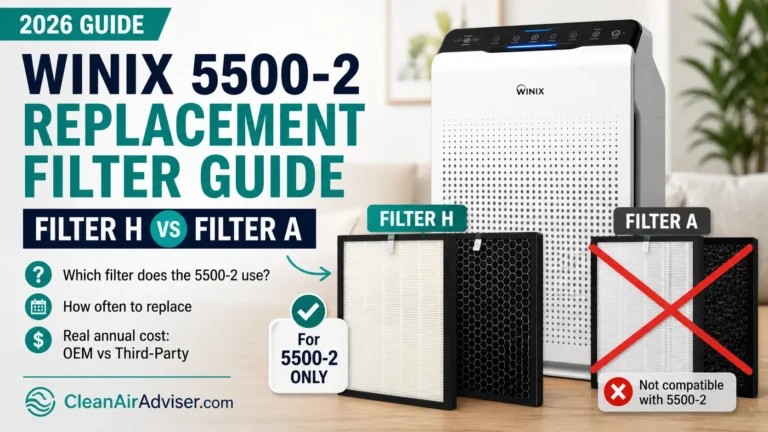
| Winix 5500-2 | Filter H, 116130 | No |
| Winix C545 | Filter S, 1712-0096-00 | No |
| Winix 5300-2 | Check the exact model label and current Winix chart | No |
The 5510 and 5520 are certified together and use the same filter set. The newer 5530 also appears on Winix’s current Filter Q product page. This is a better compatibility source than an old marketplace title or an image that simply looks the same.
Find the purifier model on its rear label. Then match 1712-0123-00 on the filter listing or box. Reject listings that claim one filter fits the 5510 and 5500-2 unless the seller clearly explains that different items are selected in a variation menu.
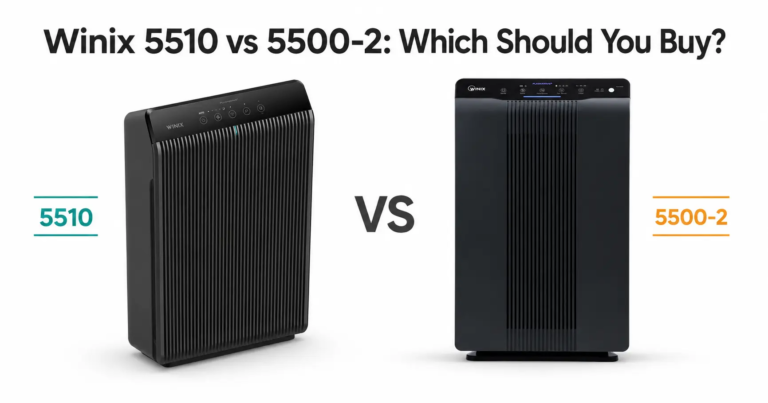
If you own the older model, use our Winix 5500-2 Filter H guide. The 5510 versus 5500-2 comparison explains why the unit and filter designs should not be mixed.
What comes in a genuine Filter Q set?
True HEPA filter
Winix says the HEPA stage captures 99.99 percent of airborne inanimate particles as small as 0.01 microns in its referenced independent media test. That statement describes filtration efficiency under test conditions. It does not mean a room becomes 99.99 percent clean in a fixed time. The purifier’s certified CADR determines how quickly it delivers cleaned air.
The HEPA filter is not washable. Water can damage the fibre structure and adhesives, and a damp filter can support unwanted growth. Do not brush the pleats, tap the filter against a wall, or use compressed air to blow captured dust back into the room.
AOC carbon filter
The AOC carbon stage reduces some household odors and gases from cooking, pets, and smoke. HouseFresh opened and weighed the filtration components and reports that Winix confirmed 226 grams of carbon in the 5510 set. Its pellets give the 5510 more carbon substance than the thin coated sheets used in many purifiers.
The current manual is explicit: the 5510/5520 AOC carbon filter cannot be washed. Rinsing it does not restore exhausted adsorption sites and may damage the filter. The washable-carbon instructions associated with some older Winix models do not apply to Filter Q.
Reusable pre-filter
The mesh pre-filter is part of the purifier, not the annual Filter Q box. It catches hair, lint, and coarse dust before those materials reach the carbon and HEPA layers. Keep it when changing the main filters.
Winix’s latest combined manual contains two maintenance cues: the service table says to check the pre-filter every 14 days, while the cleaning section says cleaning every one to two months is optimal and that conditions vary. A practical reading is to inspect it every two weeks and clean it when buildup is visible, without letting more than a month or two pass in a typical home.
Use a vacuum or soft brush for routine cleaning. If it is excessively dirty, the manual allows a room-temperature-water rinse without soap or detergent. Let it dry for at least 24 hours before reinstalling it.
How often should Filter Q be replaced?
Winix calls Filter Q a complete one-year set. The product page recommends changing both the True HEPA and AOC carbon filters once every 12 months for optimal performance. The manual adds that the interval may vary with the environment and says the lit Check Filter indicator means it is time to replace both filters.
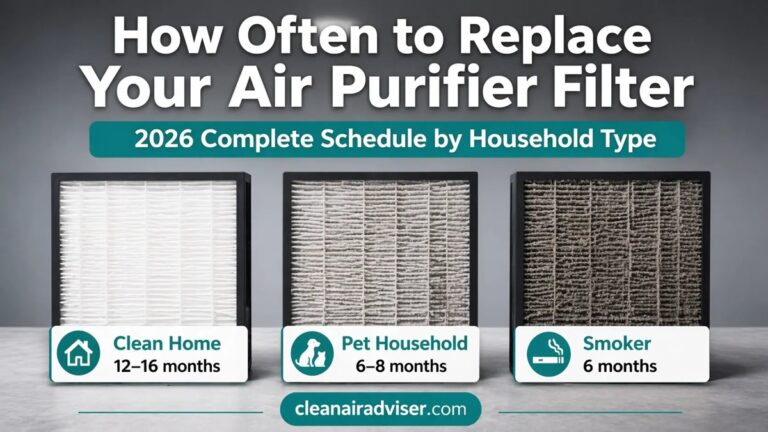
That is the official starting point. It is more defensible than household tables that invent exact six-, nine-, fourteen-, or sixteen-month lives. Filter loading depends on fan speed, daily runtime, particle concentration, smoke, cooking emissions, pets, and pre-filter maintenance.
| Condition | What to do |
|---|---|
| Check Filter light is on near one year | Replace the HEPA and AOC carbon filters with a Filter Q set, then reset the indicator |
| Heavy smoke or renovation dust occurred | Inspect sooner and replace if airflow remains poor after pre-filter cleaning or the filter is damaged |
| Odor control has declined | Remove the odor source, verify airflow, then consider early Filter Q replacement |
| Filter became wet or shows mold-like growth | Replace it and correct the moisture source |
| New filter causes abnormal noise | Power off, remove all packaging, and confirm correct seating and part number |
Do not use filter color as a calibrated capacity test. The upstream face may turn grey while capturing normal dust. A white-looking downstream face does not prove a specific number of months remain. Likewise, the smell of the room can be a clue about carbon performance but cannot verify removal of every VOC.
Our updated air purifier filter timing guide explains the difference between manufacturer intervals, airflow clues, carbon odor clues, and unsafe shortcuts.
Can the carbon and HEPA filters be replaced separately?
They are physically separate pieces, so either can be removed from the cabinet on its own. The genuine retail product, however, is sold as a complete Filter Q set, and Winix recommends replacing both main filters at about 12 months or when the indicator lights.
Older versions of this guide recommended buying two sets and staggering the carbon and HEPA replacements according to invented eight- and fourteen-month schedules. We no longer recommend that. It spends money earlier, leaves an unmatched spare, and is not Winix’s published maintenance plan.
If a specific event clearly exhausts odor control early, you may want a replacement before the annual date. Because Winix does not currently sell the genuine Filter Q carbon layer alone on its US page, compare the cost of a full genuine set with any separate third-party option. A third-party carbon piece must fit securely without creating bypass or pushing the front panel out of alignment.
Genuine Filter Q versus third-party filters
A genuine set provides the clearest chain of evidence: Winix specifies the fit, publishes the media claim, and includes the HEPA and AOC carbon layers it used for the product design. The current Winix page also identifies the compatible models and calls it a one-year set.
Third-party filters can cost less, but marketplace claims such as “H13,” “premium carbon,” or “more pleats” do not prove equal whole-machine performance. The important questions are fit, gasket quality, media consistency, carbon amount, odor, noise, and the seller’s return policy.
| Check before buying | Why it matters |
|---|---|
| Lists 5510, 5520, or 5530 and SKU 1712-0123-00 | Reduces wrong-size purchases |
| Shows both HEPA and carbon pieces | Filter Q is a two-piece annual set |
| Has a continuous perimeter seal | Air should not bypass the media |
| States whether carbon is pellets or a coated sheet | Product photos can hide a material downgrade |
| Has recent reviews for the exact model | Variation listings often combine unrelated products |
| Offers returns after a fit check | Useful if the panel will not close or noise changes |
Do not assume a large pack is automatically better value. Two low-cost filters that leak around the frame can deliver worse performance than one correctly sealed set. We cannot verify the filtration efficiency of an aftermarket brand from its Amazon description alone.
How to replace the Winix 5510 filter
- Turn the purifier off and unplug it. Move it to a clear, dry work area.
- Pull the front panel forward from the upper edge. Support the panel instead of letting it drop.
- Remove the reusable pre-filter. Set it aside for cleaning.
- Remove the AOC carbon filter. Avoid shaking dust into the room.
- Remove the True HEPA filter. Place the used filters in a bag if they are dusty.
- Vacuum the cabinet interior gently. Keep liquids away from the fan, sensor, and electrical parts.
- Unwrap every new filter. Leaving protective plastic on is a common setup error.
- Install the True HEPA filter at the back. Seat it evenly against the frame.
- Install the AOC carbon filter in the middle. It should sit flat without bowing.
- Return the clean, completely dry pre-filter to the front.
- Close the front panel. If it will not close easily, stop and recheck filter order, wrapping, and part number.
- Plug in and turn on the purifier, then reset the indicator.
The correct order from back to front is True HEPA, AOC carbon, then reusable pre-filter. This order lets the pre-filter catch coarse debris first and keeps the HEPA at the protected rear position.
How to reset the Filter Q indicator
The latest Winix 5510/5520 manual gives a simple procedure:
- Finish installing both replacement filters and close the panel.
- Turn the purifier on.
- Use a small object such as a straightened paper clip to press the recessed Filter Reset button.
- Hold it for at least five seconds, until you hear a beep and the Filter Replacement indicator turns off.
An earlier stand-alone 5510 manual contains inconsistent wording: one control-panel instruction says five seconds, while a later paragraph says ten. The newer combined 5510/5520 manual consistently says at least five seconds. The practical rule is to keep holding until the confirmation beep and light change. Do not reset the reminder merely to silence it before checking the filters.
If the light remains on, confirm the unit is powered on, hold the recessed button steadily, and wait for the beep. If it still will not clear, use the current Winix support page rather than repeatedly unplugging or pressing random button combinations.
What the indicator can and cannot tell you
Winix says the automatic indicator illuminates when the filter needs replacement. The public manual does not explain the internal calculation, so it is not responsible to state as fact that it is a pure countdown timer or a direct pressure sensor.
Treat the light as the manufacturer’s maintenance signal. It does not separately measure remaining HEPA capacity and carbon adsorption, and the reset action does not clean the filters. If performance deteriorates early, inspect before the light. If the light appears near the one-year mark, follow the replacement instruction.
Troubleshooting after a filter change
The front panel will not close
Check that all plastic wrapping is removed, the HEPA sits at the back, the carbon layer is in the middle, and the pre-filter is at the front. Verify SKU 1712-0123-00. Do not force the panel because that can bend the filter or break the latch.
Airflow is weak
Remove packaging, clean the pre-filter, clear the intake and outlet, and make sure the filter is not installed backward or crushed. Leave the 12 to 18 inches of clearance from walls recommended by the manual.
The purifier smells different
A strong chemical, damp, or musty smell is not a normal filtration benefit. Turn the purifier off, confirm the filter is dry and undamaged, and contact the seller if the odor persists. Do not mask a questionable filter smell with fragrance.
The Check Filter light remains on
Reset while the unit is on and hold for at least five seconds until the beep. The filter change and electronic reset are separate steps.
Noise begins with a new filter
Power off immediately and recheck seating, packaging, and panel closure. A wrong-size filter or loose carbon grid can change airflow noise. Return a deformed replacement rather than trimming its frame.
Filter Q cost without stale price claims
Winix’s direct price changes with promotions, and Amazon results mix genuine and third-party products. Avoid articles that call a temporary sale the permanent annual cost. Compare the price of one complete set, shipping, seller, and return terms on the day you buy.
Use this simple comparison:
Annual filter cost = price of one complete Filter Q set at the interval your environment requires
For a multi-pack, divide by the number of complete HEPA-plus-carbon sets, not by the number of individual pieces.
A listing with two HEPA filters and two carbon filters contains two complete sets. A listing with one HEPA and several thin carbon sheets may not match the genuine Filter Q design. Compare like with like.
winix 5510 replacement filter: final decision
Use this winix 5510 replacement filter guide to match the option to your room, usage, and maintenance needs.
A sound winix 5510 replacement filter decision accounts for real-world fit, ongoing costs, and the limits of the product category.
When comparing choices, keep this winix 5510 replacement filter goal in view rather than relying on a single headline claim.
This winix 5510 replacement filter guide is designed to support a practical choice, not replace source control or the manufacturer instructions that apply to your model.
Quick answer: The Winix 5510 replacement filter is Filter Q, SKU 1712-0123-00. A genuine set contains one True HEPA filter and one AOC carbon filter. Winix currently lists it for the 5510, 5520, and 5530 and recommends replacing both main filters about every 12 months. The interval can be shorter in a smoky or heavily polluted room.
Filter Q is not interchangeable with Filter H for the 5500-2. The filters may look similar in online thumbnails, so confirm both the purifier model and SKU before buying.
Buy the right box
- Purifier: Winix 5510, 5520, or 5530
- Filter name: Filter Q
- SKU: 1712-0123-00
- Included: one True HEPA filter and one AOC carbon filter
- Not included: the reusable pre-filter already installed in the purifier
Frequently asked questions
What filter does the Winix 5510 use?
Filter Q, SKU 1712-0123-00. A genuine set contains one True HEPA and one AOC carbon filter.
Do the Winix 5510, 5520, and 5530 use the same filter?
Yes. Winix’s current Filter Q product page lists all three models.
Can Filter H fit the Winix 5510?
No. Filter H, part 116130, is the current genuine replacement for the 5500-2 and AM80. Use Filter Q for the 5510.
Can I wash Filter Q?
No. Do not wash either the HEPA or AOC carbon layer. Only the reusable mesh pre-filter may be rinsed, and it must dry for at least 24 hours.
How long does Filter Q last?
Winix recommends replacing both main filters about every 12 months. The manual says the interval can vary with the environment, and heavy smoke can shorten life.
Should I replace the carbon and HEPA separately?
Winix sells Filter Q as a complete one-year set and recommends replacing both. Although the pieces are physically separate, a staggered schedule is not the published maintenance plan.
How long do I hold the reset button?
With the unit on, hold the recessed Filter Reset button for at least five seconds, until the beep sounds and the indicator turns off.
Does PlasmaWave need a replacement part?
No. PlasmaWave is built into the purifier and has no Filter Q consumable. It can be turned on or off separately.
Bottom line
For a Winix 5510, the safe purchase is simple: match Filter Q and 1712-0123-00, confirm the listing includes both main filters, and keep the reusable pre-filter. Replace the genuine set about every 12 months or when the current manual and condition call for it.
The most useful maintenance habits cost nothing: inspect the pre-filter regularly, clean it without detergent, let it dry fully, keep water away from the main filters, remove every piece of shipping plastic, and wait for the reset beep. Those steps protect airflow and prevent most replacement-day problems.
For full purifier performance, noise, sensor, and PlasmaWave analysis, read our updated Winix 5510 review.
Sources
- Winix America: genuine Filter Q 1712-0123-00 product page
- Winix America: current 5510 and 5520 user manual
- Winix America: replacement-filter directory and environment guidance
- Winix America: filter reset and maintenance FAQ
- HouseFresh: Winix 5510 filter inspection and carbon information
- ENERGY STAR: Winix 5510 certification record
- Reddit r/AirPurifiers: 5510 filter-condition discussion
- Reddit r/AirPurifiers: 5510 odor-control discussion