Best HEPA Air Purifier: Verified Picks and Buying Guide (2026)
Disclosure: CleanAirAdviser may earn a commission if you buy through an Amazon link on this page, at no extra cost to you. Our conclusions are not supplied by manufacturers or merchants.
Quick answer: The Coway AP-1512HH is our best HEPA air purifier for most bedrooms and medium-size rooms. It has a genuine HEPA filter, verified 233.6 cfm smoke CADR, a washable prefilter, a particle sensor, widely available replacements, and strong independent particle-removal results with its optional ionizer switched off. Choose the Honeywell HPA300 when you want more certified airflow without apps, the Winix 5510 when a separate pellet-carbon filter and app matter, and the Smart Air Blast Mini for a large room that needs high-output H13 filtration.
A HEPA label is useful, but it does not tell you how quickly the entire purifier cleans a room. Filter efficiency, fan airflow, air leakage, sound, and room size work together. That is why our rankings start with verified clean-air delivery and purchased-unit testing, then check the filter claim.
We did not personally test these machines. This guide distinguishes manufacturer specifications, public certification data, and independent purchased-unit measurements. Prices change, so recommendations are based on performance and ownership tradeoffs rather than a temporary sale.
Best HEPA air purifiers: quick comparison
| Pick | Particle performance | Room target | Filter claim | Main tradeoff |
|---|---|---|---|---|
| Best overall: Coway AP-1512HH | 233.6 cfm certified smoke CADR; 29-minute HouseFresh test with ionizer off | About 350 sq. ft. at 5 ACH | True HEPA | Older design, high-speed power use, optional ionizer |
| Best higher airflow value: Honeywell HPA300 | 300 cfm certified smoke CADR; 20-minute HouseFresh test | About 450 sq. ft. at 5 ACH | True HEPA | No sensor or app; costly filters and power |
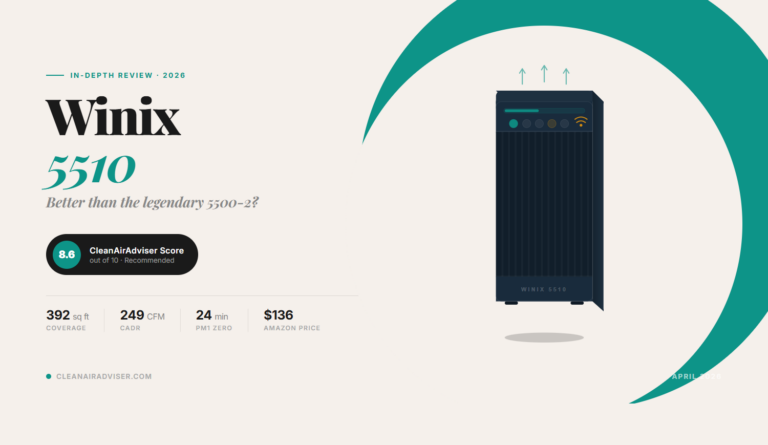
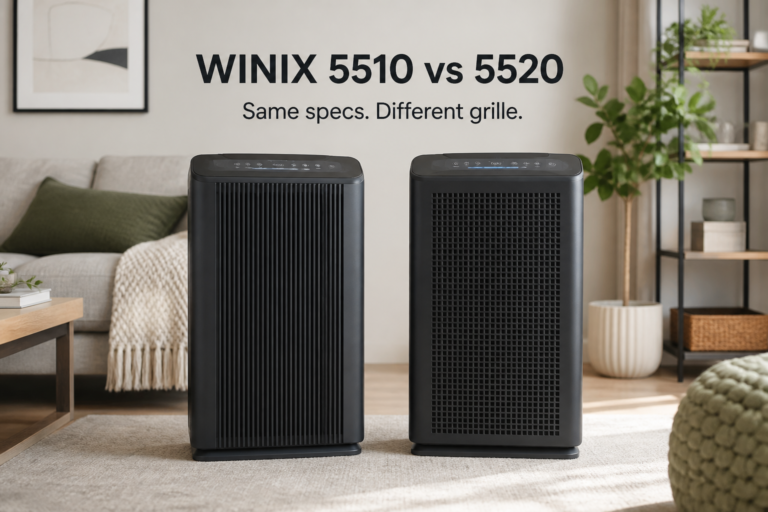
| Best smart pick with pellet carbon: Winix 5510 | 249 cfm estimated PM1 CADR at top speed | About 372 sq. ft. at 5 ACH | True HEPA | 67.2 dBA at top speed; Auto mode uses odor sensor |
| Best large-room H13 pick: Smart Air Blast Mini | 400 cfm estimated PM1 CADR; 15-minute HouseFresh test | About 600 sq. ft. at 5 ACH | H13 HEPA | Large, heavy, power-hungry, no smart features |
Fast room check: with an eight-foot ceiling, a 200 cfm purifier supplies about five air changes per hour in 300 square feet. Use the formula CADR = room area × ceiling height × target ACH ÷ 60. Add capacity for a high ceiling, an open doorway, heavy smoke infiltration, or a quieter fan setting.
What HEPA actually means
HEPA stands for high-efficiency particulate air. The U.S. Environmental Protection Agency describes HEPA as a pleated mechanical filter that can theoretically remove at least 99.97 percent of 0.3-micron particles that pass through it. The 0.3-micron point is used because it is near the most penetrating particle size. Particles larger and smaller than that point can be captured with even greater efficiency.
That last point corrects a common myth. HEPA does not suddenly stop working below 0.3 microns, and “99.97 percent at 0.3 microns” does not mean every purifier removes 99.97 percent of all particles from an entire room in one pass. It describes filter-media performance under defined conditions.
A room purifier is a system. Air can only be cleaned when the fan moves it through the filter, and the cabinet must prevent too much bypass around the media. A small, restrictive HEPA cartridge connected to a weak fan may deliver less clean air than a well-designed non-HEPA-branded machine with high verified CADR. For normal home shopping, CADR is the better first comparison.
True HEPA, H13, HEPA-grade, and HEPA-type
“True HEPA” is common U.S. consumer wording for a filter marketed to the 99.97-percent-at-0.3-micron benchmark. H13 is a European filter class with its own test framework and efficiency requirements. These labels are not interchangeable in every test context.
“HEPA-type,” “HEPA-like,” and “HEPA-grade” do not have one universal consumer performance level. It is inaccurate to say that every HEPA-type filter captures only particles above two microns. Treat these phrases as a reason to look for the manufacturer’s exact efficiency statement, test standard, operating speed, and complete-machine CADR.
In 2023, BBB National Programs reported that VeSync voluntarily discontinued certain HEPA claims after a National Advertising Division challenge. The public summary names the Levoit EverestAir, Core 300, and Core 300S and says NAD did not decide the merits because the claims were voluntarily discontinued. Do not expand that case into a claim that every Levoit filter failed. Do read each current product page exactly as written and avoid repeating an old H13 or True HEPA label that the manufacturer no longer uses.
Why CADR matters more than filter efficiency alone
Clean Air Delivery Rate combines airflow and particle-removal efficiency into a complete-machine result. AHAM Verifide reports separate CADR values for smoke, dust, and pollen. Smoke represents the smallest test aerosol and is the useful conservative number for fine particles.
AHAM’s basic room rule calls for a smoke CADR at least two-thirds of room area with an eight-foot ceiling. Its suggested room size is based on 4.8 air changes per hour. EPA’s sizing table gives nearly the same relationship: 65 cfm for 100 square feet, 130 cfm for 200, and 260 cfm for 400.
Use the published CADR only for the speed at which it was measured, normally maximum. If you plan to run a quieter setting, buy extra capacity or find independent quiet-speed performance. A machine with 300 cfm at a loud Turbo setting may move far less air on the speed you tolerate overnight.
For wildfire smoke, AHAM recommends smoke CADR equal to room area, a more conservative target than the standard two-thirds rule. Our smoke air-purifier guide separates particles from gases, and the wildfire guide explains clean-air-room sizing.
1. Coway AP-1512HH: best HEPA purifier for most rooms
The Coway AP-1512HH Mighty is an older design, but its evidence is unusually complete. Public certification data lists about 233.6 cfm smoke CADR, 247.7 cfm dust CADR, and 232.2 cfm pollen CADR. Its suggested room size is roughly 362 square feet at 4.8 ACH.
HouseFresh bought the machine and measured PM1 reaching zero in its 728-cubic-foot room in 26 minutes with the ionizer active. With the ionizer disabled, it took 29 minutes. The mechanical filter system therefore remains strong without electronic assistance. Maximum sound reached 60.1 dBA, and power draw climbed to 75.3 watts, so the top setting is best used when rapid cleaning is worth the noise.
The prefilter is removable and washable, the particle sensor can manage Auto mode, and genuine and compatible replacements are easy to find. The carbon stage is a thin sheet rather than a deep bed, so it supports light everyday smells but should not be bought for serious gas or VOC control.
The optional Vital Ion function can be switched off. HEPA media itself is mechanical and does not generate ozone, but an added ionizer is a separate technology. We judge the Coway on its ionizer-off result because that is the cleaner comparison for buyers seeking mechanical filtration.
Best for: a bedroom, office, or medium-size living room where simple controls, proven filtration, and replacement availability matter.
Read our updated Coway AP-1512HH review and Coway replacement-filter guide before ordering a spare.
2. Honeywell HPA300: best higher-airflow value
The Honeywell HPA300 is a straightforward fan-and-filter machine with no app, sensor, Auto mode, ionizer, or remote. ENERGY STAR data lists a 300 cfm smoke CADR, 320 cfm dust CADR, 300 cfm pollen CADR, a 465-square-foot room size, HEPA filtration, and zero ppb ozone emissions in its report.
HouseFresh’s purchased unit reached PM1 zero in 20 minutes at Turbo. Its sound test measured 43.6 dBA on speed one, 48.8 on speed two, 53.9 on speed three, and 59.5 on Turbo. The same unit took 50 minutes at speed one and 34 minutes at speed two, a useful demonstration of how quieter operation changes real cleaning speed.
The HPA300 uses three smaller HEPA cartridges behind a carbon-coated prefilter. Replacements are widely available, but the machine needs three HEPA filters for a full change, and Honeywell gives a frequent schedule for the thin prefilter. HouseFresh estimated high annual filter and maximum-speed electricity costs. Check the price of a complete genuine replacement set before treating a sale price as a bargain.
This is the pick for someone who wants verified airflow and mechanical simplicity, not a polished app. It works well for a medium or large room if you can tolerate its sound and ownership cost.
Best for: high certified CADR, simple physical controls, zero intentional electronic cleaning, and buyers who do not need an air-quality display.
3. Winix 5510: best smart HEPA pick with pellet carbon
The Winix 5510 is the modern successor to the 5500-2. It combines a True HEPA filter, a washable prefilter, and a separate 226-gram pellet-carbon stage. The separate carbon cassette is easier to evaluate and replace than a thin carbon-coated sheet, although 226 grams is still modest beside a specialist gas purifier.
HouseFresh measured PM1 reaching zero in 24 minutes and estimated 249 cfm top-speed PM1 CADR. That supports about 372 square feet at five ACH. The main weakness is maximum sound: 67.2 dBA in the same test. At speed two, sound fell to 40.8 dBA and clearance time increased to 47 minutes.
The Winix app adds remote control, but Auto mode uses an odor sensor rather than a particle sensor. Pollen, dust, and dander may not make it increase fan speed. Use a steady manual setting when particles are the priority. PlasmaWave can be disabled; our recommendation does not depend on claims that it neutralizes allergens or gases.
Best for: buyers who want current app control, a separate carbon stage for ordinary odors, and strong maximum HEPA performance, and who can manage the noise tradeoff.
Our Winix 5510 review covers every fan speed, and the Filter Q guide explains current OEM compatibility.
4. Smart Air Blast Mini: best large-room H13 purifier
The Smart Air Blast Mini is a large metal purifier with an H13 HEPA filter, a centrifugal fan, three manual speeds, wheels, and no sensor or app. Its design is closer to durable school or clinic equipment than a lifestyle appliance.
Smart Air publishes 740 cubic meters per hour at maximum, about 435 cfm. HouseFresh tested a purchased unit and estimated 400 cfm PM1 CADR at top speed and 272 cfm at a sub-45-dBA operating point. The unit reached PM1 zero in 15 minutes at maximum. Its measured sound ranged from 44.9 to 56.3 dBA. Those figures make it unusually capable at moving clean air without an extremely loud high setting.
The tradeoffs are size, weight, power, and price. HouseFresh’s unit weighed 59 pounds and used 122.7 watts at maximum. The purifier has no Auto mode, PM display, app, or scheduling. The optional carbon filter should be evaluated separately, since HEPA does not remove gases.
Best for: a large living room, classroom, office, shared workspace, or buyer who wants a strict H13 claim and high mechanical airflow.
See the Smart Air Blast Mini specifications
What about the Levoit Vital 200S and Core 400S?
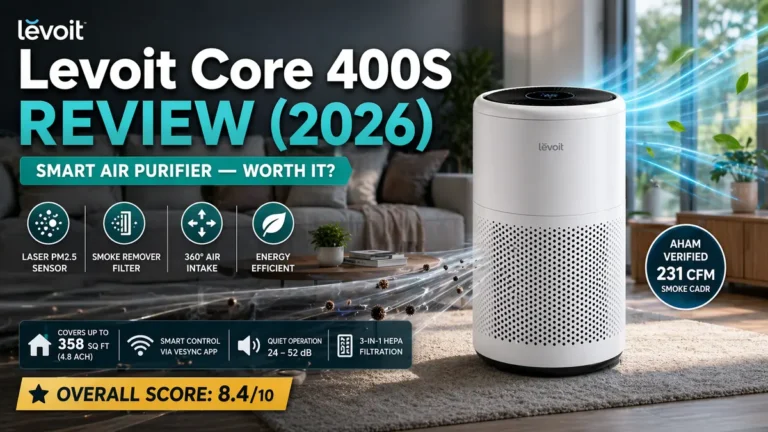
Both are strong particle purifiers. The Vital 200S has 242 cfm certified smoke CADR, and HouseFresh’s unit reached PM1 zero in 23 minutes with a 57.7-dBA maximum. The Core 400S has a compact design, app control, and a particle sensor, although independent testing found regional performance differences.
The reason they are not ranked as strict HEPA picks is wording, not a claim that they fail to clean particles. Levoit’s current pages use narrower efficiency and “HEPA-grade” language than many older listings and reviews. The public NAD summary names the EverestAir, Core 300, and Core 300S, not the Vital 200S or Core 400S, and it did not decide the challenge on its merits.
If your goal is verified room particle removal, the Vital 200S remains one of our favorite balanced machines. If your purchase requirement is specifically a current True HEPA or H13 label, choose one of the four models above and confirm the exact replacement filter before checkout.
See our Vital 200S review and Core 400S review for the current wording and test details.
HEPA does not remove every pollutant
Gases, odors, and VOCs
HEPA is particle filtration. It does not capture carbon monoxide, radon, or most gases and VOCs. Activated carbon or another sorbent is needed for some gases, and EPA notes there is no widely used residential performance rating comparable to particle CADR. Carbon can be effective when a large amount of material is used.
Thin coated sheets may reduce light odors briefly. The Winix’s pellets offer more physical sorbent than a coating, but specialist units carry pounds rather than ounces. The Austin Air HealthMate, for example, uses a large carbon and zeolite bed but delivered only an estimated 156 cfm PM1 CADR in HouseFresh testing. It is a niche gas-media choice, not our default particle purifier. Fix gas sources and ventilate with clean outdoor air when appropriate.
Mold
A HEPA purifier can capture some airborne mold particles. It cannot repair a leak, dry damp material, or stop growth. EPA says the solution to a mold problem is moisture control and cleanup. Do not use a filter to delay remediation.
Allergy and asthma symptoms
Filtration can reduce airborne particles, and some studies report improvements in one or more allergy or asthma outcomes. EPA describes the average health improvements as small and says they do not occur for every symptom or person. A purifier is an exposure-reduction tool, not a cure or a substitute for prescribed treatment.
For a trigger-specific room plan, see our air purifier for allergies guide. It separates pollen, dust mites, pet allergen, and mold instead of treating them as one problem.
How to choose in five minutes
- Measure the room: length × width × ceiling height.
- Choose an ACH target: roughly five ACH is a useful home benchmark; use more capacity for heavy smoke or high exposure.
- Calculate CADR: volume × ACH ÷ 60. Compare smoke CADR first.
- Check sound at useful speeds: do not size from a silent mode that moves very little air.
- Confirm the exact filter: model number, filter code, efficiency wording, price, and availability.
- Check added technology: decide whether any ionizer or plasma function can be disabled.
- Inspect ownership cost: a low machine price can be offset by several required filters and high power draw.
Filter replacement without guesswork
There is no universal six-month or twelve-month life for every HEPA filter. Loading depends on runtime, fan speed, indoor particle concentration, pets, smoke, prefilter care, filter area, and humidity. A timer-based indicator estimates usage; it does not directly measure remaining filter efficiency.
Inspect the filter according to the manual. Replace it when the manufacturer calls for replacement and condition supports it, when airflow has fallen materially despite prefilter cleaning, when the filter is damaged or damp, or when the unit cannot maintain expected particle levels. Do not wash a HEPA filter unless the manufacturer explicitly says it is washable. Water can damage media and seals.
A loaded HEPA filter does not automatically start passing all captured particles back into the room. The common practical problem is rising resistance and falling clean-air delivery. Handle a dirty filter carefully, bag it if the manual recommends, and avoid shaking dust indoors.
Frequently asked questions
Is H13 always better than True HEPA?
Not necessarily in a room purifier. A more efficient filter can add airflow resistance. Compare complete-machine CADR, sound, sealing, and the exact test claim. A lower-airflow H13 machine may clean a room more slowly than a well-engineered True HEPA machine with higher CADR.
Do HEPA purifiers produce ozone?
The mechanical HEPA filter does not produce ozone. A purifier may also include an ionizer, electrostatic stage, plasma system, or UV component that has separate emission considerations. Check the whole product, not just the filter.
Can HEPA capture particles smaller than 0.3 microns?
Yes. EPA explains that 0.3 microns is near the most penetrating particle size used for the benchmark. Diffusion helps filters capture many smaller particles efficiently.
Should I run the purifier all day?
Longer run time filters more air. Continuous operation at a tolerable speed is usually more effective than brief sessions. Increase speed during pollution events, cleaning, cooking particles, or high pollen entry, then reduce it when noise matters.
Can one purifier clean a whole house?
A portable purifier mainly serves the room or connected area where it operates. Closed doors and walls limit circulation. Use multiple units for separated rooms or consider an HVAC filter rated as high as the system can safely accommodate.
Is a HEPA purifier worth it for allergies?
It can be worthwhile when airborne particles are part of the exposure and the machine is correctly sized. It will not remove allergen embedded in bedding, carpet, or upholstery. Pair filtration with source control and appropriate medical advice.
Final verdict
The Coway AP-1512HH remains our best strict-HEPA choice for most medium rooms because its certified CADR, replacement availability, and ionizer-off independent result are all clear. The Honeywell HPA300 delivers more verified airflow with fewer features, the Winix 5510 adds app control and a separate pellet-carbon stage, and the Smart Air Blast Mini is the strongest large-room H13 option here.
Buy by clean-air delivery first and filter wording second. A HEPA label is valuable, but the purifier still needs enough airflow for your room at a sound level you will actually use.
Sources
- U.S. EPA: What is a HEPA filter?. Definition, 0.3-micron benchmark, and smaller-particle explanation.
- U.S. EPA: Guide to Air Cleaners in the Home. CADR sizing, health-evidence limits, gases, mold, ozone, placement, and runtime.
- AHAM Verifide: Room Air Cleaner Directory. CADR explanation and two-thirds room rule.
- AHAM Verifide: Air Changes per Hour FAQ. 4.8-ACH suggested room-size basis.
- BBB National Programs: VeSync voluntarily discontinues certain HEPA claims. Exact models and procedural outcome.
- HouseFresh: Coway AP-1512HH purchased-unit review. Certification data, ionizer-on and ionizer-off tests, sound, and power.
- ENERGY STAR: Honeywell HPA300 certified product record. CADR, room size, HEPA filter type, and ozone result.
- Honeywell: HPA300 official product page. Manufacturer specifications and filter configuration.
- HouseFresh: Honeywell HPA300 purchased-unit review. Full-speed and lower-speed particle tests, sound, power, and ownership costs.
- Winix: 5510 official product page. Filter, room size, features, and warranty.
- HouseFresh: Winix 5510 purchased-unit review. Estimated CADR, sound by speed, power, and filter construction.
- Smart Air: Blast and Blast Mini technical manual. H13 filter, CADR by speed, sound, power, dimensions, and maintenance.
- HouseFresh: Smart Air Blast Mini purchased-unit review. PM1 tests, estimated CADR, sound, power, and weight.
- Austin Air: HealthMate official product page. HEPA and carbon-zeolite media specifications.
- HouseFresh: Austin Air HealthMate purchased-unit review. PM1 clearance and estimated CADR.