Air Purifier for Smoke Smell: What Works for Odor and Residue (2026)
Disclosure: Clean Air Adviser may earn a commission from qualifying purchases made through Amazon links, at no extra cost to you. Product selection and conclusions are based on the evidence described above.
Quick answer: This air purifier for smoke smell guide explains the realistic role of carbon, particle filtration, source control, and cleanup.
Smoke smell, smoke particles, and surface residue are different problems
| Problem | What helps | What a purifier cannot do |
|---|---|---|
| Airborne particles and haze | High smoke CADR, suitable particle filter, continuous operation | Stop the source or clean deposited residue |
| Airborne odor gases | Activated carbon or a gas medium designed for the compounds present | Guarantee removal of every gas or make smoke exposure safe |
| Thirdhand residue | Source removal, cleaning, laundering, material replacement, or professional remediation | Pull contamination out of walls, carpet, mattresses, or upholstery |
EPA guidance explains that many residential air cleaners contain one filter for particles and another for gases. CADR applies to particle removal. It does not rate odor or VOC removal. EPA also notes that activated carbon can be effective when a large amount of material is used, but gas filters can be selective. A carbon filter that adsorbs one compound well may perform poorly against another.
This is why carbon weight is a useful screening clue, not the only specification that matters. Carbon chemistry, pellet size, bed depth, air speed, humidity, the target gas, and how saturated the filter has become all affect performance. There is no evidence-based rule that 200 grams, 500 grams, or any other single threshold guarantees a particular result in your home.
Best air purifiers for smoke smell
1. Levoit Core 400S with Smoke Remover filter: best mainstream balance
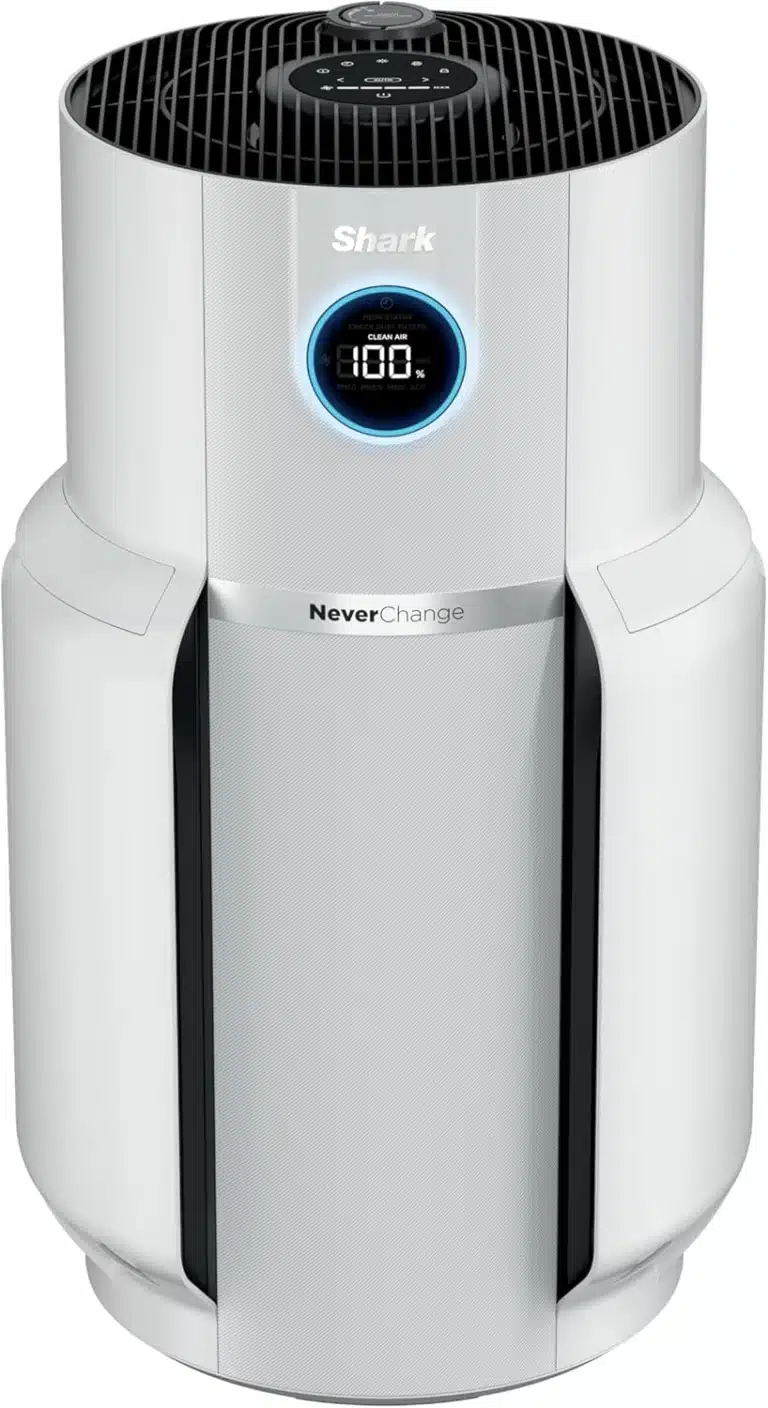
The Core 400S is a good fit when you need fast particle cleaning and more carbon than most mainstream cylindrical purifiers provide. The important detail is the filter choice. HouseFresh measured roughly 240 grams of carbon in the Original filter and 450 grams in the optional Smoke Remover filter. Choose the Smoke Remover version for this use case.
HouseFresh purchased US and European Core 400S units and found regional performance differences. The US unit cleared the test room’s PM1 pollution in 24 minutes and produced 35.5 to 60.3 dBA across its tested settings. Levoit currently lists a smoke-specific replacement filter for the model. The particle and carbon media are bonded together, so when the carbon is exhausted you replace the complete filter even if the particle section still looks usable.
The Core 400S is not a remediation machine. Its 450-gram carbon layer is meaningful for a mainstream product, but it is far smaller than the gas bed in the Austin Air. It suits occasional tobacco drift, cooking smoke, a brief burnt-food incident, or some wildfire odor after you have stopped outside air from entering.
Best for: normal-size rooms where both fast particle removal and moderate odor control matter.
Read our Levoit Core 400S review and Core 400S filter guide before choosing a filter variant.
2. Winix 5510: best value with a separate carbon filter
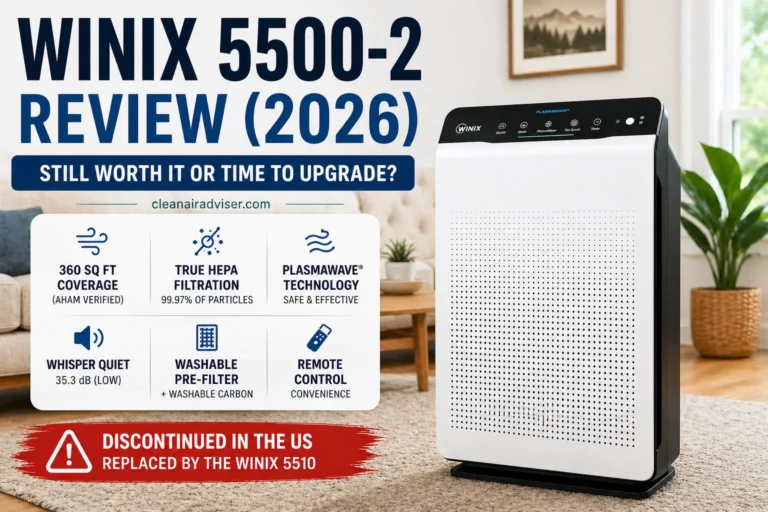
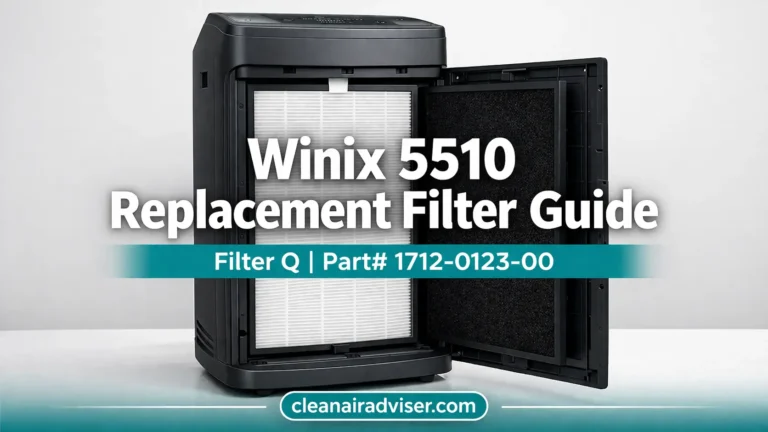
The Winix 5510 separates its particle filter, pellet-carbon filter, and washable pre-filter. That layout is convenient around smoke because the carbon stage can become odor-loaded before the particle filter is completely clogged.
HouseFresh confirmed with Winix that the 5510 contains 226 grams of carbon. Its purchased unit cleared PM1 from the test room in 24 minutes and produced an estimated 249 cfm of particle clean-air delivery. The manufacturer describes Filter Q as a roughly one-year set, while the manual says the interval varies by environment. Frequent smoke can shorten useful carbon life, so do not wait for a calendar if odor begins passing through the filter again.
The 5510 has an odor sensor that can change fan speed in Auto mode. A sensor response is not proof that every harmful gas has been removed, and an air-quality light is not a safety monitor for carbon monoxide. The unit also includes optional PlasmaWave ionization. It can be switched off. Our recommendation is based on its airflow and physical filters, not a claim that PlasmaWave destroys VOCs.
Best for: everyday household odor control, cooking smoke, and light or intermittent smoke intrusion.
See our Winix 5510 review and Filter Q replacement guide for noise, settings, and filter details.
3. Austin Air HealthMate: best for a deep gas filter
The HealthMate is the step up when a few hundred grams of carbon is not enough. Austin Air lists up to 15 pounds of activated carbon and zeolite in the machine. HouseFresh purchased and tested a HealthMate and confirmed the 15-pound media figure.
That large gas bed comes with tradeoffs. HouseFresh measured an estimated top-speed particle CADR of 156 cfm and a 52-minute PM1 clearance time in its room, much slower than the two mainstream machines above. It measured 61.5 dBA and about 148 watts at the highest setting. The unit is also expensive and has simple manual controls rather than an app or onboard air-quality display.
HouseFresh’s gas-sensor experiment showed VOC readings falling over several hours, not in a guaranteed 20-minute window. The test supports the value of a substantial gas filter, but it does not establish how quickly the HealthMate will remove the specific tobacco, cannabis, wildfire, or cooking compounds in another room.
Best for: persistent airborne odors or VOC concerns where gas-filter capacity matters more than particle CADR, price, smart controls, or low power use.
Which purifier should you choose?
- A neighbor’s smoke enters occasionally: seal the entry path where practical, then use the Core 400S Smoke Remover or Winix 5510 in the affected room.
- Cooking creates particles and temporary odor: use the range hood vented outdoors first. A Core 400S can help with what remains.
- Wildfire smoke is entering: prioritize smoke CADR and room fit. Odor is secondary to reducing fine particles. See our wildfire-smoke purifier guide.
- Someone smokes inside: stop indoor smoking. Filtration can reduce some pollution but cannot eliminate secondhand exposure.
- A former smoker’s home smells: inspect surfaces and materials. A deep-carbon purifier may reduce re-released gases, but remediation is the primary job.
Our broader best air purifiers for smoke guide compares models across wildfire, tobacco, and cooking scenarios. The cigarette-smoke guide focuses on tobacco-specific particle and odor considerations.
How to size the purifier
Use smoke CADR to size particle removal. For a room with an 8-foot ceiling, EPA’s guide uses a minimum tobacco-smoke CADR of about two-thirds of the room’s area in square feet. That corresponds to roughly five air changes per hour.
A 300-square-foot room therefore needs about 195 to 200 cfm. For a different ceiling height, use:
Required CADR in cfm = room area × ceiling height × desired air changes per hour ÷ 60
This calculation does not predict gas removal. A machine can have an excellent smoke CADR and a weak carbon layer. Conversely, a deep carbon bed may restrict airflow and deliver a lower particle CADR. Choose for the main risk, then check whether the second filter stage is adequate.
Keep doors and windows closed during a wildfire episode when outdoor air is worse, unless official safety guidance says otherwise. In ordinary conditions, ventilation with clean outdoor air can be useful for odors. Do not bring polluted outdoor air inside just to dilute an indoor smell.
How to run it after a smoke event
- Stop the source. Turn off the burner, move smoking outdoors away from doors and windows, or block the smoke entry path where safe.
- Ventilate only when the outdoor air is cleaner. For a burnt cooking odor, a vented range hood and open window can be faster than recirculating filtration. During wildfire smoke, follow local air-quality guidance.
- Use a high fan speed first. Higher airflow moves more room air through both filters. Reduce the speed when the event has passed, but keep the purifier running.
- Do not obstruct airflow. Give the intake and outlet the clearance specified in the manual.
- Inspect the filters afterward. Heavy smoke can load both particle and carbon media. Replace according to the manual and actual condition.
There is no responsible universal answer to “how many minutes?” The result depends on room volume, source strength, ventilation, carbon condition, the compounds present, and whether residue is continuing to release gases. A blue sensor light or the absence of odor does not prove that every harmful pollutant is gone.
Why the smell can return
EPA says chemicals from smoking and vaping can build up on hard surfaces and embed in soft materials, including clothing, upholstery, drapes, bedding, and carpet. Some can later return to the air. This is thirdhand exposure.
If a room smells again after the purifier is off, consider these possibilities:
- The source is still entering through a door, window, shared wall, or ventilation path.
- Carpet, padding, furniture, curtains, mattresses, or painted surfaces hold residue.
- The HVAC system is moving contaminated air from another area.
- The activated carbon is saturated and has lost useful capacity.
- The purifier is too small or was operated on a speed with insufficient airflow.
For light residue, laundering washable textiles and cleaning surfaces according to their manufacturer instructions may help. Extensive tobacco contamination can require professional assessment, material replacement, sealing, or other remediation. Renters should document the condition and speak with the property owner or local housing authority before altering walls, flooring, or ventilation systems.
When the purifier itself smells smoky
A smoke-loaded filter can become the odor source. Turn the unit off and unplug it, then inspect it using the manual. Replace disposable carbon or combined filters when odor passes through or the manual calls for replacement. Do not wash a filter unless the manufacturer explicitly says that exact layer is washable.
Clean reusable pre-filters because lint and soot can restrict airflow, but understand that cleaning a mesh screen does not restore saturated carbon. Our filter-replacement guide explains how to combine the manual’s interval with airflow, odor, damage, and actual loading.
What to avoid
- Ozone generators in occupied spaces. EPA describes ozone as a lung irritant and advises against intentional ozone generators sold as air cleaners.
- Fragrance used to cover the smell. Scent changes what you perceive; it does not remove smoke pollution and can add more chemicals to the air.
- Judging safety by odor alone. Some harmful pollutants have little odor, while people can become accustomed to a persistent smell.
- Relying on a small desktop unit. A purifier needs enough clean-air delivery for the entire room.
- Treating an ionizer as a carbon replacement. Our recommendations rely on particle and gas media. Optional electronic features do not create carbon capacity.
- Ignoring carbon monoxide. Residential air purifiers are not carbon-monoxide controls. Use properly installed, working CO alarms and leave the area if an alarm sounds.
Air purifier for smoke smell: final decision
Use this air purifier for smoke smell guide to match filtration to the actual source and avoid expecting a portable unit to clean embedded residue.
A practical air purifier for smoke smell choice combines enough particle airflow with carbon that suits the odor load.
For persistent odor, an air purifier for smoke smell is support for cleaning and source control, not a substitute for them.
Keep this air purifier for smoke smell decision focused on room size, carbon capacity, and the source of contamination.
An air purifier can reduce smoke smell while the odor compounds are airborne, but the filter has to do two different jobs. A particle filter removes smoke haze and fine particles. Activated carbon or another gas-phase medium adsorbs some of the gases that create odor. A purifier with strong particle performance and only a token carbon sheet may clear the haze while the room still smells smoky.
There is a second limit that matters even more. Smoke residue can settle on walls, flooring, upholstery, bedding, and other surfaces, then release chemicals back into the air. A purifier cannot clean those surfaces. For an actively smoky room or a former smoker’s home, source control and surface remediation come first. Filtration is support, not a way to make indoor smoking safe.
Quick answer
- Occasional smoke odor on a mainstream budget: Levoit Core 400S with the Smoke Remover filter
- Everyday value with a separate carbon stage: Winix 5510
- Heavy or persistent gaseous pollution: Austin Air HealthMate
- Wildfire haze is the main concern: prioritize a high smoke CADR, then treat carbon as a secondary feature
No purifier eliminates the health risk from secondhand smoke. The US Environmental Protection Agency says preventing smoking and vaping indoors is the only way to eliminate secondhand exposure.
We have not personally tested these purifiers. Recommendations below use current manufacturer information, independent measurements from HouseFresh, and public-health guidance. There is no widely used consumer rating equivalent to CADR for gas removal, so we do not promise an odor-removal time.
Frequently asked questions
Does a HEPA filter remove smoke smell?
Not by itself. A particle filter can remove airborne soot and fine smoke particles. Gas and odor compounds require activated carbon or another gas-phase medium designed for them. Many purifiers combine both stages.
Can an air purifier remove cigarette smell from a house?
It can reduce airborne particles and some gaseous odor, but it cannot clean residue from walls, carpet, furniture, bedding, or HVAC components. A home with extensive thirdhand contamination may need professional remediation or material replacement.
How long does smoke odor removal take?
There is no defensible universal time. Room volume, smoke quantity, ventilation, carbon amount and condition, fan speed, humidity, and surface residue all change the result. Be skeptical of fixed claims such as 20 minutes for one cigarette or three hours for a heavy event.
Is more activated carbon always better?
More media generally provides more potential adsorption capacity, but carbon type, bed design, target gases, humidity, and airflow also matter. A deep gas bed can restrict particle airflow. Compare carbon information and independent testing, then account for the room and pollutant.
Does an odor sensor tell me when the air is safe?
No. Consumer odor sensors react to a limited set of gases and can be affected by cleaners, perfume, cooking, and humidity. They are useful for automatic fan control, not as health or carbon-monoxide instruments.
Can I use a purifier while someone smokes indoors?
It may reduce some airborne pollution, but it cannot eliminate the exposure or health risk. EPA says the only way to eliminate secondhand exposure is to prohibit smoking and vaping indoors, including in vehicles and near building air intakes.
Bottom line
For occasional smoke odor, the Levoit Core 400S with its Smoke Remover filter offers a useful combination of particle airflow and 450 grams of carbon. The Winix 5510 is a practical alternative with 226 grams of carbon in a separate filter. For persistent gas and odor problems where cost, power use, and particle speed are secondary, the Austin Air HealthMate’s 15-pound carbon and zeolite bed is in a different class.
None of them can make indoor smoking safe or erase residue embedded in a building. Stop the source, ventilate when outdoor air is clean, address contaminated surfaces, and use filtration for the pollutants that remain airborne.
Sources
- US EPA: Guide to Air Cleaners in the Home
- US EPA: Secondhand Tobacco Smoke and Indoor Air Quality
- US EPA: Secondhand Smoke and Electronic-Cigarette Aerosols
- US EPA: Will Air Cleaners Reduce Health Risks?
- US EPA: Ozone Generators Sold as Air Cleaners
- HouseFresh: Levoit Core 400S independent test
- Levoit: Core 400S Smoke Remover replacement filter
- HouseFresh: Winix 5510 independent test
- Winix America: Filter Q specifications
- Winix America: 5510 and 5520 user manual
- HouseFresh: Austin Air HealthMate independent test
- Austin Air: HealthMate product specifications
- HouseFresh: Activated carbon air purifier comparison