Best air purifier for smoke 2026: Top Picks for Wildfire, Cigarette & Cooking Smoke
Disclosure: CleanAirAdviser.com is a participant in the Amazon Associates Program. If you purchase through our links, we may earn a small commission at no extra cost to you. This helps us continue testing and reviewing air purifiers. Our opinions are our own.
Most air purifiers handle dust fine. Smoke is a different problem entirely.
Smoke is two things at once — fine particles that damage your lungs, and toxic gases and odors that a HEPA filter alone cannot touch. Choosing the best air purifier for smoke is not just about HEPA filtration — carbon performance matters just as much. Get the wrong purifier and you will clear the haze but breathe in the VOCs all day. Get the right one and your home stays genuinely clean air even during wildfire season or living with a smoker.
Here is exactly what to buy — and why.
This guide is based on independent lab test data from HouseFresh, AirPurifierFirst, Consumer Reports, TechGearLab and Outdoor Life, EPA air quality research, Reddit r/AirPurifiers community data from 3,248 verified recommendations, and thousands of verified owner reviews from Amazon, Walmart and Best Buy. We also analyzed Google Trends data showing a +750% surge in wildfire smoke searches in the last week of March 2026 — the highest spike recorded for any air purifier keyword this year.
One critical thing most smoke air purifier guides get wrong: wildfire smoke, cigarette smoke, and cooking smoke are not the same problem. They require different filtration priorities. We cover all three — separately — with specific picks for each.
Quick Picks — Best Air Purifiers for Smoke 2026
Below are our top recommendations for the best air purifier for smoke in different situations, including wildfire, cigarette, and cooking smoke.
| Pick | Model | Price | Best For |
|---|---|---|---|
| 🥇 Best Overall | Winix 5510 | ~$136 | Wildfire + cigarette smoke |
| 🥈 Best Large Room | Coway Airmega 400S | ~$350 | Open-plan homes, wildfire states |
| 🥉 Best Budget | Coway AP-1512HH | ~$110 | Everyday smoke + smell removal |
| Best Cigarette Smoke | Winix 5510 | ~$136 | Heavy VOCs + nicotine odors |
| Best Asthma Safe | Levoit Vital 200S | ~$160 | No ionizer — zero ozone |
| Best Premium | Blueair Blue Pure 211i Max | ~$280 | Wildfire-prone states, large rooms |
| Best Emergency Option | DIY Corsi-Rosenthal Box | ~$40 | When purifiers sell out |
Does an Air Purifier Actually Remove Smoke? The Science
Yes — with important nuance that most guides skip. Here is what the independent data actually shows.
The EPA has confirmed that HEPA air purifiers can reduce indoor smoke particle concentrations by up to 85% when used correctly. Consumer Reports independent lab testing — which involves injecting cigarette smoke particles into a sealed room and measuring PM0.1 through PM2.5 levels — consistently shows that the best HEPA purifiers clear smoke at both high and low fan speeds. The distinction between high-speed and low-speed performance is critical: many purifiers ace the high-speed test but fail badly at low speeds, which is the setting most people run them at daily.
AirPurifierFirst’s smoke box test — a controlled chamber test measuring PM2.5 clearance — found the Alen FLEX cleared all smoke in just 32 seconds. The Winix 5510 achieved PM1 zero in 24 minutes in a real 728 cubic foot room. These are the kinds of independent numbers that actually matter — not manufacturer CADR claims that are tested under ideal conditions.
What air purifiers cannot do for smoke: They cannot clean smoke particles already embedded in walls, carpets, furniture, and clothing — what researchers call “third-hand smoke.” They cannot eliminate smoke outdoors, and they cannot fully compensate for an open window during a wildfire event. Seal your home first, then run your purifier.
Wildfire vs Cigarette vs Cooking Smoke — Why They Need Different Filters
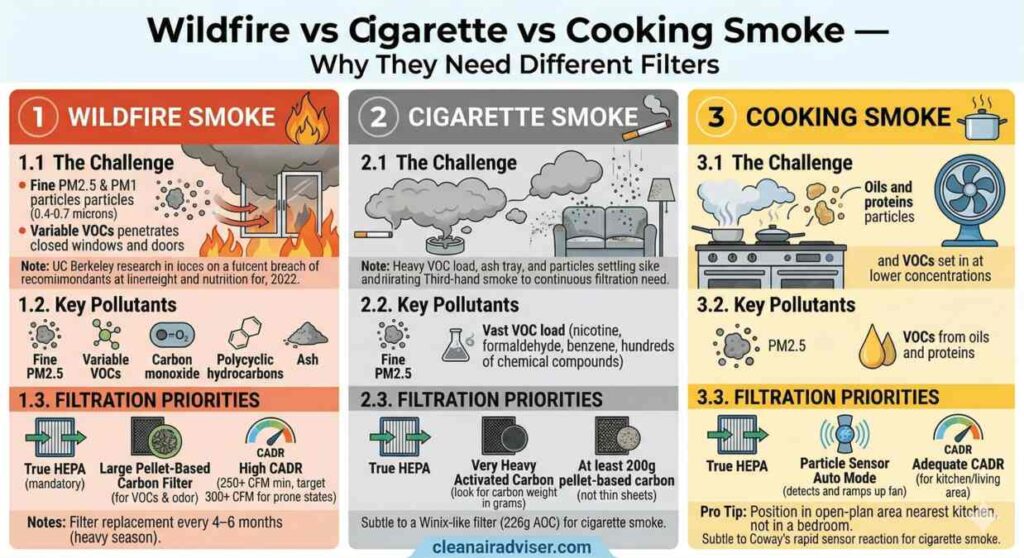
This is the most important section most smoke air purifier guides skip entirely. These are three fundamentally different air quality challenges that require different filtration priorities.
Wildfire Smoke
Wildfire smoke is the most complex and medically dangerous of the three. It contains fine PM2.5 and PM1 particles (0.4–0.7 microns — well within HEPA range), but also a highly variable mix of VOCs, carbon monoxide, polycyclic aromatic hydrocarbons, and ash depending on what is burning. Research from the University of California, Berkeley found that wildfire PM2.5 can penetrate closed doors and windows — making indoor air quality actively dangerous even with windows shut.
What you need for wildfire smoke: True HEPA (mandatory) + large pellet-based carbon filter (for VOCs and odor) + high CADR — minimum 250 CFM, ideally 300+ CFM for wildfire-prone states. Filter replacement every 4–6 months during heavy smoke season, not annually.
Cigarette Smoke
Cigarette smoke contains fine particles similar in size to wildfire smoke, but with an even heavier load of VOCs — nicotine, formaldehyde, benzene, and hundreds of other chemical compounds that are extremely challenging for thin carbon filters. The particles settle on surfaces and re-become airborne when disturbed (third-hand smoke), meaning continuous filtration is essential rather than reactive operation.
What you need for cigarette smoke: True HEPA + very heavy activated carbon (look for carbon weight in grams — at least 200g pellet-based carbon, not thin fibrous carbon sheets). The Winix 5510’s 226g pellet-based AOC carbon filter is specifically why it outperforms competitors for cigarette smoke odor removal.
Cooking Smoke
Cooking smoke is the most manageable of the three. It produces PM2.5 particles and VOCs from oils and proteins, but at lower concentrations and shorter durations than wildfire or cigarette smoke. A particle sensor in auto mode is the most valuable feature here — it detects the cooking smoke spike immediately and ramps up the fan before the smoke spreads through the home. The Coway AP-1512HH’s particle sensor makes it particularly effective for cooking smoke because it reacts within seconds of a cooking event, not minutes.
What you need for cooking smoke: True HEPA + particle sensor auto mode + adequate CADR for your kitchen/living area. Position the purifier in the open-plan area nearest the kitchen, not in a bedroom.
What to Look For — Buying Guide for Smoke
If you are comparing models, the best air purifier for smoke should always include True HEPA and activated carbon.
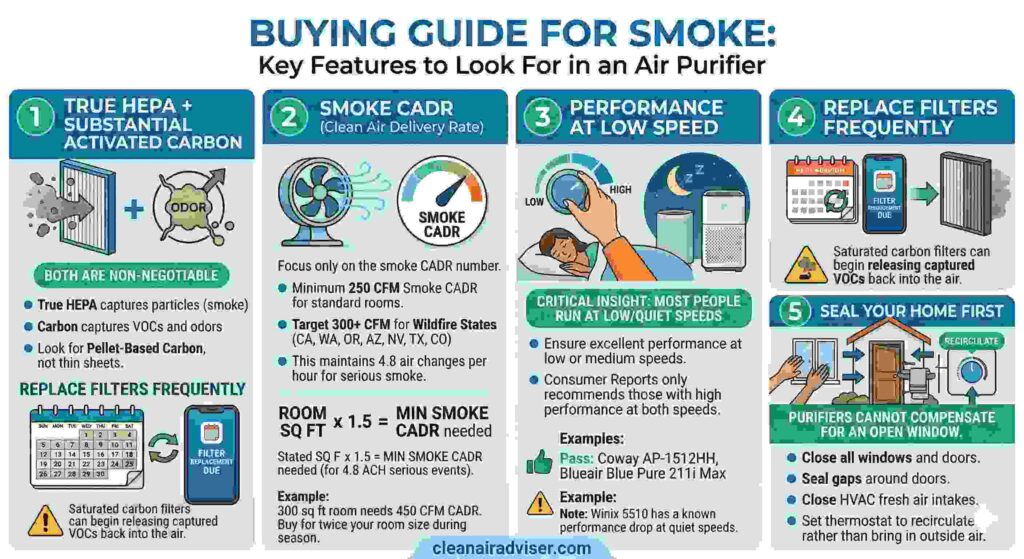
1. True HEPA + Substantial Activated Carbon — Both Are Non-Negotiable
For smoke specifically, both filters are mandatory — not optional. HEPA captures the particles. Carbon captures the VOCs and odors. Most budget purifiers use thin carbon-coated fibrous sheets that saturate quickly and provide minimal odor protection. For serious smoke situations, look for purifiers with pellet-based activated carbon and a stated carbon weight of at least 100g. The Winix 5510 has 226g. For heavy cigarette smoke households, the Alen FLEX offers an upgrade filter with over 900g of carbon — a meaningful difference for persistent smoke odors.
2. Smoke CADR of 250+ CFM — Higher for Wildfire States
CADR (Clean Air Delivery Rate) is tested separately for smoke, dust, and pollen. For smoke situations, the smoke CADR number is the one that matters. Minimum 250 CFM smoke CADR for standard rooms. For wildfire-prone states — California, Washington, Oregon, Arizona, Nevada, Texas, Colorado — target 300+ CFM smoke CADR to maintain adequate air changes per hour when outdoor air quality is in the hazardous range.
The calculation: multiply your room’s square footage by 1.5 to find the minimum smoke CADR needed for 4.8 ACH. A 300 sq ft room needs 450 CFM smoke CADR for serious wildfire protection — which means most “300 sq ft rated” purifiers are underpowered for active smoke events. During wildfire season, buy for twice your room size.
3. Performance at Low Speed — Most Guides Miss This
Consumer Reports’ testing revealed a critical insight: many purifiers that perform excellently at high speed fail badly at low speed. Since most people run their purifier at low or medium speed for noise reasons, this is the performance level that actually matters day-to-day. Consumer Reports only recommends purifiers that perform well at both high and low speeds. The Coway AP-1512HH and Blueair Blue Pure 211i Max both pass this test. The Winix 5510 has a known performance drop at quiet speeds — important to understand before buying.
4. Replace Filters Every 4–6 Months During Smoke Season
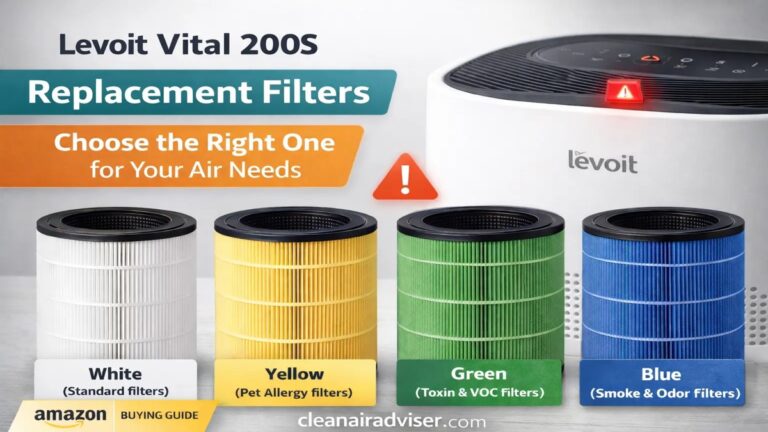
This is the advice almost every manufacturer and review site gets wrong. Standard filter replacement guidance — 12 months — is based on normal household air quality. During wildfire season or in homes with smokers, carbon filters saturate significantly faster. Replace carbon filters every 4–6 months during heavy smoke periods. A saturated carbon filter not only stops removing odors — it can begin releasing previously captured VOCs back into the air. Set a calendar reminder when you install new filters during smoke season.
5. Seal Your Home First
No air purifier can compensate for an open window during a wildfire event. Before running your purifier during an active smoke event: close all windows and doors, seal gaps around doors with towels or weather stripping, close your HVAC system’s fresh air intake if possible, and set your thermostat to recirculate rather than bring in outside air. Your air purifier then handles the residual smoke that has already entered and the particles that penetrate through unavoidable gaps.
🥇 Best Overall — Winix 5510
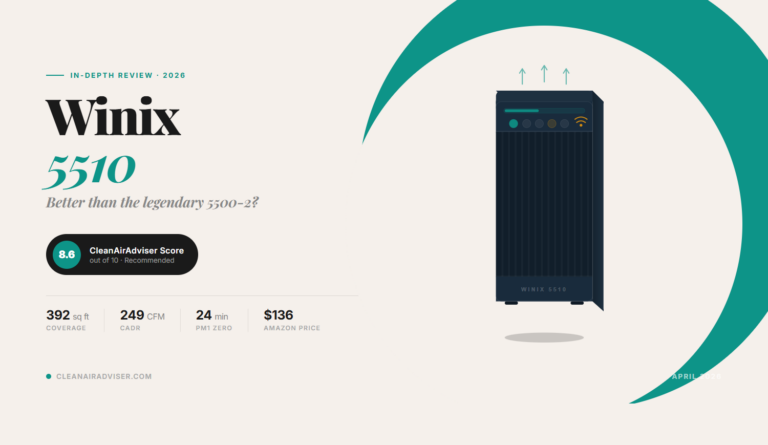
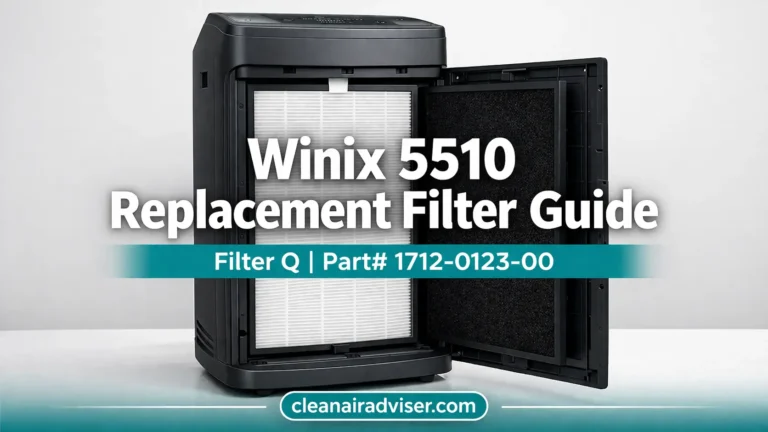
The best all-around air purifier for smoke in 2026 — covering wildfire, cigarette and everyday smoke at $136. The Winix 5510 earns the top spot for smoke specifically because of the combination of its 226g pellet-based AOC carbon filter, its 249–253 CFM CADR, and its PlasmaWave technology that breaks down smoke VOCs at a molecular level — not just captures the particles. AirPurifierFirst independently rated it the best budget option for wildfire smoke after extensive real-world testing. In their PM2.5 reduction test, it dropped AQI from 104.9 to 4.7 µg/m³ in 60 minutes — a 96% reduction.
The pellet-based carbon is the key differentiator for smoke. Most competing purifiers at this price use thin fibrous carbon sheets that provide light odor control. The Winix 5510’s 226g of activated carbon pellets handles heavy VOC loads from both wildfire smoke and cigarette smoke in a way that fibrous carbon simply cannot match. This is why it outperforms the Coway AP-1512HH specifically for smoke odor situations despite similar particle removal performance.
One honest limitation for smoke use: The Winix 5510 uses an odor sensor — not a particle sensor. During a wildfire smoke event, it will not automatically ramp up on auto mode because wildfire smoke particles have minimal odor until concentrations are very high. For wildfire situations, run it manually on Speed 3 or 4 rather than relying on auto mode. For cigarette smoke — which does have a strong odor — auto mode works effectively.
✓ Pros
- 226g pellet-based AOC carbon — best odor control at this price
- 249–253 CFM CADR — strong wildfire smoke clearance
- PlasmaWave neutralizes smoke VOCs at molecular level
- PM2.5 zero in 24 minutes — independently tested by HouseFresh
- 96% air quality improvement in 60 minutes (AirPurifierFirst)
- WiFi + Winix Smart App — monitor air quality remotely
- AHAM Verified, CARB Certified, Energy Star
- 2-year warranty
✗ Cons
- Odor sensor only — does NOT auto-ramp for wildfire particles
- 67.2 dB at max speed — very loud
- Light sensor turns off auto mode in dark rooms
- OEM filters $79.99/year — expensive vs competitors
- Performance drops significantly at quiet speeds
| Coverage Area | 392 sq ft at 4.8 ACH (AHAM Verified) |
| CADR | 249–253 CFM |
| Carbon Filter | 226g pellet-based AOC — superior smoke odor control |
| Sensor Type | ⚠️ Odor sensor only — manual mode for wildfire |
| PlasmaWave | Yes — disableable via button or app |
| Noise Level | 23.5 dB (sleep) / 67.2 dB (max) |
| Annual Filter Cost | ~$80 OEM / ~$35–40 third-party |
| Price | ~$136 |
Who should buy it: Anyone dealing with wildfire smoke, cigarette smoke, or cooking odors in a room up to 400 sq ft who wants the best carbon filtration at a mid-range price. See our full Winix 5510 review for complete performance data.
If you’re choosing between the two Winix models for smoke control specifically, see our detailed Winix 5510 vs 5500-2 comparison — both perform similarly on smoke CADR, but the 5500-2’s washable pellet carbon and the 5510’s modern app control offer different long-term value.
🥈 Best Large Room — Coway Airmega 400S
The best air purifier for smoke in large open-plan homes and wildfire-prone states. The Coway Airmega 400S delivers 430 CFM CADR — among the highest of any residential purifier at its price — making it the correct choice for anyone in California, Washington, Oregon, Arizona, Nevada, Texas or Colorado who faces regular wildfire smoke events. At 430 CFM, it can clear a 300 sq ft room in under 4 minutes and maintains meaningful air quality protection even in rooms up to 600 sq ft during smoke events.
Consumer Reports rates it as one of the few purifiers that excels at both high and low fan speeds for smoke removal — the critical real-world performance standard most purifiers fail. Its dual True HEPA + carbon filter system, particle sensor auto mode, and washable pre-filter make it a set-and-forget solution during wildfire season: it detects when smoke enters, ramps up automatically, and clears the air without you needing to manually intervene.
✓ Pros
- 430 CFM CADR — highest of any pick in this guide
- Excels at both high AND low speeds — Consumer Reports verified
- Particle sensor — detects wildfire smoke automatically
- Dual True HEPA + carbon filter system
- WiFi + Coway app + Alexa compatible
- Washable pre-filter — handles ash and large particles
- 3-year warranty — longest in class
- Real-time air quality LED indicator
✗ Cons
- ~$350 — significant investment
- ~$80/year OEM filters
- Heavy at 24.7 lbs — not easy to move room to room
- Larger footprint than most purifiers
| Coverage Area | 1,560 sq ft (1 ACH) / ~325 sq ft (4.8 ACH) |
| CADR | 430 CFM — among highest available |
| Sensor Type | ✅ Particle sensor — reacts to wildfire smoke automatically |
| Smart Features | WiFi + Coway app + Alexa |
| Filter Cost | ~$80/year OEM |
| Warranty | 3 years |
| Price | ~$350 |
Who should buy it: Residents of wildfire-prone states, anyone with open-plan living spaces over 400 sq ft, and households where smoke events happen regularly enough to justify the investment in maximum performance.
🥉 Best Budget — Coway AP-1512HH
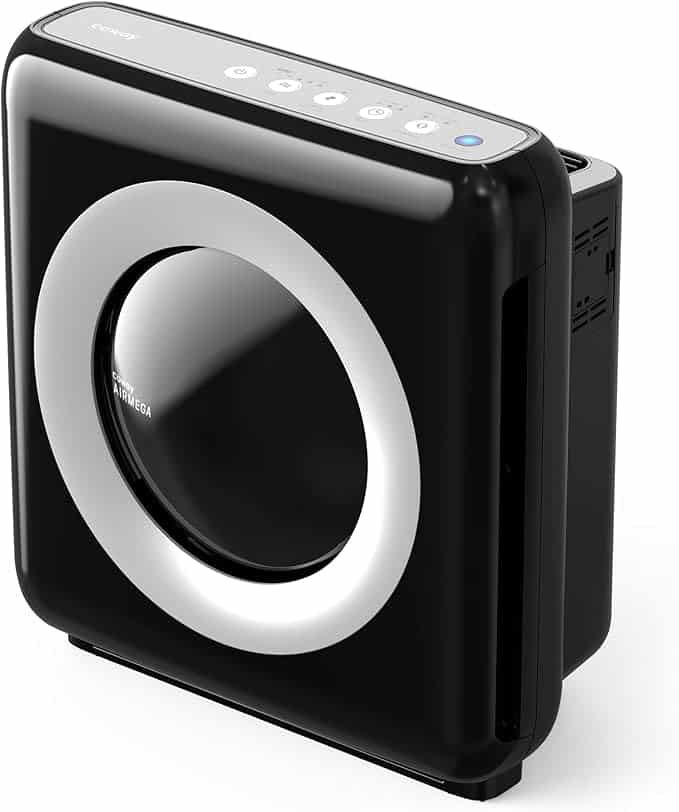
The most proven smoke air purifier at any price — and the best value for everyday smoke situations. The Coway AP-1512HH has 233 CFM smoke CADR — AHAM certified — and its particle sensor auto mode makes it particularly effective for cooking smoke and general household smoke situations. When you burn something on the stove, the Coway’s sensor detects the particle spike within seconds and the fan ramps up immediately. For wildfire smoke where particles have limited odor, it also ramps up via the particle sensor — an advantage the Winix 5510 does not have.
Its main limitation for smoke specifically is the fibrous carbon filter — less effective for heavy VOC loads from cigarette smoke or prolonged wildfire exposure compared to the Winix 5510’s pellet carbon. For light-to-moderate smoke situations — occasional wildfire events, cooking smells, general household odors — the Coway is outstanding value. For heavy cigarette smoke or states with frequent severe wildfire events, upgrade to the Winix 5510 or Airmega 400S.
✓ Pros
- 233 CFM smoke CADR — AHAM certified
- Particle sensor — reacts to cooking and wildfire smoke automatically
- Proven across 144 Reddit recommendations
- 96% air quality improvement in 60 minutes — independently tested
- Excels at low speed — Consumer Reports verified
- ~$35/year with generic filters — lowest running cost of any pick
- 3-year warranty
- Eco Mode — auto fan-off when air is clean
✗ Cons
- Fibrous carbon — not ideal for heavy cigarette or prolonged wildfire smoke
- No WiFi or app control
- Ionizer resets to ON after power outages — disable manually
| Coverage Area | 361 sq ft at 4.8 ACH (AHAM Verified) |
| CADR | Smoke 233 / Dust 246 / Pollen 240 CFM |
| Sensor Type | ✅ Particle sensor — reacts to all smoke types |
| Carbon Type | Fibrous — adequate for light smoke, not heavy |
| Annual Filter Cost | ~$35 (generic) / ~$57 (OEM) |
| Warranty | 3 years |
| Price | ~$110 |
Who should buy it: Budget-conscious buyers dealing with cooking smoke, occasional wildfire events, and general household air quality. The best starting point for anyone who doesn’t want to overspend. See our full Coway AP-1512HH review for complete details.
Best Asthma Safe Pick — Levoit Vital 200S
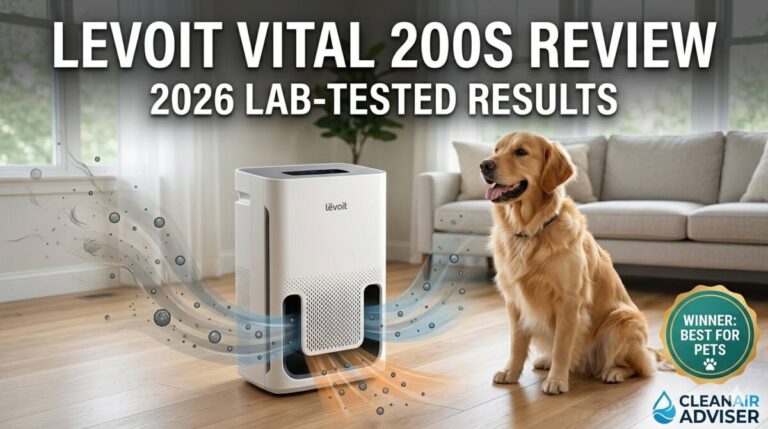
The safest smoke air purifier for asthma patients — zero ionizer, zero ozone. When you combine smoke exposure with asthma, the purifier choice becomes medically significant. Smoke already irritates airways; ozone from ionizers compounds the damage. The Levoit Vital 200S has no ionizer whatsoever — making it the only pick in this guide that produces zero ozone under any circumstances. Mayo Clinic explicitly warns that ozone-generating purifiers worsen asthma; for smoke situations where you are already inhaling irritants, this is a non-negotiable feature for asthma sufferers.
Its PM1 zero time of 23 minutes is actually faster than the Winix 5510’s 24 minutes — and its particle sensor auto mode reacts to smoke particles immediately. The U-shaped intake design that makes it excellent for pet hair also helps with smoke — it draws air from floor level where smoke particles settle, rather than from the sides where they are more dispersed.
| Coverage Area | 380 sq ft |
| CADR | 245 CFM |
| Ionizer | ✅ None — zero ozone risk |
| PM1 Zero Time | 23 minutes (HouseFresh) |
| Sensor Type | ✅ Particle sensor |
| Price | ~$160 |
Who should buy it: Asthma patients, households with pet birds, anyone with respiratory sensitivity who also faces smoke exposure. See our full Best Air Purifier for Allergies guide for more asthma-specific guidance.
Best Premium — Blueair Blue Pure 211i Max
The top recommendation for wildfire-prone US states from Consumer Reports and the most consistent performer at low fan speeds. The Blueair Blue Pure 211i Max uses HEPASilent dual filtration technology — combining mechanical HEPA filtration with electrostatic particle charging — which allows it to maintain strong particle removal performance even at low fan speeds. This is exactly what Consumer Reports tests for and where most competitors fail. In CR’s testing, the 211i Max excels at both high and low speeds for smoke, dust and pollen removal — a rare distinction.
The 211i Max covers up to 1,858 sq ft at 1 ACH — making it one of the most powerful residential purifiers available. During an active wildfire event, this coverage capacity means it can maintain meaningful air quality protection across a large open-plan home or multiple connected rooms simultaneously.
Important caveat: Blueair’s BBB accreditation was revoked in February 2024 due to customer service issues, and some owners report WiFi connectivity problems and difficulty finding replacement filters. The purifier itself performs excellently — the company’s after-sale support is the concern. Buy from Amazon with Prime for easiest returns if needed.
| Coverage Area | Up to 1,858 sq ft (1 ACH) |
| Technology | HEPASilent — HEPA + electrostatic |
| Low Speed Performance | ✅ Excels — Consumer Reports verified |
| Smart Features | WiFi + Blueair app + air quality monitoring |
| Annual Filter Cost | ~$135/year |
| Price | ~$280 |
Who should buy it: Residents of wildfire-prone states who want the best-in-class low-speed performance, large homes needing maximum coverage, and buyers who prioritize performance over running costs.
Emergency Option — DIY Corsi-Rosenthal Box
When wildfire season hits and air purifiers sell out within hours — here is the backup that actually works.
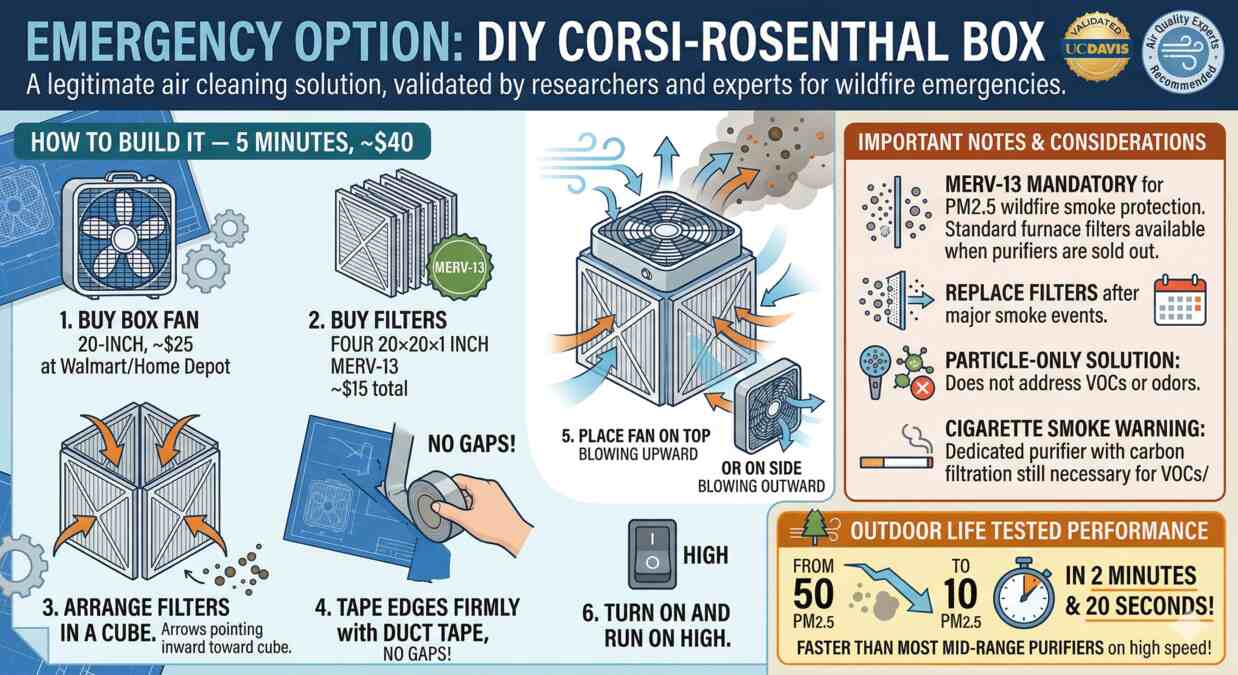
The Corsi-Rosenthal Box — named after its co-developers Dr. Richard Corsi and Jim Rosenthal — is a DIY air purifier made from a standard box fan and HEPA filters from a hardware store. This is not a hack or a compromise — it is a legitimate air cleaning solution validated by multiple independent researchers, including from the University of California Davis, and recommended by air quality experts during wildfire emergencies.
Outdoor Life tested a basic fan-plus-HEPA-filter setup and found it cleared air from 50 PM2.5 to 10 PM2.5 in 2 minutes and 20 seconds. That is faster than most mid-range air purifiers at high speed.
How to Build It — 5 Minutes, ~$40
- Buy a 20-inch box fan (~$25 at Walmart or Home Depot)
- Buy four 20×20×1 inch MERV-13 HEPA-style filters (~$15 total)
- Arrange four filters in a square cube shape around the fan, with airflow arrows pointing inward
- Tape edges firmly with duct tape — no gaps
- Place the fan on top blowing upward, or on the side blowing outward
- Turn on and run on high
AQI Action Guide — What to Do at Each Smoke Level
Most guides tell you to “run your purifier during smoke events.” Here is the specific guidance based on AQI levels that no other review site provides.
| AQI Level | Category | Action |
|---|---|---|
| 0–50 | Good | Auto mode on any speed — normal operation |
| 51–100 | Moderate | Run on Speed 2–3 continuously. Close windows. |
| 101–150 | Unhealthy for Sensitive Groups | Run on Speed 3–4. Seal doors and windows. Keep purifier running 24/7. |
| 151–200 | Unhealthy | Maximum speed continuously. Seal all gaps. Limit time in poorly ventilated rooms. |
| 201–300 | Very Unhealthy | Maximum speed. Consider multiple purifiers. Occupants with respiratory conditions should consider leaving. |
| 301+ | Hazardous | Evacuate if possible. If staying: multiple purifiers at max, N95 masks indoors, minimize movement. |
State-by-State Wildfire Risk — What You Need
Not all US residents face the same smoke risk. Here is a region-specific guide based on historical wildfire data and air quality patterns.
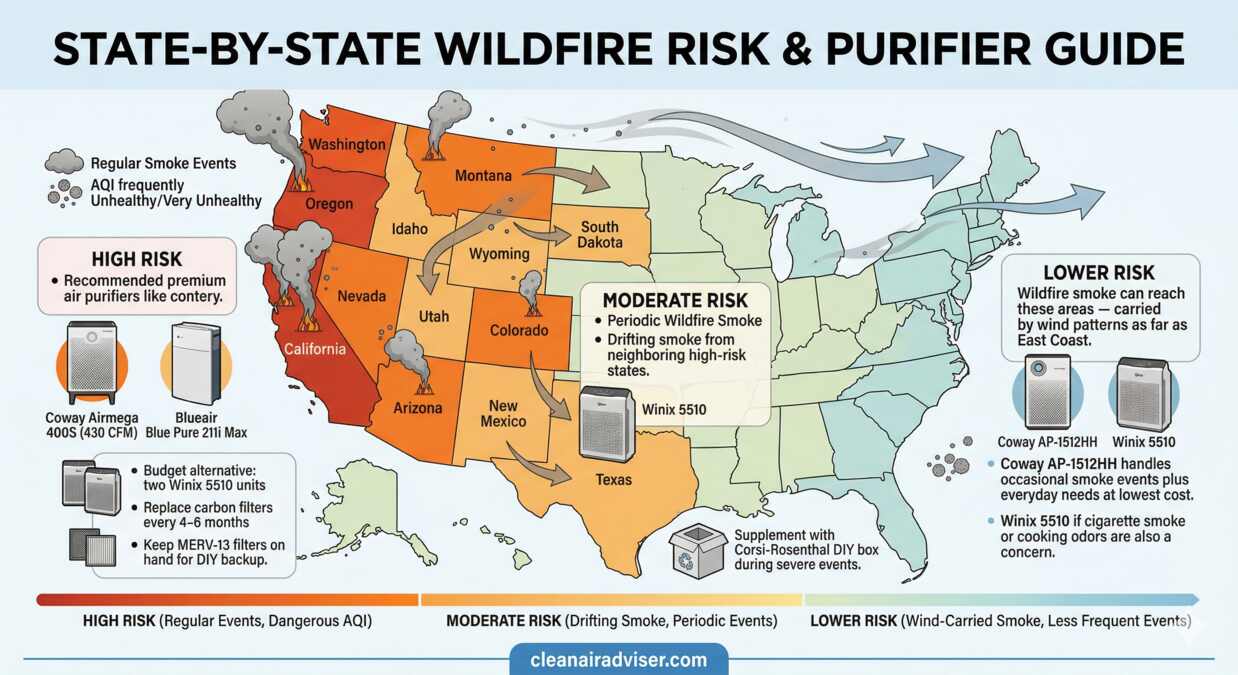
High Risk States — California, Oregon, Washington, Colorado, Nevada, Arizona, Montana
These states experience regular annual wildfire smoke events with AQI frequently reaching Unhealthy or Very Unhealthy levels for extended periods. Recommendation: Coway Airmega 400S (430 CFM) or Blueair Blue Pure 211i Max as primary unit. Budget alternative: two Winix 5510 units — one for bedroom, one for living area. Replace carbon filters every 4–6 months. Keep MERV-13 filters on hand for DIY backup during smoke events when purifier availability is limited.
Moderate Risk States — Texas, New Mexico, Idaho, Wyoming, Utah, South Dakota
These states face periodic wildfire smoke, often drifting from neighboring high-risk states. Smoke events are less frequent but can be severe. Recommendation: Winix 5510 as primary unit. Adequate for most smoke events in these regions. Supplement with Corsi-Rosenthal DIY box during particularly severe events.
Lower Risk States — Eastern US, Midwest, Pacific Northwest urban areas
Wildfire smoke can still reach these areas — carried by wind patterns from western fires as far as the East Coast. However events are less frequent and typically less severe. Recommendation: Coway AP-1512HH handles the occasional smoke event plus everyday air quality needs at the lowest cost. Winix 5510 if cigarette smoke or cooking odors are also a concern.
Full Comparison Table — Best Air Purifiers for Smoke 2026
| Feature | Winix 5510 | Coway 400S | Coway AP-1512HH | Levoit Vital 200S | Blueair 211i Max |
|---|---|---|---|---|---|
| Score | 8.9 | 8.8 | 9.0 | 8.7 | 8.6 |
| Price | ~$136 ✅ | ~$350 | ~$110 ✅ | ~$160 | ~$280 |
| Smoke CADR | 249–253 CFM | 430 CFM ✅ | 233 CFM | 245 CFM | High ✅ |
| Carbon Type | Pellet 226g ✅ | Dual filter | Fibrous ⚠️ | Standard | Activated carbon |
| Sensor | Odor only ⚠️ | Particle ✅ | Particle ✅ | Particle ✅ | Particle ✅ |
| Low Speed | Drops ⚠️ | Excels ✅ | Excels ✅ | Good | Excels ✅ |
| Ionizer | PlasmaWave | Yes (disable) | Yes (disable) | None ✅ | Electrostatic |
| WiFi | ✅ | ✅ | ❌ | ✅ | ✅ |
| Filter Cost/yr | ~$80 OEM | ~$80 | ~$35 ✅ | ~$50 | ~$135 |
| Warranty | 2 years | 3 years ✅ | 3 years ✅ | 1 year | 2 years |
| Best For | Cigarette + wildfire | Large rooms + wildfire states | Cooking + budget | Asthma + smoke | Wildfire states, premium |
Frequently Asked Questions
Final Verdict — Best Air Purifier for Smoke 2026
After analyzing independent lab test data from six testing organizations, Google Trends data showing a 750% surge in wildfire smoke searches, Reddit community consensus from 3,248 recommendations, and EPA air quality research, here is the clear breakdown by situation:
For most people dealing with smoke: Winix 5510 (~$136) — the best balance of CADR, pellet carbon for VOCs, and PlasmaWave for odor neutralization. The top budget pick for wildfire smoke per AirPurifierFirst’s independent testing and the best value for cigarette smoke odor control. Its one key limitation: the odor sensor means you need to manually set high speed during wildfire events rather than rely on auto mode.
For wildfire-prone states and large rooms: Coway Airmega 400S (~$350) — 430 CFM CADR, particle sensor that reacts to wildfire smoke automatically, and Consumer Reports verified performance at both high and low speeds. The correct choice for California, Oregon, Washington and other high-risk states where smoke events are regular and severe.
For budget buyers and cooking smoke: Coway AP-1512HH (~$110) — particle sensor auto mode makes it the most reactive purifier for cooking smoke and light wildfire events. Lowest ongoing cost at ~$35/year. The fibrous carbon limits its effectiveness for heavy cigarette or prolonged wildfire smoke — upgrade to Winix 5510 for those situations.
For asthma patients + smoke: Levoit Vital 200S (~$160) — zero ionizer, zero ozone, particle sensor, 23-minute PM1 clearance. The only medically appropriate choice when combining asthma management with smoke protection.
For wildfire states wanting the best: Blueair Blue Pure 211i Max (~$280) — Consumer Reports top pick for wildfire smoke, excels at low speeds, massive coverage capacity. Higher filter costs but unmatched performance in high-risk areas.
The most important action regardless of which purifier you choose: Run it continuously. Smoke does not take breaks and a purifier running at medium speed 24/7 outperforms one running at high speed only when you notice smoke. Replace filters before smoke season starts — not after.
Also see our Best HEPA Air Purifier Buying Guide 2026, our Winix 5510 Review, and our Best Air Purifier for Allergies 2026 for related guides.
Sources used in this guide: HouseFresh independent lab testing (PurpleAir Zen sensor, 728 cubic ft test room), AirPurifierFirst independent testing including smoke box test (Alen FLEX 32-second clearance), Consumer Reports air purifier ratings (180+ purifiers tested, high and low speed smoke removal), TechGearLab independent testing, Outdoor Life DIY filter testing (fan + HEPA filter PM2.5 clearance), EPA air quality and wildfire smoke guidance, University of California Berkeley wildfire smoke penetration research, Mayo Clinic asthma and air purifier guidance, Reddit r/AirPurifiers community data via RedditRecs (3,248 Redditors, 889 discussions, data to March 28, 2026), Google Trends data (best air purifier for wildfire smoke: +750% surge week of March 25, 2026), Amazon and Walmart verified purchase reviews, AirNow.gov AQI data. All prices accurate as of April 2026.