Coway AP-1512HH Review (2026): Still Worth It After the Mighty2?
Disclosure: Clean Air Adviser may earn a commission when you buy through links on this page. This does not change what you pay. We have not personally lab-tested or owned the AP-1512HH, so this review separates Coway’s specifications, independent test results, and public owner feedback.
Quick answer: This Coway Airmega AP-1512HH review finds that the Coway Airmega AP-1512HH Mighty earned its reputation for a reason. It is compact, simple to use, independently proven to clean particles quickly, and supported by a mature replacement-filter market. But in 2026, it is no longer the automatic best buy it once was. Coway now sells the newer Mighty2, and the AP-1512HH’s current direct price is close enough that you should compare them before ordering.
Our verdict: The AP-1512HH remains a very good choice for a bedroom, office, or medium-size living area when it is meaningfully discounted. Existing owners should usually keep it and replace the filters rather than upgrade. New buyers paying close to full price should compare the Coway Mighty2 review first. The old Mighty is quiet on its lower settings, but loud and relatively power-hungry at maximum speed. Its thin deodorization sheet is also better for light everyday smells than serious smoke or VOC problems.
Quick buying rule
- Buy the AP-1512HH if it costs at least about $40 less than the Mighty2 and you want proven particle cleaning with simple controls.
- Buy the Mighty2 if the price gap is small, especially if you value a newer platform and are buying for several years of use.
- Choose a carbon-heavy purifier instead if cooking odor, tobacco smoke, or VOC removal is your main goal.
- Keep your current AP-1512HH if the fan runs normally and the cabinet is intact. A fresh filter is usually a much cheaper improvement than replacing a working purifier.
Coway Airmega AP-1512HH review: specifications that matter
Marketing pages can make room coverage look more impressive by using only one air change per hour. For ongoing particle control, the more useful number is Coway’s 361-square-foot rating at 4.8 air changes per hour. That is the figure we would use for bedrooms and other occupied rooms with roughly eight-foot ceilings.
| Specification | Verified figure | What it means |
|---|---|---|
| Recommended room size | 361 sq. ft. at 4.8 ACH | A sensible target for frequent cleaning, not just occasional air movement |
| Smoke CADR | 233 CFM on Coway’s current page | Strong particle-cleaning capacity for a compact purifier |
| Dust CADR | 246 CFM | Useful for airborne dust, although no purifier removes settled dust |
| Pollen CADR | 240 CFM | Suitable for pollen-sized particles in a properly sized room |
| Filtration | Washable pre-filter, deodorization filter, HEPA filter, optional bipolar device | Good particle system, modest odor capacity |
| Fan controls | Auto, speeds 1 to 3, and Eco | Three manual speeds, not four |
| Manufacturer noise range | 24 to 53 dBA | Independent measurements are more useful for real buying decisions |
| Maximum rated power | 77 watts | Top speed is far less efficient than the two lower speeds |
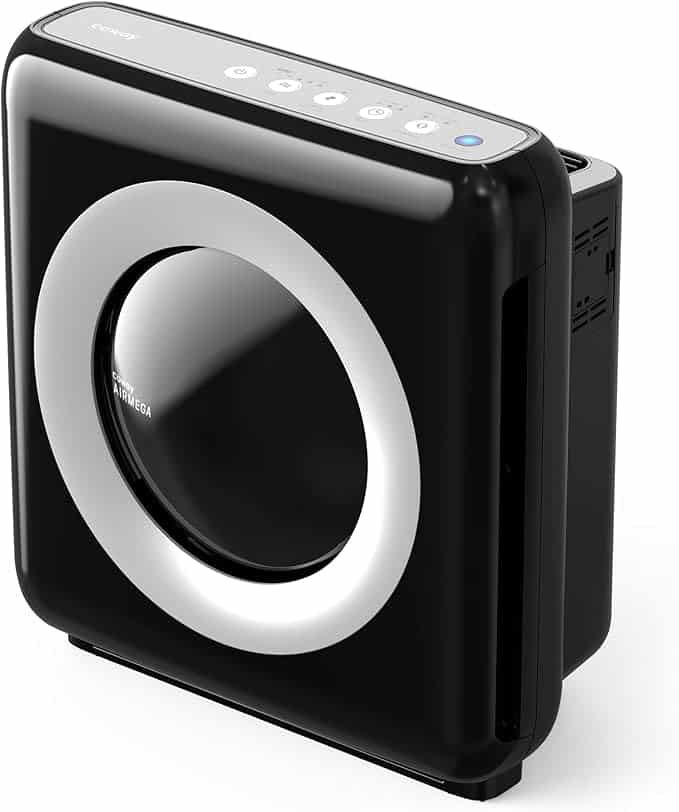
| Dimensions and weight | 16.8 x 18.3 x 9.6 in.; 12.3 lb. | Short and fairly easy to move, but wider than a tower purifier |
| Connectivity | No Wi-Fi or app | Physical controls only |
ENERGY STAR’s certification record lists very similar but not identical CADR figures: 233.6 for smoke, 247.7 for dust, and 232.2 for pollen. Small differences between certification records and a current brand page are not unusual. The important conclusion is unchanged: this is roughly a 230-CFM-class purifier.
Coway Airmega AP-1512HH review: independent performance
HouseFresh bought the AP-1512HH and tested it in a 728-cubic-foot room. At maximum speed, it reduced its room’s PM1 reading to zero in 26 minutes with the ionizer enabled and 29 minutes without it. That three-minute difference is useful context: the mechanical fan and filters do most of the work. You do not need the ionizer turned on to get strong particle removal.
This result supports the AP-1512HH’s long-standing reputation. It has enough airflow to deal with pollen, airborne dust, pet dander fragments, and smoke particles in a suitable room. Still, an air purifier is not a vacuum. Hair and heavier dust settle quickly, so regular floor and furniture cleaning remains necessary.
Room layout also matters. Put the unit in the room where you spend the most time, leave open space around the intake and top outlet, and avoid hiding it behind a sofa or curtain. One purifier in a hallway will not reliably clean several closed bedrooms.
What room size should you actually use?
Coway also advertises 874 square feet at two air changes per hour and 1,748 square feet at one air change per hour. Those figures describe how far the same airflow can be spread, not extra cleaning power. One air change per hour is too slow for buyers trying to control wildfire smoke, pollen, or other particles throughout the day.
For an ordinary room with an eight-foot ceiling, we would stay near the 361-square-foot figure. Go smaller if the ceiling is unusually high, doors stay open, outdoor smoke enters frequently, or you want quicker recovery after cooking. If your room is much larger, two correctly placed purifiers can be more effective than expecting one compact unit to clean around walls and furniture.
Coway Airmega AP-1512HH review: noise on each speed
The old article treated Coway’s 24.4 dBA figure as though it were an independent result. It is a manufacturer specification. HouseFresh measured the unit from three feet away at 38.9 dBA on speed 1, 44.4 dBA on speed 2, and 60.1 dBA on speed 3. Testing rooms and meters differ, so numbers from different sources should not be compared as if they came from one setup.
| Setting | HouseFresh noise | Best use |
|---|---|---|
| Speed 1 | 38.9 dBA | Sleeping, quiet work, or continuous background cleaning |
| Speed 2 | 44.4 dBA | Best balance of comfort and cleaning for many rooms |
| Speed 3 | 60.1 dBA | Short bursts after cooking, smoke entry, or high particle events |
HouseFresh also repeated its particle test at speed 2 and reached zero PM1 in 51 minutes while staying below 45 dBA. That makes speed 2 the practical sweet spot for many owners. Public owner discussions show the same pattern: low and medium are commonly described as comfortable, while Auto mode can become surprisingly loud when the sensor sends the fan to speed 3.
If you are noise-sensitive, run speed 2 continuously and use speed 3 only when you need a faster cleanup. A steady tolerable setting is more useful than a purifier you switch off because it is distracting.
Energy use: efficient low speeds, expensive maximum speed
Power use changes dramatically with fan speed. HouseFresh measured 0.3 watts in standby, 3.7 watts at speed 1, 8.7 watts at speed 2, and 75.3 watts at speed 3. That is why a single annual-cost claim can be misleading. Your actual electricity bill depends on the setting, daily run time, and local rate.
At 15 cents per kilowatt-hour, running speed 2 around the clock would cost roughly $11.43 per year using the independent 8.7-watt measurement. Running speed 3 continuously would cost about $98.96. These are simple estimates, not promises, and your rate may be very different.
Eco mode monitors the sensor and stops the fan after the air has remained clean for about 30 minutes. That can reduce power use, but it also means less continuous air mixing. During allergy season or a smoke event, a constant low or medium speed is the more predictable choice.
Filter costs and odor limits
The official replacement set contains one HEPA filter and two deodorization sheets. Coway’s schedule is about one year for the HEPA filter and six months for each deodorization filter, while the washable pre-filter should be checked and cleaned every two to four weeks. Real replacement timing depends on smoke, pets, dust, fan speed, and hours of use.
On August 13, 2026, Coway listed the genuine set at $59.99 on sale, with a $64.99 regular price. Prices change, so check the current total before buying. The same filter set fits the AP-1512HH and Airmega 200M, which helps availability.
The deodorization filter is a thin carbon-treated sheet, not a deep bed of loose carbon pellets. It can help with light everyday smells, but it is not designed for heavy tobacco smoke, persistent cooking gases, or substantial VOC exposure. Particle CADR does not measure gas removal. If odor is your primary problem, prioritize a purifier that publishes a meaningful carbon weight and expect to replace that media regularly.
Third-party filters can cost less, but materials, fit, airflow resistance, and quality control vary. Our AP-1512HH replacement-filter guide explains the tradeoffs and compatible choices in more detail.
Ionizer and ozone: what the evidence says
The AP-1512HH includes an optional bipolar device, often described by owners as an ionizer. It is not PlasmaWave, which is a Winix brand name. The control can be turned off, and HouseFresh’s test shows the purifier still cleaned particles quickly without it.
ENERGY STAR’s certification record lists ozone emissions of 9 parts per billion. That is below the program’s certification limit, but some buyers prefer no intentional ionization at all. If that describes you, leave the feature off and rely on the mechanical filters. We would not buy this model because of the ionizer, and we would not make claims that it treats illness or makes a room medically safe.
Air cleaners can reduce airborne particle concentrations when correctly sized and operated. They do not replace ventilation where it is appropriate, source control, smoke alarms, mold remediation, or advice from a qualified health professional.
Auto and Eco modes: useful, but the sensor is basic
The colored air-quality light and automatic fan response are convenient. Cooking or another particle event can make the light change color and send the fan to a higher speed. But the AP-1512HH does not show a numerical PM2.5 reading, and its dust sensor is not a substitute for a calibrated air-quality monitor.
Owner reports also show why expectations matter. Many people praise Auto mode for reacting quickly to cooking. Others report that a dirty or aging sensor seems slow or overly sensitive. A Reddit discussion about full-speed noise illustrates a common situation: the purifier was not malfunctioning, but Auto mode had detected particles and selected its loudest speed.
If the behavior seems wrong, first clean the pre-filter and sensor area according to the manual, confirm that all filter packaging was removed, and give the intake clear space. For consistent cleaning, set the highest manual speed you can comfortably tolerate instead of depending entirely on the color light.
Controls, maintenance, and daily use
The AP-1512HH’s simplicity is one of its strengths. Controls cover power, speed, ionizer, timer, and filter indicators. The timer offers one, four, and eight-hour choices. There is no app, Wi-Fi connection, schedule builder, or remote air-quality history to troubleshoot.
The front panel comes off for filter access, and a safety mechanism stops the fan if the cover is open. The washable mesh pre-filter catches hair and larger debris before they reach the more expensive filters. Vacuum or rinse it as the manual directs, let it dry fully, and reinstall it before running the purifier.
After replacing a filter, reset its indicator with the appropriate reset control. Do not treat the light as a measurement of how dirty the filter is. It is a time-based maintenance reminder, so a home with heavy smoke or construction dust may need earlier inspection.
What owners like and dislike
Retailer reviews are useful for spotting repeated daily-use themes, but they are not controlled tests. Walmart’s AP-1512HH review page currently shows strong overall ratings and recurring praise for quiet lower speeds, straightforward controls, and responsive air-quality indication. Recent negative reviews include reports of a plastic or filter smell and surprise at the unit’s physical size.
Reddit discussions repeat several practical points: speed 3 is loud, speed 2 is easier to live with, the sensor area may need cleaning, and the shallow carbon layer is not ideal for serious odor removal. These are individual reports, not failure-rate statistics. We found no reliable public dataset that tells us what percentage of units develop a sensor, motor, odor, or panel problem.
That distinction matters. Statements such as “thousands of owners prove it lasts ten years” sound convincing but go beyond the available evidence. The defensible conclusion is that the model has been sold and recommended for many years, replacement filters remain widely available, and current owner feedback is mostly positive, with identifiable limitations.
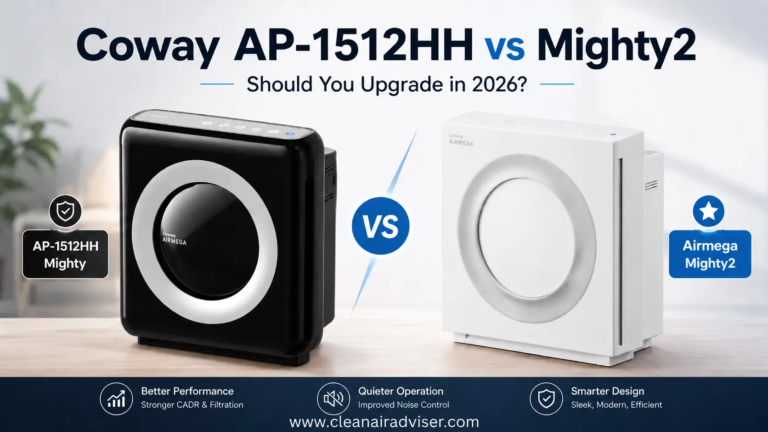
AP-1512HH vs Mighty2
| Decision | AP-1512HH Mighty | Coway Mighty2 |
|---|---|---|
| Best reason to buy | Discounted price, proven performance, mature filter market | Newer model and better long-term choice when prices are close |
| Room coverage | 361 sq. ft. at 4.8 ACH | Check the current Coway rating in our Mighty2 review |
| Controls | Simple physical controls, no app | Newer control and feature package |
| Replacement filters | Widely available, shared with Airmega 200M | Newer filter ecosystem |
| Who should choose it | Bargain hunters and current owners | Most new buyers when the price difference is modest |
At Coway’s direct prices checked on August 13, 2026, the AP-1512HH was $239.99 and the Mighty2 was $269.99. A $30 gap is small over several years of ownership, so we would compare the newer model rather than ordering the old Mighty automatically. Retail prices change often. If the AP-1512HH drops well below the Mighty2, its value case becomes much stronger.
You can also read our detailed Coway Mighty2 vs AP-1512HH comparison before deciding.
Pros and cons
What it does well
- Fast independent particle-removal result
- Strong CADR for its compact footprint
- Quiet and economical on lower speeds
- Simple controls with Auto and Eco modes
- Washable pre-filter and widely available replacements
- Works well without the optional ionizer
What to consider
- Maximum speed is loud and power-hungry
- Thin carbon sheet is limited for strong odors and gases
- No numerical particle display, app, or Wi-Fi
- Current full price is close to the newer Mighty2
- Wide body needs more floor or furniture space than a tower
- Optional ionizer will not appeal to every buyer
Who should buy the Coway AP-1512HH?
It is a good fit for:
- A bedroom, office, or medium-size room near 361 square feet or smaller.
- Buyers focused mainly on pollen, smoke particles, dust, and pet dander fragments.
- People who prefer physical buttons over an app.
- Shoppers who find it at a meaningful discount.
- Current owners deciding whether to replace a filter or replace the machine.
Skip it if:
- You need substantial gas or odor adsorption.
- You want detailed PM2.5 readings, remote controls, or scheduling in an app.
- You need quiet operation while using maximum airflow.
- The Mighty2 or another newer purifier costs only slightly more.
- You expect one compact purifier to clean an entire multi-room home.
Frequently asked questions
Is the Coway AP-1512HH still worth buying in 2026?
Yes, when it is discounted or when you specifically want its simple controls and proven particle performance. At close to Coway’s full direct price, compare the newer Mighty2 before buying.
Does the AP-1512HH remove smoke?
Its HEPA filter and roughly 233-CFM smoke CADR make it effective for smoke particles in a properly sized room. Its thin deodorization filter has limited capacity for smoke gases and odors, so do not expect it to solve both parts of a serious smoke problem by itself.
Can I turn the ionizer off?
Yes. The optional bipolar device has its own control, and independent testing found only a small difference in particle-removal time with it disabled.
Is the AP-1512HH quiet enough for a bedroom?
Low speed is suitable for many bedrooms, and speed 2 may work for people comfortable with steady white noise. Maximum speed measured 60.1 dBA in HouseFresh’s setup and may be too loud for sleep.
How often should its filters be replaced?
Coway recommends about six months for each deodorization sheet and one year for the HEPA filter, with pre-filter cleaning every two to four weeks. Inspect sooner in dusty, smoky, or pet-heavy conditions.
Does it help with pet hair?
The pre-filter can catch some hair that reaches the intake, while the HEPA filter targets smaller airborne particles associated with dander. Most pet hair settles quickly and still needs vacuuming.
Should an existing owner upgrade to the Mighty2?
Usually not just because a newer model exists. If your AP-1512HH runs normally, a genuine replacement filter is the better-value move. Upgrade when you need a feature the older unit lacks, the fan or cabinet is failing, or the new model solves a specific problem in your room.
Coway Airmega AP-1512HH review: final verdict
The Coway AP-1512HH is still a capable air purifier, but its best 2026 identity is a proven value buy, not an unquestioned category winner. Independent testing confirms fast particle removal. Lower speeds are quiet and inexpensive to run, replacement filters are easy to find, and the controls are refreshingly simple.
For this Coway Airmega AP-1512HH review, the tradeoffs are equally clear. Speed 3 is loud and draws much more power, the carbon sheet has limited odor capacity, and the basic sensor does not provide a numerical particle reading. Most importantly, Coway’s newer Mighty2 can cost only a little more.
If the AP-1512HH is at least about $40 cheaper than the Mighty2, it remains easy to recommend for a medium-size room. If their prices are close, start with the newer model. Existing AP-1512HH owners should feel no pressure to replace a working unit.
Sources
- Coway: Airmega Mighty AP-1512HH product specifications and current direct price
- Coway: AP-1512HH owner’s manual
- ENERGY STAR: AP-1512HH certification record
- Coway: Airmega 200M/AP-1512HH genuine filter set
- HouseFresh: independently purchased AP-1512HH performance, noise, and power tests
- HouseFresh: air-purifier testing methodology
- Wirecutter: current best air purifier guide
- Walmart: public AP-1512HH customer reviews
- Reddit r/AirPurifiers: owner discussion of Auto mode and maximum-speed noise