Best Air Purifier for Smoke: Tested Picks and Honest Limits (2026)
Disclosure: Clean Air Adviser may earn a commission when you buy through links on this page. This does not change what you pay. We have not physically tested these purifiers. Recommendations use current manufacturer specifications, EPA guidance, certified data, and clearly identified purchased-unit measurements.
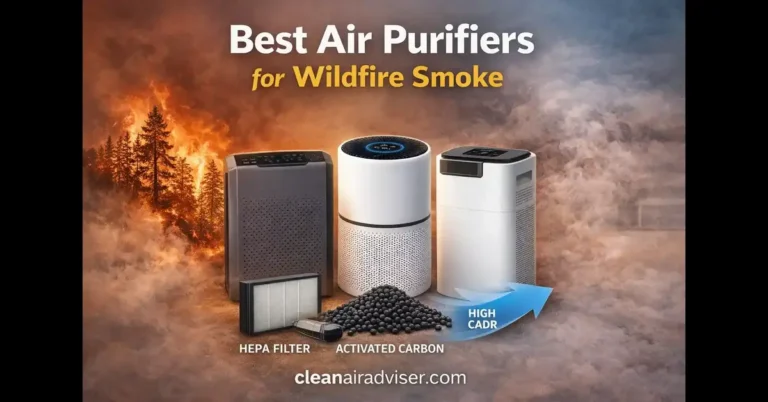
Quick answer: The best air purifier for smoke depends on whether you are dealing with airborne particles, odor, or both. Smoke has a particle problem and a gas problem. For particles, choose enough verified smoke CADR for the room. For some odor and gases, look for a meaningful amount of appropriate activated carbon or other sorbent media. No portable purifier eliminates every smoke gas or makes indoor smoking safe.
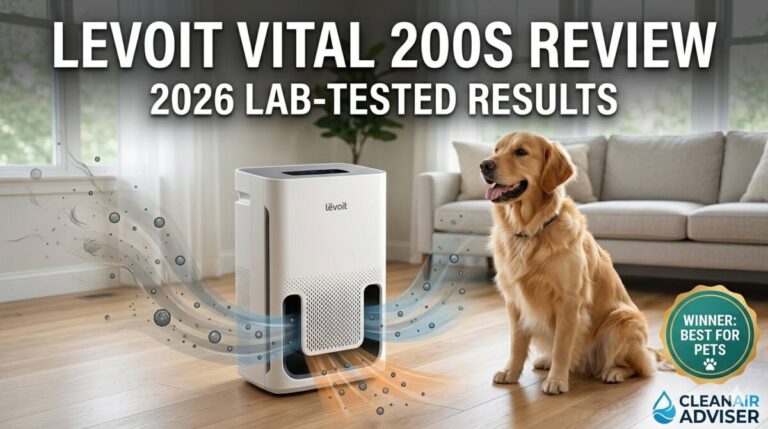
Our best conventional all-around choice is the Levoit Vital 200S for its 242 cfm certified smoke CADR, strong independent particle removal, manageable maximum noise, particle sensor, washable prefilter, and lack of an ionizer. Choose the AirFanta 3Pro when particle airflow per dollar matters most. The Winix 5510 offers a separate 226-gram pellet-carbon stage for routine odor support. For serious recurring gas or odor problems, the Austin Air HealthMate carries far more sorbent media but cleans particles much more slowly.
Smoke safety comes before shopping
- Follow evacuation and emergency instructions during a nearby fire.
- Never rely on a purifier for carbon monoxide. Maintain working CO alarms.
- Do not smoke or vape indoors. EPA says filtration can reduce secondhand exposure but cannot eliminate it.
- Use an outdoor-venting range hood for cooking whenever possible.
- Seek medical help for chest pain, severe breathing difficulty, or other urgent symptoms.
Best air purifier for smoke: quick comparison
| Pick | Particle airflow | Gas media | Best use |
|---|---|---|---|
| Best conventional: Levoit Vital 200S | 242 cfm certified smoke CADR; 23-minute HouseFresh PM1 test | Pellet carbon in combined filter | Wildfire particles, cooking particles, everyday rooms |
| Best airflow value: AirFanta 3Pro | 353 cfm estimated PM1 CADR at top speed by HouseFresh | Optional HEPA plus carbon filters reduce airflow | Fast particle removal in a larger room |
| Best moderate odor support: Winix 5510 | 253 cfm certified smoke CADR; 249 cfm estimated by HouseFresh | 226 grams of pellet carbon, according to Winix via HouseFresh | Particles plus recurring light-to-moderate odor |
| Best heavy-carbon option: Austin Air HealthMate | 156 cfm estimated PM1 CADR by HouseFresh | 15 pounds of carbon and zeolite | Serious odor or gas concerns in a smaller room |
| Best simple cooking-particle pick: Coway AP-1512HH | 233 cfm certified smoke CADR | Thin carbon sheet | Cooking particles and general PM2.5 |
| Emergency DIY: four-filter CR box | 401 ± 31 cfm wildfire-smoke CADR in EPA chamber research | None | Temporary particle filtration when commercial units are unavailable |
The best air purifier for smoke is not always the most expensive model. Prices and stock change too often to be useful as fixed specifications. Compare the current purifier price, correct replacement-filter price, local availability, and return policy before ordering.
Smoke is not one pollutant
The word “smoke” covers a changing mixture of solid and liquid particles, gases, and residues. The composition depends on what is burning, combustion temperature, ventilation, and distance from the source.
Wildfire smoke
Fine PM2.5 is the central portable-purifier target. Wildfire smoke can also contain a variable mixture of gases and chemicals, especially when buildings and manufactured materials burn. Particle filtration can greatly reduce indoor PM2.5. A consumer carbon filter cannot promise complete removal of the gas mixture.
Wildfire preparation also requires a cleaner-air room, closed windows while outdoor air is worse, compatible HVAC recirculation, spare filters, AirNow monitoring, and a heat-safe plan. Our refreshed wildfire-smoke guide covers those emergency steps in detail.
Cigarette, cigar, cannabis, and vape emissions
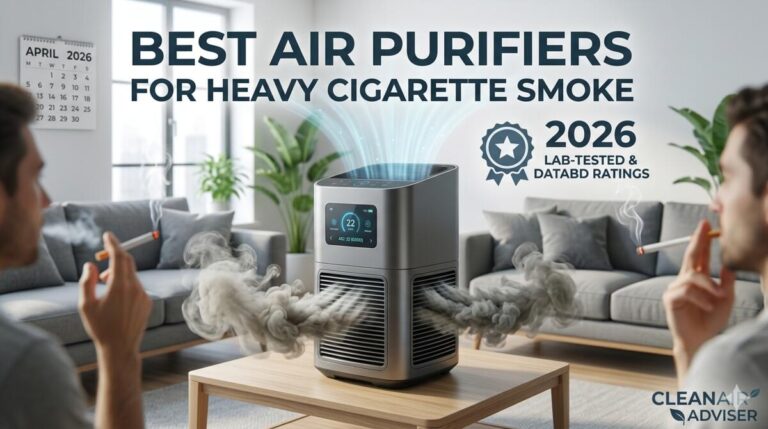
Tobacco smoke contains both particle and gas phases, and residue contaminates surfaces and textiles. EPA says the only way to eliminate indoor secondhand exposure is to prohibit smoking indoors and near doors, windows, and air intakes. Ventilation and filtration can reduce exposure but cannot eliminate it.
A purifier is most defensible for smoke infiltrating from outdoors or an adjacent unit after reasonable source-control steps, not as permission to smoke in the room. Large carbon beds may reduce some odor and gases, while HEPA removes airborne particles. Neither cleans walls, carpets, upholstery, or thirdhand residue.
Cooking smoke
Frying, grilling, high-temperature oil, and burnt food can quickly generate PM. Cooking can also release gases that a particle filter does not measure. EPA recommends running an outdoor-venting range hood whenever cooking, using back burners when possible, and leaving the hood on for 10 to 20 minutes afterward.
A purifier is useful supplemental particle control, especially in an open kitchen and living area. Do not put it where grease can coat the filter or where its outlet disrupts hood capture. A PM sensor can respond to particle spikes but does not detect carbon monoxide or every cooking gas.
How to choose the best air purifier for smoke
Start with smoke CADR
CADR combines particle-removal efficiency and airflow. Use the tobacco-smoke CADR because it represents the smallest of the standard particle categories. A filter-efficiency claim such as 99.97% does not tell you how quickly the machine cleans a room.
For an eight-foot ceiling, about five air changes per hour requires:
Required smoke CADR = room square feet x 0.67
A 300-square-foot room therefore needs roughly 200 cfm at the speed being used. For frequent heavy wildfire smoke, EPA also cites AHAM’s conservative approach of smoke CADR approximately equal to room area. That would make the same room a 300 cfm target.
The old version of this page reversed the formula and claimed a 300-square-foot room required 450 cfm for 4.8 ACH. That was incorrect. A 450 cfm purifier would provide substantially more than 4.8 ACH in a 300-square-foot room with an eight-foot ceiling.
Check performance at tolerable noise
Certified CADR is usually measured on maximum speed. A purifier can be excellent on paper and too loud for overnight use. HouseFresh measured the Winix 5510 at 67.2 dBA on maximum, but only 125 cfm at its selected sub-45 dBA setting. Size around the speed people will actually leave running.
Two quieter purifiers can be a practical alternative to one loud machine. Their CADRs approximately add when both operate in the same open room with good placement.
Treat carbon weight as capacity context, not a guarantee
More sorbent media usually offers more potential capacity, but carbon weight alone does not prove removal of a specific gas. Performance also depends on media chemistry, humidity, residence time, airflow, and concentration. Thin carbon sheets may help light odor briefly. Deep beds containing pounds of media are more credible for sustained odor and selected VOCs.
No honest consumer guide can say a purifier “handles toxic VOCs” as one category. Gas filters are selective, and EPA notes that no residential product is expected to remove every gaseous pollutant in a typical home.
Avoid ozone generators
Do not use an ozone generator in an occupied space. EPA reports that ozone has little potential to remove indoor contaminants at concentrations within health standards. Higher concentrations can harm occupants and create reaction byproducts.
Some ionizers and electronic cleaners emit ozone indirectly. If a purifier includes an electronic feature, look for recognized low-ozone certification or a model-specific test and the ability to disable it. Mechanical filtration works without ionization.
1. Levoit Vital 200S: best conventional smoke purifier
The Vital 200S is our default for a normal bedroom or living room because it balances verified airflow, noise, maintenance, and simple mechanical filtration. Its certified smoke CADR is 242 cfm, supporting about 360 square feet at five ACH or roughly 240 square feet under the conservative heavy-smoke rule.
HouseFresh’s purchased unit reached PM1 zero in its 728-cubic-foot room in 23 minutes. Its washable front prefilter is easy to inspect after a smoke or cooking event. The built-in sensor measures particles, VeSync offers remote monitoring, and the standard model has no ionizer.
The combined filter includes pellet carbon, but it is not a deep gas canister. Buy it primarily for particles, with modest odor support as a secondary benefit.
Read our Vital 200S review and filter guide.
2. AirFanta 3Pro: best particle airflow per dollar
The AirFanta 3Pro uses four replaceable filter panels and a PC-fan array. HouseFresh estimated a 353 cfm PM1 CADR at maximum after it cleared the test room in 17 minutes. Independent measurements cited in the same review reported 413 cfm at 12 volts and 436 cfm at 13 volts, showing why test setting must accompany the number.
With HEPA-plus-carbon filters, HouseFresh’s particle test took 20 minutes instead of 17. Carbon adds resistance, so the tradeoff is expected. At 6.54 volts the unit measured 43.3 dBA and still cleared the room in 28 minutes.
The modular design requires simple assembly and leaves filters exposed. It has no deep gas bed. Choose it when rapid particle removal matters more than appliance styling, sensor automation, or serious gas control.
3. Winix 5510: best moderate odor support
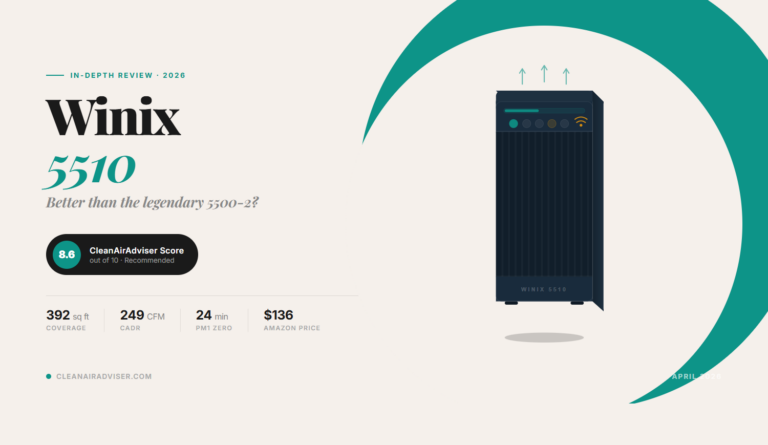
The Winix 5510 has a certified 253 cfm smoke CADR, with HouseFresh estimating 249 cfm from its purchased-unit test. Filter Q separates the True HEPA and pellet AOC carbon stages. HouseFresh reports that Winix confirmed 226 grams of carbon.
That amount is more credible for recurring kitchen or pet odor than a thin coated sheet, but it is not a “heavy VOC” filter. HouseFresh’s current cigarette-smoke guide favors devices with several pounds of carbon, not the 5510, for serious tobacco odor.
The 5510’s Auto mode uses a gas sensor rather than a PM2.5 sensor, so manual speed is more predictable for wildfire particles. Maximum is loud at 67.2 dBA. PlasmaWave is optional, and Winix currently reports an eight-hour time-weighted-average ozone result of 0.22 ppbv in a 30-cubic-metre chamber.
See our Winix 5510 review and Filter Q guide.
4. Austin Air HealthMate: best heavy-carbon option
Austin Air says the HealthMate contains 15 pounds of activated carbon and zeolite. HouseFresh bought the model, confirmed that unusually large gas-media bed, and measured an estimated 156 cfm PM1 CADR. Its particle clearance is much slower than the cheaper high-CADR picks because the dense media restricts airflow.
At five ACH, HouseFresh recommends only about 234 square feet. It measured 61.5 dBA and 147.6 watts on maximum, plus 77 cfm at its sub-45 dBA setting. The machine is expensive, heavy, and lacks app control or a sensor.
This is a specialist tradeoff: far more sorbent media, less particle airflow. Consider it when a persistent odor or selected gas concern remains after source control and ventilation, and when the smaller particle room target is acceptable. For an unknown chemical exposure, consult an indoor-air or occupational-health professional instead of assuming carbon is suitable.
5. Coway AP-1512HH: simple cooking-particle pick
The Coway AP-1512HH has a certified 233 cfm smoke CADR, a particle sensor, washable prefilter, physical controls, and a long replacement-filter history. It is a good particle purifier for cooking smoke when used several feet outside the grease plume and alongside a range hood.
Its carbon stage is a thin sheet, so odor capacity is limited. Buy it for fine particles and responsive particle sensing, not for heavy tobacco gases. Its optional ionizer can be disabled.
Read our Coway AP-1512HH review and replacement-filter guide.
Emergency particle option: Corsi-Rosenthal box
EPA chamber research measured 401 ± 31 cfm wildfire-smoke CADR from a four-filter MERV 13 Corsi-Rosenthal design with a cardboard shroud. A one-filter box fan measured only 111 ± 1 cfm, demonstrating how much design changes performance.
Use a newer certified box fan from 2012 or later, follow EPA’s instructions, orient filter arrows correctly, add a shroud, and inspect filters during smoke. A DIY cleaner has no gas media and is best treated as a temporary particle option when a commercial cleaner of known performance is unavailable or unaffordable.
How to use a purifier for each smoke source
During wildfire smoke
- Follow local alerts and evacuation orders.
- Choose one room, close windows and doors, and avoid indoor particle sources.
- Set compatible cooling or HVAC to recirculate and close fresh-air intake where safe.
- Run enough purifier speed continuously to hold PM2.5 down.
- Ventilate when outdoor air improves.
For neighbor or corridor tobacco smoke
- Document and address the source through building management or applicable local processes.
- Identify entry paths without blocking required ventilation or fire safety features.
- Use high particle CADR near the affected room, plus substantial carbon if odor is a major concern.
- Clean contaminated surfaces and textiles. Filtration does not remove thirdhand residue.
For cooking
- Start the outdoor-venting hood before cooking and use back burners.
- Keep it running for 10 to 20 minutes afterward.
- Run the purifier in the connected living area without interfering with hood capture.
- Open windows only when outdoor air and weather are suitable.
Filter replacement after smoke
There is no universal four-to-six-month smoke schedule. Loading depends on particle concentration, hours of exposure, airflow, prefilter care, carbon mass, and continuing infiltration. A severe event may shorten life, but an arbitrary date is not evidence that a filter is spent.
Inspect after sustained smoke. Clean reusable prefilters according to the manual. Replace the main filter if airflow remains reduced, media is heavily loaded or damaged, smoke odor persists, or the manufacturer indicator and instructions call for replacement. Do not wash a non-washable HEPA filter.
Our filter timing guide explains the condition-based checks.
Frequently asked questions
Does a HEPA purifier remove smoke?
It removes airborne smoke particles when the unit has enough CADR. HEPA does not remove gases, carbon monoxide, or residue already on surfaces.
How much carbon is enough?
No single weight guarantees performance for every gas. Hundreds of grams can support ordinary odor control. Pounds of carbon provide more potential capacity for recurring odor and selected VOCs but restrict airflow and cost more.
Can an air purifier make indoor smoking safe?
No. EPA says filtration can reduce secondhand smoke but cannot eliminate exposure. Smoking and vaping should be kept outdoors and away from entrances and air intakes.
Should Auto mode be used for smoke?
A PM sensor can respond to particle spikes, while a gas sensor does not directly measure particles. During a known smoke event, manual continuous airflow is more predictable than relying on any sensor.
What CADR is needed for a 300-square-foot room?
About 200 cfm provides five ACH with an eight-foot ceiling. For frequent heavy wildfire smoke, a conservative target is about 300 cfm.
Will a purifier remove smoke smell from walls?
No. Carbon may reduce airborne odor molecules, but walls, carpet, paint, furniture, and textiles can hold residue. Those materials require appropriate cleaning, restoration, or replacement.
Best air purifier for smoke: bottom line
Choose the Vital 200S for balanced conventional particle filtration, AirFanta 3Pro for high airflow value, Winix 5510 for moderate pellet-carbon odor support, Austin Air HealthMate when a large gas-media bed justifies slower airflow and higher cost, and Coway AP-1512HH for simple cooking-particle control.
Choosing the best air purifier for smoke is only one layer. Stop indoor smoking, vent cooking outdoors, follow wildfire safety instructions, and maintain CO alarms. Smoke CADR addresses particles. Carbon can help selected gases. Neither replaces source control.
Sources
- US EPA: Guide to Air Cleaners in the Home
- US EPA: Secondhand Tobacco Smoke and Indoor Air Quality
- US EPA: Strategies for Improving Indoor Air Quality While Cooking
- US EPA: Ozone Generators Sold as Air Cleaners
- US EPA: DIY air-cleaner wildfire-smoke research
- HouseFresh: Levoit Vital 200S purchased-unit review
- HouseFresh: AirFanta 3Pro purchased-unit review
- HouseFresh: Winix 5510 purchased-unit review
- HouseFresh: Austin Air HealthMate purchased-unit review
- Austin Air: HealthMate official product information
- Winix America: Winix 5510 official specifications
- HouseFresh: purchased-unit cigarette-smoke purifier comparison
For turnover planning, smoke, odor, and guest-comfort decisions, see our air purifier guide for Airbnb hosts.