Best Air Purifier for Allergies: Evidence-Based Picks (2026)
Disclosure: If you buy through an Amazon link on this page, CleanAirAdviser may earn a commission at no extra cost to you. Recommendations are based on fit and evidence, not commission.
Quick answer: This best air purifier for allergies guide compares practical room sizing, independent performance evidence, and the limits of filtration for pollen, pet allergen, and dust.
Best air purifiers for allergies: quick comparison
| Pick | Particle airflow | Practical room target | Best reason to choose it | Main tradeoff |
|---|---|---|---|---|
| Best overall: Levoit Vital 200S | 242 cfm certified smoke CADR | About 360 sq. ft. at 5 ACH | Balanced airflow, washable prefilter, particle sensor, no ionizer | Combined filter means all media is replaced together |
| Best high airflow: AirFanta 3Pro | 353 cfm estimated by HouseFresh with particle filters | About 529 sq. ft. at 5 ACH | High particle airflow per dollar and good quiet-speed performance | Exposed filter-box design, light assembly, no automatic mode |
| Best simple pick: Coway AP-1512HH | 233.6 cfm certified smoke CADR | About 350 sq. ft. at 5 ACH | Long track record, washable prefilter, particle sensor | Older design, high-speed power use, optional ionizer |
| Best allergies plus routine odors: Winix 5510 | 249 cfm estimated PM1 CADR at top speed | About 372 sq. ft. at 5 ACH | Separate pellet-carbon stage, app, strong maximum performance | Very loud at top speed and Auto mode uses an odor sensor |
Room-size shortcut: for an eight-foot ceiling and a target of five air changes per hour, divide smoke CADR by about 0.67. A 240 cfm purifier therefore serves roughly 360 square feet at five ACH. For a higher ceiling, open doorway, or unusually heavy exposure, choose more airflow or use two purifiers.
Do air purifiers actually help allergies?
They can help, but the size of the benefit varies. The U.S. Environmental Protection Agency says multiple studies have found improvements in one or more allergy or asthma symptoms with portable HEPA cleaners. It also warns that improvements are not always large, do not occur for every symptom, and may not be noticeable to every person.
A multicenter randomized, double-blind, placebo-controlled study followed adults with house-dust-mite allergic rhinitis for six weeks. Homes in the active group used two HEPA purifiers, one in the bedroom and one in the living room. Medication scores and indoor particle levels improved, including a bedroom PM2.5 reduction of up to 51.8 percent. Subjective symptom, quality-of-life, and visual-analog scores did not differ significantly from the placebo group. That is useful evidence for exposure reduction, but it is not a promise that one purifier will make a particular person feel better.
The physical limitation is just as important. Many pollen grains, dust-mite particles, and pet allergens settle onto fabrics and floors. A purifier captures material only while it is airborne and passes through the filter. Walking, vacuuming, making a bed, or a pet moving through the room can resuspend some of it, but filtration cannot replace cleaning and source control.
If wheezing, breathlessness, or severe symptoms are involved, use the purifier as an environmental measure alongside medical care. It is not a rescue treatment and should never replace prescribed asthma or allergy medication.
For the broader evidence and the limits with smoke, gases, mold, and infection risk, read Do Air Purifiers Actually Work?
How to choose the right allergy purifier
1. Start with CADR, not a huge one-air-change room claim
Clean Air Delivery Rate combines filter efficiency and airflow. For allergy particles, a high smoke CADR is a useful conservative comparison because smoke represents the smallest of the three standard CADR test aerosols. Dust and pollen CADR are also useful when available.
The EPA sizing table uses 65 cfm for 100 square feet, 130 cfm for 200 square feet, and 195 cfm for 300 square feet with an eight-foot ceiling. That is about 0.65 cfm per square foot, close to 4.8 air changes per hour. AHAM Verifide room-size labels are also based on 4.8 ACH.
A common online formula says to multiply room area by 1.5 to get CADR. That would give a 300-square-foot room a 450 cfm requirement, which is closer to eleven air changes per hour with an eight-foot ceiling, not six. The correct five-ACH calculation is:
Required CADR = room area × ceiling height × target ACH ÷ 60
For 300 square feet, an eight-foot ceiling, and five ACH: 300 × 8 × 5 ÷ 60 = 200 cfm.
2. Choose a speed you will actually run
Published CADR is normally measured at the highest fan speed. If that setting is too loud, your real clean-air delivery will be lower. Buying some spare capacity lets you use a quieter middle speed while keeping useful airflow. Independent sound measurements at every speed are more informative than a marketing sleep-mode number alone.
3. Prefer a particle sensor, but do not depend on Auto mode
A particle sensor can react to airborne dust or fine particles. An odor or gas sensor may not react to pollen or dander because they do not create a useful gas signal. Even a particle sensor may miss a continuing allergy source or may reduce the fan too early. A steady manual speed is often the more predictable setting during pollen season, cleaning, or time spent with a pet.
4. Look at prefilter access
Hair and visible dust are not the allergy itself, but they can load the first filter surface. A removable washable prefilter is convenient in a pet home. Clean it according to the manual and let it dry completely before reinstalling it. Do not wash a particle filter unless its manufacturer explicitly says it is washable.
5. Avoid intentional ozone generation
EPA calls ozone a lung irritant and advises avoiding cleaners that intentionally produce it. Some ionizers, electrostatic devices, plasma systems, and inadequately coated UV lamps can emit ozone. If a recommended purifier includes an optional ionizer, leave it off if you prefer mechanical filtration only. A high particle CADR matters more than an added electronic label.
1. Levoit Vital 200S: best overall
The Vital 200S is the most balanced option here for a normal bedroom or closed living room. Its certified smoke CADR is 242 cfm, supporting about 360 square feet at five ACH with an eight-foot ceiling. Levoit’s AHAM room listing is 388 square feet at 4.8 ACH.
HouseFresh bought a Vital 200S and measured PM1 reaching zero in 23 minutes in its 728-cubic-foot test room at maximum speed. It recorded 57.7 dBA at that speed. At a quieter speed near its sub-45-dBA target, the purifier took 46 minutes. Those results show both the strong maximum performance and the normal airflow penalty when noise is reduced.
The removable front prefilter is easier to maintain than a cylindrical screen buried inside a round filter. The unit also has a particle sensor, Auto mode, app schedules, a control lock, and no ionizer. These features make it practical in a bedroom, a pet home, or a room where pollen enters regularly.
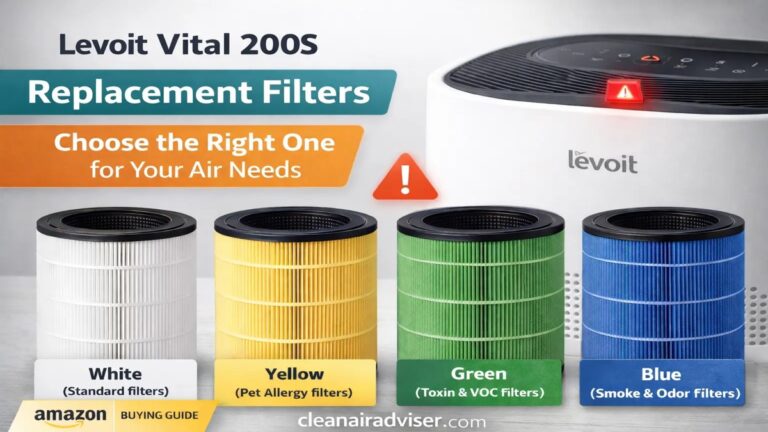
The supplied filter combines particle and carbon media. The carbon pellets can support ordinary odor control, but this is not a deep gas-removal machine. Allergens are particles, so do not pay extra for an odor-focused filter unless odors are a separate problem. Replace the filter when airflow, condition, and the manufacturer’s indicator justify it, not simply because an arbitrary calendar date appears online.
Best for: most allergy buyers who want verified airflow, easy prefilter cleaning, smart control, and no electronic cleaning mode.
See our Vital 200S review and Vital 200S replacement-filter guide before buying a spare.
2. AirFanta 3Pro: best high-airflow value
The AirFanta 3Pro is for the buyer who values particle airflow more than a polished appliance design. It uses four side filters and a top panel of PC-style fans. Some light assembly is required, and the filters remain visible. There is no app, particle sensor, or automatic mode.
HouseFresh measured PM1 reaching zero in 17 minutes with the particle-filter configuration and estimated 353 cfm CADR. That supports about 529 square feet at five ACH. With the carbon-plus-particle filters, the test took 20 minutes, showing the predictable airflow cost of denser media. Maximum sound was 56.3 dBA. At 6.54 volts, HouseFresh measured 43.3 dBA and a 28-minute clearance time, a useful result for a large bedroom or home office.
The 3Pro can be an excellent pollen-season machine because high clean-air delivery helps dilute particles entering through doors and on clothing. Its weaknesses are also clear: the exposed modular design is easier to disturb, there is no automatic control, and buyers must choose the correct filter set. It is less suitable where children or pets may pull at the filters.
Best for: a larger room, high airflow per dollar, travel or storage flexibility, and buyers comfortable setting fan voltage manually.
3. Coway AP-1512HH: best simple proven pick
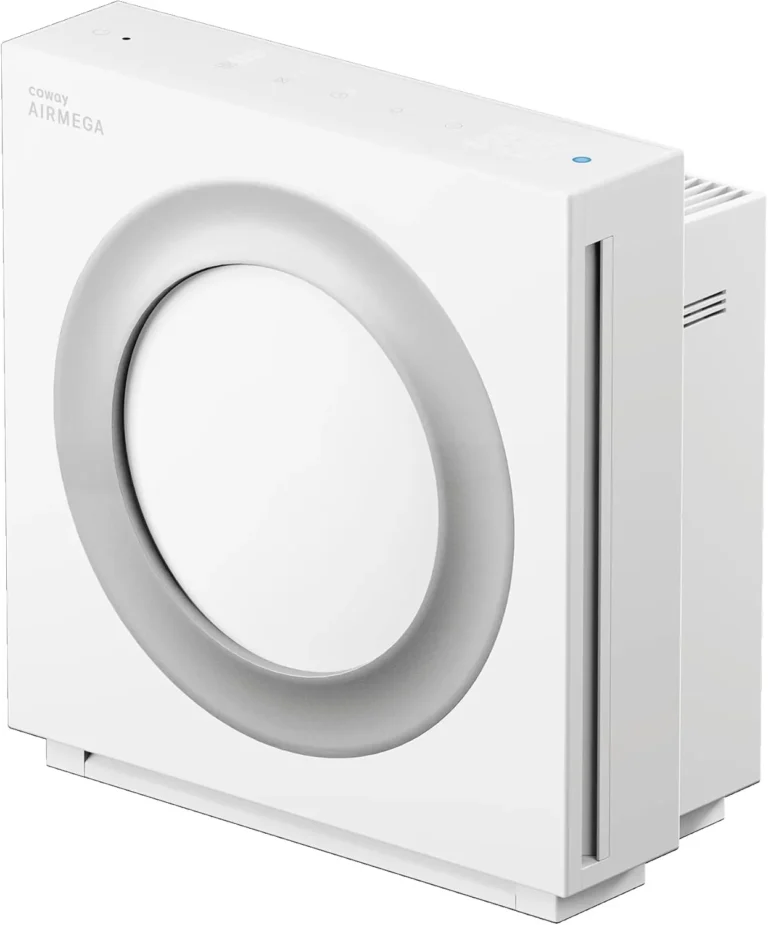
The Coway AP-1512HH Mighty remains a good choice when simplicity and a long record matter more than an app. Its certified CADR figures are about 233.6 cfm for smoke, 247.7 cfm for dust, and 232.2 cfm for pollen. The certified room size is roughly 362 square feet at 4.8 ACH.
HouseFresh’s purchased unit reached PM1 zero in 26 minutes at maximum with the ionizer active and 29 minutes with it disabled. The difference confirms that the mechanical filters still provide strong particle removal on their own. Maximum sound was 60.1 dBA, and power draw rises sharply on the highest speed.
The washable prefilter is easy to remove, the particle sensor can manage Auto mode, and replacement filters are widely available. The carbon sheet is thin, so choose it for allergy particles rather than serious odor or VOC control. The optional ionizer can be switched off. Buyers who want app control or a more convenient pet-hair intake will likely prefer the Vital 200S.
Best for: a straightforward purifier for a small or medium room, especially when an app is unnecessary.
Our Coway AP-1512HH review covers the current Mighty2 comparison, and the replacement-filter guide explains OEM and compatible options.
4. Winix 5510: best when routine odors matter too
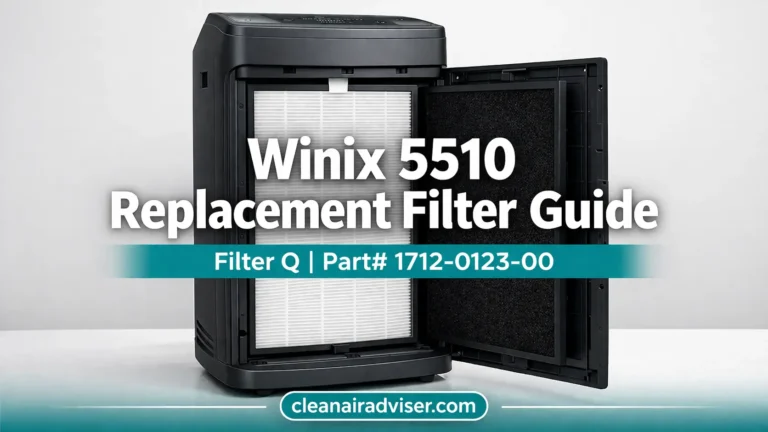
The Winix 5510 combines a particle filter with a separate 226-gram pellet-carbon stage. That arrangement is more serviceable than a bonded all-in-one filter and can help with ordinary cooking or pet odors. It is still a modest carbon quantity, not a solution for heavy VOC exposure.
HouseFresh measured PM1 reaching zero in 24 minutes and estimated 249 cfm CADR at top speed, enough for about 372 square feet at five ACH. The important tradeoff is sound: top speed reached 67.2 dBA. At speed two, the unit measured 40.8 dBA and took 47 minutes to reach PM1 zero. This is a capable cleaner, but its quiet-speed performance falls well below its headline result.
Winix Auto mode uses an odor sensor rather than a particle sensor. Pollen and dander may not cause it to increase fan speed, so use a steady manual setting when allergies are the main concern. PlasmaWave is optional and can be disabled. We found no reliable basis for the claim that it neutralizes allergen proteins, so our recommendation rests on mechanical airflow, filter construction, and price.
Best for: buyers who want a separate pellet-carbon filter, app control, and strong maximum particle removal, and who can tolerate the noise or use a lower manual speed.
Read the full Winix 5510 review for sound, CADR, filter, and app details.
Use a different plan for each allergen
Pollen
A correctly sized particle purifier can capture pollen while it is airborne, but keeping pollen out matters first. During your season, close windows when outdoor counts are high, remove shoes, change clothes after outdoor activity, and shower before bed so pollen does not move into bedding. Run the purifier continuously in the bedroom at a tolerable manual speed. A sensor is helpful, but it cannot stop pollen entering on hair, fabric, or a pet.
Dust mites
Dust mites and much of their waste live deep in bedding, upholstery, carpet, and soft toys. A room purifier only catches material after it becomes airborne. AAFA recommends keeping relative humidity between 30 and 50 percent, using allergen-resistant mattress and pillow covers, washing bedding regularly, and vacuuming with a HEPA-filtered machine. These controls are more direct than buying a purifier alone.
Pet allergy
The allergy comes from proteins in dander, saliva, and urine, not from hair itself. Filtration can lower airborne allergen, but pet allergens also spread through clothing and settle widely. Keep the animal out of the bedroom if possible, clean fabrics and hard surfaces, and use the purifier as an additional layer. A placebo-controlled cat-allergy trial reduced airborne cat allergen without producing a significant change in symptoms, while newer work shows substantial airborne Fel d 1 reduction under controlled conditions. That mixed picture is why no honest review should promise relief.
Our cat-allergy purifier guide explains the evidence and room strategy in more detail. For shedding and odor priorities, see the pet air-purifier guide.
Mold allergy
A particle filter may remove some airborne mold particles. It cannot stop mold growing on damp material or solve a musty building. EPA’s guidance is direct: fix the water source, dry wet material, and clean up mold. If the affected area is large, hidden, or linked to contaminated water, seek qualified remediation guidance. Do not use a purifier to delay a moisture repair.
A practical bedroom setup
- Measure the bedroom floor area and ceiling height.
- Calculate the CADR needed for about five ACH. Add capacity for a high ceiling or open doorway.
- Place the purifier where the intake and outlet have clear space. Keep it away from curtains and furniture that block airflow.
- Run a higher speed while the room is empty, then use the highest speed that remains comfortable for sleep.
- Keep windows closed during high-pollen periods. Clean bedding and control the actual source of the allergen.
- Inspect the prefilter regularly. Replace the main filter when its condition, reduced airflow, odor breakthrough, or the manufacturer’s indicator supports replacement.
If one machine cannot serve an open plan at the desired ACH, two well-placed units are often more useful than one machine with a giant one-ACH marketing number. Portable purifiers are designed for a room or connected area, not an entire multi-room home behind closed doors.
Common buying mistakes
- Trusting a huge room claim: check the ACH behind it. A four-figure room label may describe only one air change per hour.
- Buying by “HEPA 13” alone: efficiency is only half the system. A restrictive filter with weak airflow can deliver less clean air than a well-engineered unit with verified CADR.
- Using Sleep mode all day: a whisper-quiet setting may move too little air for the room.
- Expecting odor carbon to treat allergens: allergies in this guide are driven by particles or proteins carried on particles. CADR and source control come first.
- Relying on Auto mode: the sensor may not detect the allergen you care about or may reduce speed too soon.
- Ignoring settled reservoirs: filtration cannot clean a mattress, carpet, sofa, or stuffed toy.
- Buying an ozone generator: ozone is a lung irritant, not an allergy treatment.
Best air purifier for allergies: final decision
The best air purifier for allergies matches verified CADR to the room and works alongside cleaning, source control, and medical care when needed.
Quick answer: The Levoit Vital 200S is the best all-around air purifier for allergies in a typical bedroom or closed living room. It combines a verified 242 cfm smoke CADR, a removable washable prefilter, a particle sensor, good independent particle-removal performance, app control, and no ionizer. The AirFanta 3Pro delivers more particle airflow for a larger room, the Coway AP-1512HH is the simple proven choice, and the Winix 5510 is worth considering when ordinary odors matter too.
An air purifier can reduce airborne pollen, pet allergen, mold particles, and fine dust. It cannot clean allergens already settled in a mattress, carpet, sofa, or clothing, and it cannot cure allergic rhinitis or asthma. The right expectation is lower airborne exposure in one room, not a symptom guarantee.
This guide compares certified clean-air delivery, room size, sound, filter access, sensor behavior, and purchased-unit testing. We did not personally test these machines. Manufacturer specifications are identified separately from independent results, and every technical or medical source is linked below.
Frequently asked questions
Is HEPA worth it for allergies?
A high-efficiency particle filter is useful when paired with enough airflow for the room. Look for verified CADR or credible independent particle testing rather than relying on the filter label alone. HEPA filtration can reduce airborne exposure, but settled allergens still require source control and cleaning.
How many hours a day should I run an air purifier for allergies?
Run it continuously during periods of exposure if noise and energy use allow. More runtime means more air passes through the filter. Use a higher tolerable speed when pollen is entering, after cleaning, or while the source is active, then reduce it for sleep if necessary.
Where should I put the purifier?
Start in the room where the sensitive person sleeps or spends the most time. Leave the intake and outlet unobstructed. A purifier in a hallway will not reliably clean multiple closed bedrooms.
Can an air purifier remove dust mites?
It can capture some airborne particles associated with dust mites, but it does not remove mites living in bedding and upholstery. Humidity control, covers, bedding care, and appropriate vacuuming directly address the reservoir.
Can an air purifier cure allergic rhinitis or asthma?
No. It is an exposure-reduction tool. Clinical evidence shows particle reduction and some health or medication benefits in some groups, but not consistent improvement in every symptom or person. Follow a clinician’s advice for diagnosis and treatment.
Should I use a humidifier with an air purifier?
Only if indoor air is genuinely too dry and you can keep the humidifier clean. Excess humidity supports dust mites and mold. EPA generally recommends keeping indoor relative humidity around 30 to 50 percent. Measure humidity rather than guessing.
Final verdict
Choose the Levoit Vital 200S for the strongest balance of certified airflow, independent performance, easy prefilter care, and everyday usability. Choose the AirFanta 3Pro when you need more airflow and accept its modular design. The Coway AP-1512HH remains a dependable simple machine, while the Winix 5510 suits buyers who also value a separate pellet-carbon stage.
Whichever model you choose, size it for roughly five air changes per hour, run it at a speed you can live with, and match your source-control plan to the allergen. That combination is more useful than a medical promise, an oversized room label, or a special “allergy” filter name.
Sources
- U.S. EPA: Guide to Air Cleaners in the Home. Health-evidence limits, CADR sizing, placement, filter replacement, mold, gas filtration, and ozone guidance.
- AHAM Verifide: Air Changes per Hour FAQ. Explanation of the 4.8-ACH suggested room size.
- Yonsei Medical Journal: randomized placebo-controlled HEPA purifier study in dust-mite allergic rhinitis.
- Asthma and Allergy Foundation of America: Dust Mite Allergy. Humidity, bedding, vacuuming, and limited-room filtration guidance.
- AAFA: Allergy Capitals report. Practical pollen-exposure reduction steps.
- U.S. EPA: Can mold cause health problems?. Moisture control and cleanup guidance.
- American Journal of Respiratory and Critical Care Medicine: placebo-controlled air-cleaner trial in cat-allergic people.
- Clinical and Experimental Allergy: air filtration and airborne cat-allergen reduction study.
- Levoit: Vital 200S official product page. Manufacturer specifications and features.
- HouseFresh: Levoit Vital 200S purchased-unit review. Particle, noise, power, and filter observations.
- HouseFresh: AirFanta 3Pro purchased-unit review. Particle-filter and carbon-filter results, estimated CADR, and sound testing.
- HouseFresh: Coway AP-1512HH purchased-unit review. Certified CADR, ionizer-on and ionizer-off tests, sound, and power.
- HouseFresh: Winix 5510 purchased-unit review. Top-speed and quiet-speed particle tests, sound, power, and filter construction.
- Winix: 5510 official product page. Manufacturer features, filter, room-size, and warranty information.